From Jobsite to Network: Scaling Smart Work Zones Across Programs
By Ryan Dobbins and David Feise, Contributing Authors
Smart work zones deliver the most long-term value when their data can move beyond the jobsite. That is the core idea behind FHWA’s Work Zone Data Exchange (WZDx) specification: a common format for publishing work zone activity data so other systems can use it, not just the system that collected it. USDOT describes WZDx as a way to standardize work zone “event” data so it can be consumed by connected applications.
For owners and contractors, the takeaway is that industry is moving toward work zones that can “publish” key facts in machine-readable form, such as location, lane closure status, timing and restrictions. When that information is standardized, it can flow into DOT traffic management centers, 511 systems, third-party aggregators, navigation apps and connected-vehicle services.
That expands how far upstream warnings can travel and how quickly traveler information can update, without every stakeholder building a custom integration for every project.
Scaling Smart Work Zones
Smart work zones create value for a single job by shrinking the time between changing conditions and field response. The harder challenge is getting that same closed-loop behavior to show up consistently across a multistate program with hundreds of active sites.
That is where a Traffic Management Office (TMO) fits. Instead of treating each setup as a standalone event, the TMO model treats every work zone as a connected node in a larger system, with shared visibility into what is happening in the field and how quickly the organization is responding.
In that structure, smart work zone tools do more than warn drivers. They generate a steady stream of operational signals. Queue growth, speed differentials, stop-and-go volatility and recurring hotspots become measurable inputs, while a centralized team can use those inputs to coordinate resources, standardize triggers and align traffic control decisions across regions.
It also enables consistent measurement across a program, so performance can be compared across markets and job types using the same definitions and dashboards.
This connection between smart work zone telemetry and a centralized operating layer is also where artificial intelligence (AI) becomes practical. With enough standardized data from similar job types, AI can support planning by recommending traffic control plan templates based on roadway class, speed, volume, time of day, work duration and observed queue behavior from prior sites.
The next step is Automated Traffic Control Plans: recommended adjustments inside defined guardrails, such as earlier warning placement, detour activation guidance or timing changes, based on live queue growth and speed drops. The point is consistency and speed at scale, powered by the same smart work zone signals that already improve situational awareness on a single job.
What to Measure
The most useful way to evaluate smart work zone value is to measure the parts of the toolchain that are supposed to move. Not “was the device deployed,” but whether the system produced earlier warning, steadier traffic behavior and less exposure at the control point.
- Start with queue behavior. Track how quickly queues form and how far the back of the line migrates upstream. Pair that with the severity of speed drops approaching the back of the queue. Those measures show whether the sensing and warning layers are doing their job by giving drivers time to slow earlier.
- Next, measure how often the zone gets destabilized. Stop-and-go volatility and repeated “hot spots” show where drivers struggle with the setup or where traffic conditions overwhelm the original plan. Those indicators also show where adjustments are needed, such as adding advance warning, reworking channelization or setting clearer detour triggers.
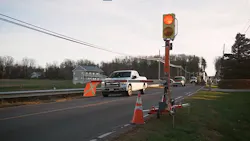
- Then measure exposure at the control point, especially on flagging and one-lane/two-way operations. AFADs are valuable here because they preserve the same stop-and-go function while moving the operator away from the live lane. Tracking exposure hours makes that benefit visible in operational terms.
- Finally, measure response consistency across the program, which becomes the central question at multistate scale. The TMO model only works when similar conditions drive similar actions, using the same triggers and the same playbook. Look for faster adjustments, fewer improvised resets and clearer documentation of what changed, when it changed and why.
When these measures improve, the downstream outcomes tend to improve with them. Fewer high-risk moments, fewer emergency changes to the setup and less worker exposure to live traffic.
Ultimately, accident prevention is the real promise of connected work zones backed by connected operations.
Ryan Dobbins is AWP Safety’s vice president of environmental, health and safety (EHS), and David Feise is president of Arrive Alive Traffic Control (AATC), an AWP Safety company.