Arch Support
When the Pennsylvania Department of Transportation (PennDOT) first announced plans to replace Pittsburgh’s Commercial Street Bridge, it called the project a “very ambitious and complex endeavor.” The 73-old bridge is a main corridor into the city, so there was a strong desire to keep it open for as long as possible throughout the new construction.
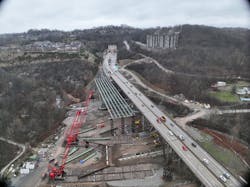
The solution is an arched delta frame structure that is being built 100-feet away from the current bridge, that will, upon completion, slide over into its final position during a painstaking three-week operation the summer of 2026. It’s such a vital corridor, commuters in the ‘burgh are already dreading even those three short weeks.
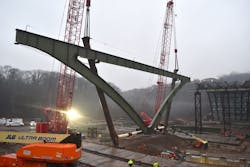
Building the new bridge has commenced, with two crawler cranes from ALL Crane Rental of Pennsylvania, a member of the ALL Family of Companies, performing a series of highly technical moves. “First, our operators have to build each arch,” said Keith Duell, sales representative with ALL Crane Rental of Pennsylvania. “Then they set it in position on temporary piers adjacent to Commercial Street.”
It takes seven pieces of steel, ranging in weight from 25,000 to 80,000 pounds, to assemble each arch. The largest and heaviest piece is a header beam that measures 163 feet across. Two Manitowoc MLC300 lattice boom crawler cranes work in tandem to move the pieces into position for awaiting ironworkers from Amelie Construction.
“This is a highly engineered project,” said Jesse Sudetic, project manager with Amelie Construction. “Constructing the arches can’t happen in the air, so we’re using a specially-built U-shaped jig to assemble each arch on the ground.” Sudetic praised the work of Fasick Group for engineering support.
Assembling each arch is meticulous work. It takes approximately four days to build each one, then 10 to 12 hours to set it into position.
After the arch is assembled on the ground, with the Manitowoc MLC300s bringing in each piece, connections are torqued. Then the cranes begin the careful process of walking up the arch so they can set it onto the awaiting temporary piers. At this point, the combined weight of the arch and the jig is 535,000 pounds.
Veteran ALL crane operators Mike Haberle and Jim Slimick are at the controls. Haberle described the setting process. “Once an arch is assembled and torqued, we hook both cranes to the jig and lift the jig off the ground six to eight feet. Amelie’s team removes the temporary towers that hold the jig and arch off the ground. The other operator and I will cable up 10 to 15 feet, track forward, and remain in perfect sync as we cable up a little more and track forward a little more until we get the arch completely upright. From there, we pick the arch up off the ground, track it into place, and set it on the bearing plate. Once Amelie’s ironworkers get everything bolted up, we unhook both cranes.”
ALL and Amelie are building 14 total arches for the bridge. The completed structure is scheduled to be moved into place in July.
“Once we complete the bridge erection, the general contractor will put the concrete deck on top,” said Sudetic. “PennDot will shut the parkway down for three weeks, they’ll implode the old bridge, pick up the new structure with hydraulic jacks, and slide it into position.”
The techniques behind the Commercial Street bridge replacement represent another aspect of Accelerated Bridge Construction (ABC). It’s a construction philosophy that employs meticulous advance planning and overwhelming manpower to make bridge replacement go as quickly as possible to minimize interruptions to commuters and local business.
“Replacing an entire bridge in three weeks is rare, but it can be done with the right plan and the right team,” said Sudetic.