Something's in the Water
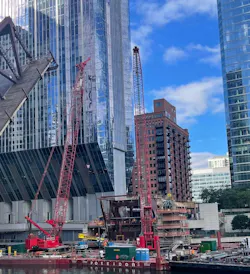
Something unusual is in the waters of the Chicago River … and this time it’s not green dye for St. Patrick’s Day. Two crawler cranes are floating on barges, capturing the attention of visitors to downtown Chicago.
The cranes, from Central Contractors Service, a member of the ALL Family of Companies, are assisting with the rebuild of the iconic, 110-year-old Lake Street Bascule Bridge. The river is a familiar job site for Central, which has a history of using barges to float its cranes to hard-to-reach spots downtown.
This time, it is two 220-ton Manitowoc crawler cranes, a 14000 and an MLC200. Both are moving steel for the bridge’s west leaf and related rail work for the Green and Pink Lines.
The pairing brings together two generations of Manitowoc’s 220-ton crawler cranes, each well suited to the work at hand. “The 14000 and MLC200 both give us the capacity and reach this project requires,” said Paul Urbanski, sales manager for Central Contractors Service. “Having both in our fleet gives us more options to match the right equipment to the job.”
The Lake Street bridge is a double-deck, double-leaf, moveable bridge that carries vehicles, pedestrians, and CTA buses on its lower level and the CTA’s Green and Pink Line trains on its upper level. The rebuild project includes replacing the deck system and superstructure, rehabbing substructures, replacing train tracks, and restoring historic bridge houses.
Cranes aren’t the only unusual sights floating on the river. New bridge spans will also arrive at the job site via barge after being assembled at another location. These same two cranes handled the off-site assembly of the new spans, as well as taking apart the old bridge.
Both cranes are configured with 180 feet of main boom with full counterweight. The heaviest pieces that each will be lifting weigh around 48,000 pounds. There will be no dual picks throughout the project.
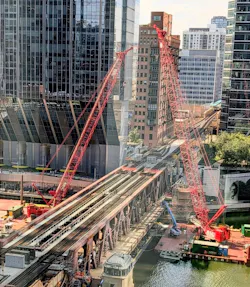
Cranes were assembled on land and driven onto barges already in the water. The barges are made of connectable sections so they can form the precise size each crane needs for stability. Each section can also be independently filled with varying amounts of water to create a custom foundation for the shifting weight of crane operations.
Urbanski says the level of the barges must stay within 3% to maintain safe crane operations. Adjustable spuds on each corner of the barges push deeply into the riverbed for added stability.
Work on the bridge has attracted public attention, with user-generated videos popping up on social media. “It’s been a unique project to be involved with,” said Urbanski.
It is reminiscent of a project more than a decade ago when Central also gained attention for floating a crane onto the river on a barge. That time it was a 660-ton Manitowoc 888 RINGER aiding in construction of a new downtown high-rise. It attracted much attention and landed on the cover of a heavy-lift industry trade magazine. The branch has returned to the water on multiple occasions. “Construction using barge-mounted cranes happens more often than people realize,” said Urbanski.
Central Contractors Service expects to return to the floating jobsite at the end of the year to begin disassembling the next phase of the bridge scheduled for replacement.
About ALL
The ALL Family of Companies is the largest privately held crane rental and sales operation in North America, operating under the ALL, ALT, Central, Dawes, and Jeffers names. For a rental quote: 800-232-4100 or www.allcrane.com.