Heat is a Work Zone Hazard
By Ramon Moreno, Contributing Author
Heat changes the job. It changes how people move, how quickly they react and how they communicate. And in a highway work zone, those small changes matter because the work is happening next to live traffic.
That is the part people sometimes miss. Heat stress is a health issue, yes, but it is also a traffic safety issue.
A worker who is overheated may miss a radio call. A flagger may lose focus during a long queue. A crew member may step into a bad position because fatigue is slowing their judgment. A driver may already be impatient, distracted or trying to beat the merge. Add heat, noise, glare and long hours, and the margin for error gets thin.
Heat illness is preventable, but workers still get sick every year and some cases are fatal. The National Institute for Occupational Safety and Health (NIOSH) points to common risk factors: high temperature and humidity, direct sun, low air movement, heavy work, dehydration, clothing and personal protective equipment (PPE) that hold in heat and lack of acclimatization.
The question is not whether heat belongs in the safety conversation, but whether we are treating it like a real work zone hazard.
Start Before the Work Gets Hard
The best heat plan starts before anyone is struggling, meaning heat should be part of the pre-job briefing. Crews need to talk through the day in plain terms.
- What is the forecast?
- Where is the shade?
- Where is water staged?
- Who is new or recently returned after time away?
- What tasks will be hardest physically?
- When will breaks happen?
- What changes if the heat index climbs or the work takes longer than expected?
Supervisors should also allow for adjustments to the plan, such as moving heavy work earlier when possible, rotating people out of high-exposure positions or keeping water and electrolyte options close enough that using them does not feel like leaving the job. Identify cooling locations before the shift starts and make sure every worker knows that speaking up is expected.
Heat illness often gives warning signs before it becomes an emergency. The problem is that crews sometimes normalize those signs, including headache, dizziness, heavy sweating, muscle cramps, nausea and confusion. Importantly, these symptoms cannot be brushed off as “just the heat.”
Acclimatization is Not Optional
One of the most important heat controls is also one of the easiest to overlook: acclimatization.
NIOSH recommends gradually increasing exposure for new and returning workers over seven to 14 days. New workers need more time than workers who have already been in the heat. Because in roadwork, crews change, seasonal workers come on board and people return from vacation or injury. Other times, a worker may transfer from a cooler region into a hotter one, or a night crew may move to days.
The point is that you cannot tell by looking who is acclimatized. That is why a strong program schedules shorter heat exposure for new and returning workers, adds more frequent rest breaks and keeps supervisors watching closely during the first week or two.
Skin protection should be part of the plan, too. NIOSH advises that crews should wear sunscreen with an SPF of 15 or higher and reapply it at least every two hours, especially during long shifts in direct sun.
Hydration Must Be Easy
Water has to be available, cool and close. The Occupational Safety and Health Administration (OSHA) says employers should provide cool water and, for jobs lasting two hours or more, access to fluids with electrolytes.
In a roadwork zone, “nearby” has a specific meaning. If getting water requires crossing a work area, walking too far from their position or waiting until the next scheduled break, workers may delay it, and delay is the enemy.
Make hydration part of the rhythm of the job:
- Encourage small, frequent drinks (roughly one cup every 15-20 minutes per NIOSH).
- Avoid alcohol, drinks high in caffeine or sugar, and heavy meals.
- Remind workers before they feel thirsty.
- Watch for workers who are pushing through.
- Build breaks into the operation.
Protect the Flagger Position
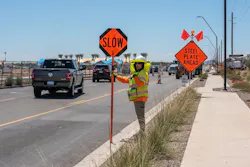
If there is one role that needs special attention in heat, it is the flagger (the Protector). Flaggers stand in the sun, manage impatient drivers and make fast decisions. They have to stay visible, alert and predictable, and heat makes every part of that harder.
A good heat plan should ask:
- Is the flagger positioned where they can be seen and still get relief?
- Can we rotate the assignment?
- Is there nearby shade during breaks?
- Is the flagger able to communicate clearly with the rest of the crew?
The answer cannot be “they’ll be fine.” Flagging is active safety work requiring constant attention and judgment. The same is true for spotters, equipment operators and workers near the pedestrian-vehicle boundary. If a task depends on someone seeing, signaling or reacting at the right moment, then heat belongs in the control plan for that task.
Keep the Work Zone Built Right
Heat can also tempt workers to take shortcuts. If a crew is tired, a device check may get skipped or a sign that is slightly off stays that way, because nobody wants to walk back and fix it. Sometimes a buffer space that should remain empty starts collecting equipment because it is convenient, or workers gather in the wrong place because it is the only shade nearby.
That is where heat and work zone discipline collide and where the traffic control plan still has to hold.
- The buffer still needs to stay empty.
- Pedestrian routes still need to be clear.
- Devices still need to be checked and reset if traffic, weather or visibility changes.
Heat does not always create a new hazard but weakens the controls you already rely on, meaning a hot day is not an excuse to accept a setup that has started to drift.
Train for Emergency
Every heat plan also needs an emergency plan.
- Who calls 911?
- What is the exact location?
- How will emergency responders access the work zone?
- Who meets them?
- What happens to traffic control while the crew responds?
- How do you cool the worker while help is on the way?
In road and highway work, an emergency response is also a traffic control issue. If a worker needs help, the crew still has to protect the scene, manage traffic and keep other workers from being exposed to a second hazard, and that takes preparation.
The Takeaway
Heat safety in roadwork is not complicated, but it must be intentional. Brief it. Plan for it. Stage water and shade where people can use them. Acclimatize new and returning workers. Rotate high-exposure tasks. Watch flaggers and spotters closely. Keep the traffic control plan intact. Treat symptoms early. Know what you will do if someone needs help.
The goal is to keep people sharp enough, hydrated enough and protected enough to do dangerous work safely while traffic keeps moving around them, so that fatigue does not show up in decisions, reaction time, communication and field discipline. Those are the habits that help crews catch risk before it turns into harm.
Ramon Moreno, EHS director with AWP Safety, is based in Arizona where he leads safety initiatives in one of the country’s most challenging heat environments.