Ohio DOT Rolls Out Driverless “Crash Trucks” to Shield Highway Workers
Key Takeaways
-
ODOT is testing autonomous crash truck attenuators near Columbus, using a lead truck to guide driverless trucks and protect crews.
-
In 2026, 36 crashes involving ODOT trucks have already occurred, on pace to surpass last year.
-
Nationwide, work zones remain hazardous: 899 deaths and 818 fatal crashes were reported in 2023. Over 40,000 people were injured in U.S. work zone crashes in 2023 (the latest data available).
-
Experts say distracted and inattentive driving is a top cause, emphasizing the need for both technology and driver awareness.
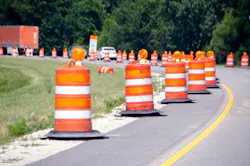
After years of crashes involving its own vehicles, the Ohio Department of Transportation (ODOT) is testing new autonomous crash truck technology designed to better protect highway workers.
So far this year, 36 crashes involving ODOT trucks are already on pace to surpass last year’s total, pushing the agency to explore new safety options for crews working along busy highways, according to Cleveland 19 News.
“People continue to run into our work zones, our people, our equipment, our vehicles, and we’re just looking for another way to keep our folks safe,” ODOT press secretary Matt Bruning told the station.
ODOT’s safety challenges are part of a bigger national problem. According to the Federal Highway Administration, 899 people died in work zone crashes in 2023, the most recent data available. This shows that, even with safety campaigns, road work is still very dangerous for crews fixing and maintaining highways.
To reduce those risks, ODOT’s emerging technologies division is testing autonomous crash truck attenuators at the private Transportation Research Center near Columbus. The closed facility allows researchers to experiment on private roads away from public traffic.
ODOT already uses attenuator trucks, often called crash trucks, which sit behind mobile work zones to shield crews. The impact-absorbing device mounted on the back is designed to collapse during a crash and soak up the force of a collision.
“The problem is someone has to drive that truck,” Bruning told Cleveland 19 News. “We’re looking for ways to figure out how we can have the safety of the attenuator and the dump truck without having to put someone in the dump truck.”
The risks extend beyond fatalities. According to the National Work Zone Safety Information Clearinghouse, 2023 data recorded 818 fatal work zone crashes and 899 total deaths, with hundreds of those incidents involving large trucks.
Injury figures paint an even broader picture. The National Safety Council reports that about 40,170 people were injured in work zone crashes in 2023, underscoring the human toll these incidents take on both drivers and road workers.
Christian Nixon, an ODOT highway technician who has experienced several close calls, said the new system could significantly reduce the risks crews face.
“Yeah, it’s very exciting. I think it would definitely eliminate a lot of risks that we have to encounter on the roads,” Nixon told Cleveland 19 News. “So having something that would automatically do that for us would be a big help.”
The autonomous system relies on a method known as platooning. A lead truck with a driver would travel in front, while a driverless attenuator truck follows closely behind.
“There would be a vehicle in front of the dump truck with the attenuator, and the dump truck with the attenuator would not need a driver,” Bruning explained to Cleveland 19 News. “It would simply follow the other vehicles, sort of a follow the leader type mentality here.”
Safety experts say driver behavior remains a key factor in many crashes. According to the Insurance Institute for Highway Safety, distracted and inattentive driving continues to play a major role in roadway collisions, including those in active construction zones.
Nixon said motorists also play an important part in protecting work crews. “We ask that you watch out for us. We’re trying to make sure the roads are presentable and are all good,” he told the station. “So it’s drivable for the motor public and we want to get home just like you do.”
ODOT has not announced when autonomous crash trucks might appear on public roads. For now, the technology remains in the research and testing phase as the department looks for new ways to keep workers out of harm’s way.
About the Author
 Karina Mazhukhina, Digital Content Specialist
Karina Mazhukhina, Digital Content Specialist
Digital Content Specialist
Karina Mazhukhina has extensive experience in journalism, content marketing, SEO, editorial strategy, and multimedia production. She was previously a real-time national reporter for McClatchy News and a digital journalist for KOMO News, and ABC-TV affiliate in Seattle.