How Iowa Cut Traffic Fatalities by Nearly 100 in One Year
Key Takeaways
- Iowa reduced traffic fatalities from 357 in 2024 to 259 in 2025 through a coordinated Safe System approach.
- The state expanded rumble strips, wider pavement markings and other roadway safety features to reduce lane departures.
- Engineering improvements, public education and enhanced post-crash response worked together to improve safety.
The state of Iowa saw a significant reduction in traffic fatalities in 2025, and the drop did not happen by chance, but through a concerted effort to make their roads safer.
According to data released from the Iowa Department of Transportation, the state reported 259 traffic-related deaths in the state in 2025, reflecting a sharp decline from 2024’s 357 traffic fatalities.
Iowa DOT emphasized a Safe System approach to improve roadway safety for all of its users. It introduced several road safety features along their roadways to support the rise of driver assistance features and minimize lane departures, which is one of their highest contributors to traffic fatalities, according to Larry Grant, Iowa DOT’s state safety planner.
With the rise of vehicles that have safe driving features, such as lane assistance and adaptive cruise control, Iowa DOT made roadway improvements designed to help those systems work more effectively.
One of those improvements is increasing the width of lane markings from 4 inches to 6 inches for easier vehicle detection at the edge line and centerline of the roadway.
“That is for the drivers, but it’s also for those vehicles to know [they] are staying in the lane,” Grant said.
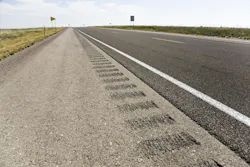
Another major road improvement was the introduction of rumble strips at not only the edge line but at the centerline of the state’s two-way roadways to combat lane departures, which accounts for 30% of their traffic fatalities.
As of the end of July, 90% of the state’s roadways have been completed with edge line rumble strips.
Grant said the use of edge line rumble strips also had a major impact on motorcycle crashes, as more than 50% of all crashes are single vehicle crashes, so keeping them in the lane is a priority.
In an effort to drive attention upwards, the state transportation department also installed retro-reflective strips on stop signs and chevron striping along curbs.
“We are trying to get the driver’s attention and ger their focus to come up and look at those things,” Grant said.
These improvements are coupled with other initiatives to reduce driver-to-driver conflict points including roundabouts, divergent diamond interchanges and reduced conflict intersections, also known as J-turns.
In a J-turn, drivers turn right in the same direction of traffic, merge into the left lane and then make a U-turn in the direction they intend to travel, according to Missouri DOT’s website. Iowa currently has one J-turn intersection installed.
“We are trying to reduce conflict points at those intersections, just like a roundabout does,” Grant said. “You’ll get a sideswipe but not going to have that severe T-bone effect when it comes to the intersections.”
Driver Education
These actions were combined with the state’s launch of an education campaign that targeted their focus areas, including lane departures.
Grant said Iowa DOT focused on the data of what was leading to traffic fatalities to drive their education campaigns — which continues to include lane departures in addition to disabled vehicles and fatigue.
Many traffic fatalities occur when a person is on the side of the roadway, due to a disabled vehicle, and therefore, the DOT released a video series educating drivers on the Move Over Law. The Move Over Law requires drivers to change lanes when approaching a vehicle on the side of the road with its hazard lights on.
Another video explained to drivers the best procedures for staying safe when their vehicle is stuck on the side of the roadway, and another attempts to combat the risks of driving while under fatigue.
Driver education also comes down to law enforcement when they are conducting traffic stops, Grant said, and “even though that can be viewed as a negative, that is also educating drivers.”
The transportation department has also worked with law enforcement and their volunteer crews on how best to manage post-crash care.
Being a rural state, many of their first responders are volunteers and the state is putting them through better training and better equipping them to more effectively respond to crashes, which can lead to saving a life and prevent a secondary crash from occurring.
And while the state has a high seatbelt compliance rate of 90%, in 50% of fatal crashes, the drivers and/or occupants are not wearing their seat belts.
Lessons from Iowa
Iowa’s 2025 reduction in traffic fatalities is a testament to how a concerted effort to target driver behaviors and introduce roadway improvements can have a major impact.
The state had a long-term goal of dropping below 300 traffic fatalities, which always seemed just out of reach.
“We got close a few years but we could never break that 300, and we kind of just said it is what it is, that was the thought process,” Grant said, “but when you work together, meaning the educational component, the engineering of safer roads, that post-crash care of getting that help to those individuals that are in those crashes sooner, and lifesaving effects sooner, it can reduce fatalities.”
About the Author
 Jessica Parks, Staff Writer
Jessica Parks, Staff Writer
Staff Writer
Jessica Parks is a staff writer at Roads & Bridges with newsroom experience in Brooklyn, Long Island and the U.S. Virgin Islands, and several years spent living in Puerto Rico. She is currently based in Tulsa, Oklahoma.