Conn. Teaches Safety With Automated Enforcement
By Timothy Young and Andrew Cadmus, Contributing Authors
Work zones are essential to keeping the nation’s roadways functioning safely and efficiently, but in the United States, fatal crashes in work zones are rising.
Data from the Center for Construction Research and Training shows that fatal crashes in work zones across the United States have increased by more than 30% over a recent 12-year period. In Connecticut alone, there were more than 2,000 crashes and six fatalities between Jan. 1, 2023, and Dec. 31, 2024, according to data from the Connecticut Crash Data Repository at the University of Connecticut.
In 2021, Connecticut lawmakers were looking for new ways to protect workers, drivers and passengers from work zone crashes. As part of this effort, the state legislature authorized the Connecticut Department of Transportation (CTDOT) to conduct a pilot program using automated speed detection equipment to identify speeding vehicles in active work zones.
Automated enforcement has been well-documented as an effective tool to reduce speeding and improve safety, and it is most successful when implemented with appropriate policies, technology and approach. The pilot program provided an opportunity for state officials to determine which policies, technologies and practices would work best for Connecticut and its people.
Through the Automated Work Zone Speed Control (AWZSC) Pilot, state lawmakers and CTDOT aimed to improve safety by reducing excessive speeding in work zones. But they also worried that the pilot could be perceived as a revenue generating “gotcha” initiative.
To address this, the legislation, pilot policies and operating procedures were structured to reinforce the program’s safety goals. Transparency, grace and common-sense application guided the approach.
Large signs were required in advance of the speed cameras to warn drivers of upcoming speed enforcement, and CTDOT maintained a website identifying enforcement locations. Only vehicles exceeding the posted speed limit by 15 mph or more were recorded and only enforced when workers were present. Instead of immediate fines, first-time offenders received a written warning, with modest fines reserved for repeat violations.
CTDOT also invested in a comprehensive public outreach and engagement campaign to increase awareness of the pilot and reinforce the need for work zone safety. The campaign included billboards, radio spots, social media content and press releases before and throughout the pilot period.
“Roads are not racetracks,” CTDOT Commissioner Garrett Eucalitto said in a statement recognizing Work Zone Awareness Week in 2025. “We need drivers to slow down, stay alert, and Obey the Orange because their choices behind the wheel impact real people, real families, and entire communities.”
Legislation Becomes Action
Connecticut’s initial legislation required the pilot program begin and conclude within a two-year window, which is a short period to develop, implement and operate a program and collect enough data to assess its effectiveness and make recommendations for improvement.
CTDOT hired HDR as program administrator to support program development, implementation and operations. HDR assisted in translating the legislation into a concept of operations and developing a roadmap for pilot implementation and operation.
While the legislation appeared straightforward on its surface, it required hundreds of policy decisions and processing business rules to determine what data to collect, how to collect it, how to process it and when to issue warnings or violations, all while remaining compliant with Connecticut’s statutes and regulations.
All of those decisions were made with safety and public interest in mind. This included guidelines for where to place equipment, avoiding the bottom of hills and acceleration lanes. And it included a two-week grace period between a warning and fine, to give people time to change their behavior, among other policies.
HDR also helped CTDOT procure a system vendor to supply the roadside technology and back office to process and mail notices. Prior to launch, the technology was thoroughly tested while collecting data for comparison later. Enforcement began during the second year of the pilot.
Beginning Enforcement
Enforcement under the pilot began in April 2023 and, in accordance with legislation, included three automated enforcement systems within designated work zones on limited-access highways.
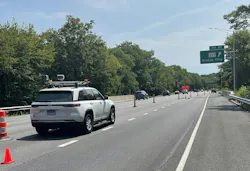
Each system consisted of a sport utility vehicle (SUV) equipped with speed detection radar and cameras. The SUVs were positioned in highly visible locations with multiple advance warning signs to notify drivers of the enforcement zone. When radar detected an approaching vehicle traveling above the enforceable speed limit, cameras captured images of the vehicle’s front and rear, including its license plate.
The system was designed to balance automation and operational efficiency with robust quality control procedures. Although automated license plate reading technology was used, each potential violation underwent manual verification to ensure accuracy.
These checks confirmed the accuracy of plate readings, that the registered owner information matched the captured images, and annual calibration and daily testing were completed.
Privacy protection was also built into the process. Any individuals or faces inadvertently captured in the camera images were masked prior to further review.
Once all quality assurance steps were completed, validated information was compiled into a violation event that was presented to a sworn officer of the Connecticut State Police, the only authority permitted under the legislation to issue infractions under the pilot.
“Know the Zone”
Prior to the start of enforcement under the pilot, CTDOT, along with support from HDR, developed and launched a comprehensive “Know the Zone” campaign. Designed to educate, the campaign reinforced the core message that safe driving in work zones helps everyone, from drivers to workers, get home safely.
The visual design featured black-and-white photography accented with construction zone orange to echo the color of work zone signs and traffic control devices and strengthen the association between the campaign’s message and work zone safety.
The campaign was featured on digital highway billboards, cable TV, streaming radio and podcasts, gas station radio and social media. The campaign resulted in more than 41.2 million paid advertising impressions in Connecticut via 10 media platforms.
HDR helped CTDOT track the public’s reaction to the program by monitoring what was being said about it on social media and in the news. This allowed HDR and CTDOT to determine whether accurate information was being shared about the pilot, and tailor future messaging to be most effective.
Evaluation
During the pilot, which conducted speed enforcement over an eight-month construction season, 24,874 warnings were issued to registered owners. Only 724 tickets were issued for repeat offenses, and 114 drivers were ticketed for a third violation.
The limited number of tickets could have been due in part to the effectiveness of the pilot in changing driver behavior.
An analysis of data collected from five locations where enforcement equipment was deployed showed the introduction of automated speed control technology succeeded in reducing the number of vehicles speeding in those work zones by up to 18%, and those excessive speeders (15 mph or more over the posted speed) by 50% or more. Some locations saw residual speed reduction weeks after the equipment and signs were removed, potentially demonstrating a positive shift in driver behavior longer-term.
Program Becomes Permanent
The benefit of CTDOT’s successful pilot was not only that it demonstrated how technology can improve safety, but that thoughtful and strategic implementation of this technology can gain public support for lasting change.
Connecticut lawmakers passed legislation in 2024, due in part to the success of the pilot, to make Automated Speed Control a permanent tool for CTDOT to use when needed. The new program, which HDR is helping to launch, can operate speed enforcement in up to 15 work zones at any given time, with other improvements such as a lower threshold for enforcement and a simplified fine structure for repeat violations.
The technology has also been improved to be more efficient. Enforcement will be conducted not only from SUVs but also stationary trailers that can be parked in work zones and left for weeks at a time, turned on remotely when workers are present. HDR is also helping implement more robust integration into existing police and judicial systems to improve efficiency of data processing and reporting.
The new program is expected to launch at the beginning of the 2026 construction season with a goal of making work zones safer for drivers and crews.