Can Vision Zero Become a Reality?
By Ferzan M. Ahmed and Bill M. Halkias, Contributing Authors
Imagine if toll road and highway operators around the world could achieve zero fatalities for an entire year or more, either singularly or collectively on the world’s toll roads and public highways.
This goal is known as Vision Zero, a concept that was born in Sweden and adopted by that nation in 1997. Its core principle is based on the ethical stance that life has priority and should not be sacrificed for the sake of other benefits in a transportation system.
Achieving a year without a highway death may sound unrealistic, but data from toll roads in the United States and Europe suggest it is increasingly within reach. From the Ohio Turnpike to Greece’s Attica Tollway, transportation agencies are showing that a combination of safer vehicles, smarter infrastructure, stronger enforcement and early driver education can dramatically reduce fatalities. Their experiences offer a blueprint for how the Vision Zero goal might move from aspiration to reality.
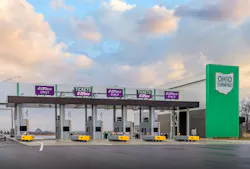
In the United States, the Ohio Turnpike nearly achieved Vision Zero several times since beginning operations on Oct. 1, 1955. As one of America’s first superhighways, it paved the way for safer and faster travel between New York and Chicago.
During the early years of operation, there were as many as 40 fatalities on the 241-mile-long Ohio Turnpike. The worst year was in 1966, when the fatality rate was 3.16 deaths per 100 million vehicle miles traveled. Automobiles of this era did not feature crumple zones, airbags and other safety innovations that are now standard, and safety belts did not become standard equipment on U.S. automobiles until 1968.
A driver wearing a seatbelt is nearly twice as safe in a serious crash as an unbelted driver in a passenger car, according to the U.S. National Highway Transportation Safety Administration.
One of the greatest dangers of not wearing a seatbelt is being ejected from the vehicle, an event that is almost always deadly (75% mortality rate). A driver not wearing a seatbelt is 30 times more likely to be ejected during a crash than a driver who is buckled up.
Nationally, America achieved an important milestone in 2024: an all-time record seat belt use rate of 90%. However, Ohio’s compliance rate lagged behind, at 85.2%.
The high rate of unrestrained fatalities in crashes is a major concern, with more than 60% of Ohio traffic fatalities in recent years involving unbuckled occupants, according to the Ohio Traffic Safety Office.
Early education is a key part of Vision Zero. In Ohio, “Buckle Up With Brutus,” is a new effort geared toward second and third graders to encourage seatbelt and booster seat usage. The program provides educational materials, like videos and worksheets, to schools and families to teach safety and good driver and passenger behavior.
The program is a collaboration between the Ohio Traffic Safety Office, Students Against Destructive Decisions (SADD), and The Ohio State University, where “Brutus” is the mascot for the football team.
Statistics show that Vision Zero is possible. The Ohio Turnpike nearly achieved Vision Zero five times, in 2008, 2010, 2011, 2012 and 2017. During each of those years, the fatality rate was 0.2 per 100 million vehicle miles traveled.
With a current daily average of 140,000 vehicles driving more than 3.1 billion miles per year, the Ohio Turnpike went nearly nine months without a fatality from Nov. 23, 2024, to Aug. 18, 2025.
Statistics unintentionally dehumanize the loss of life by reducing individuals to numbers and obscuring the personal tragedies behind the data. This can diminish the sense of urgency and empathy, especially when numbers are presented without the context of the individual lives affected. Families and communities are deeply affected by the loss of their loved ones.
Crash data should be used to advocate for change and to drive policy conversations about improving road safety through better driver education, safer infrastructure and improved vehicle technology. This can help mitigate the dehumanizing effect.
The Ohio Turnpike studies all fatal crashes, and the common denominators tend to be driver behavior and error, including speeding, distracted driving, and impaired driving. Unbuckled occupants and distressed vehicles are also factors.
The Ohio Turnpike also takes extra precautions such as increased Highway Patrol presence, extra signage, extra disabled vehicle patrol and monitoring of construction zones during known high traffic periods, such as holiday weekends.
Technology is key to solving our traffic safety crisis. Agencies should prioritize investments in technology solutions, such as digital infrastructure, artificial intelligence, Vehicle-to-Everything (V2X) communications, and automation, that will improve safety outcomes for all road users.
There are technologies on the roads through overhead cameras, drone surveillance and traffic management tools, such as variable speed limit zones. Operators of toll roads and transportation agencies around the world need as much ammunition as possible to react so that we can help drivers with increased reaction time to adverse events like bad weather or a crash ahead.
Education, proper maintenance, vigilance and enforcement are all necessary to save people’s lives. Vision Zero can become a reality because statistics have shown how close Ohio has come to achieving it.
Lessons from Greece
New roads are expected to be built in way that minimizes the number of accidents. For this, all of the latest geometric and safety standards are taken into consideration.
In the late 1990’s, a new limited access urban highway, serving as a “ring road” around Athens, Greece, was constructed. The road, known as Attica Tollway (Attiki Odos to Greeks) is about 70 kms (43 miles).
Attica Tollway was developed by the Concessionaire Attiki Odos SA, with the road constructed in sections. The first section opened to traffic in March 2001 and the whole road was completed in June 2004, just in time for the Athens 2004 Olympic Games, contributing greatly to the success of the hosting transportation plan.
The initial concession, which included design, construction, operation and maintenance activities, ended in October 2024, and the new concessionaire, Nea Attiki Odos Concession Co., took over the operation and maintenance functions with limited construction upgrades for another 25-year-period.
It is well known that the three factors that impact road traffic safety are the road, the vehicle and the driver. Of these factors, the majority of accidents (over 90%) are attributed to the driver.
For the first 2.5 years of the staged operation, there were no fatal accidents on Attica Tollway. The first fatal crash occurred at 11:34 p.m. on Friday, Oct. 24, 2003, on a straight and almost flat section of the road.
A vehicle went off the road and overturned, with no involvement of another vehicle, resulting in the death of the driver, who was the only occupant. This was a traumatic experience, which triggered action towards addressing the main contributing factor of highway traffic accidents, that of the driver.
Road safety campaigns and education programs were developed. They were promoted through television, radio, the internet and social media, and millions of leaflets were distributed at toll stations.
The educational programs were aimed at improving driving habits. Attica Tollway developed an interactive theatrical play for kindergartens and primary schools, to make young children aware of the basic principles of road safety.
Through a series of joyful plays, children learned about the importance of wearing seatbelts, the dangers of speeding, how to safely cross the road and other principles of road safety.
These initiatives were embraced later by all toll roads of Greece, which are part of the Hellenic Association of Toll Road Network (HELLASTRON).
The results were impressive, as on all Greek Toll Roads, the 140 fatalities recorded in 2007 dropped to 28 in 2024 — an 80% decline.
Given that toll road users also drive on other roads, the 1,612 fatalities recorded in 2007 throughout Greece dropped to 665 in 2024 — a 59% reduction.
HELLASTRON and the Ohio Turnpike and Infrastructure Commission are proud promoters of the International Bridge, Tunnel and Turnpike Association’s (IBTTA) Annual Global Road Traffic Safety initiative. Each year in June, the global IBTTA message of “Be Safe Together” is promoted.
Can Vision Zero for highway fatalities become a reality? The evidence suggests that we are almost there, with only one fatality on the Attica Tollway in 2023 and nine months without a fatality on the Ohio Turnpike.
Ferzan M. Ahmed, P.E., is the executive director, Ohio Turnpike and Infrastructure Commission. He is the first vice president of the International Bridge, Tunnel & Turnpike Association for 2026. Bill M. Halkias is the managing director and CEO of the New Attica Tollway Concession Company in Athens, Greece. He served as president of IBTTA in 2024.