The Roads That Built America: 10 Historic Routes Still Carrying Travelers Today
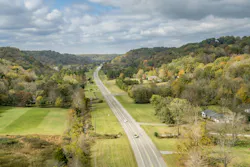
This weekend, as Americans celebrate the country’s 250th birthday, people will discuss and debate the leaders and events that have shaped the nation. But many will overlook one of America’s greatest achievements — our roads.
Long before the Interstate Highway System, before automobiles and even before the nation itself was founded, roads linked settlements, enabled commerce, supported military campaigns and helped drive westward expansion.
These routes carried Indigenous peoples, colonial settlers, merchants, presidents, soldiers and generations of travelers seeking opportunity for their families.
Some of these historic corridors have evolved from dirt paths and wagon tracks into paved highways and local roads.
As America marks its semiquincentennial, these 10 historic roads offer a reminder that mobility has been central to the nation's development since its earliest days.
Old Mine Road
Considered the oldest continuously used road in the United States, Old Mine Road stretches 104 miles from the Delaware Gap in New Jersey to Kingston, N.Y.
Historians believe the route originated in the 17th century, connecting Dutch settlements along the Delaware River with copper mines in the region.
Portions of the original roadway have been altered over time. Its New York stretch, which has been incorporated into U.S. Route 209, has been modernized and widened. However, significant sections remain intact within the Delaware Water Gap National Recreation Area. The road offers a glimpse into the transportation network that existed before American independence.
King's Highway
Established in the late 1600s, King's Highway was one of colonial America's most important transportation corridors. The route connected Boston to Charleston, S.C., linking many of the colonies along the Atlantic seaboard.
Though no longer a single continuous road, many modern streets and highways trace their origins to King's Highway. The route played a critical role in communication, trade and governance throughout the colonial era.
Boston Post Road
The Boston Post Road emerged in the 17th century as a mail delivery route between New York and Boston. Postal riders carried messages along the corridor, helping maintain connections between two of colonial America's most influential cities.
Today, portions of the route survive as local roads and state highways in New York, Connecticut, and Massachusetts. In some towns, historic milestones erected along the road during the 18th century can still be found, and there are places where the Boston Post Road has been placed on the National Register of Historic places.
Albany Post Road
Constructed during the colonial period, Albany Post Road connected New York City with Albany, serving as a vital commercial and governmental route. Designated as a postal route in 1669, it became one of the most heavily traveled roads in New York.
Much of the route later became part of U.S. Route 9. Travelers today can still drive sections that closely follow the original colonial alignment.
Great Wagon Road
The Great Wagon Road was less a single road than a migration corridor stretching from Pennsylvania through the Shenandoah Valley and into the Carolinas. During the 18th century, thousands of settlers used the route to move southward and westward.
Also known as the Philadelphia Wagon Road, the road played a major role in populating the American frontier. Modern highways throughout Virginia, North Carolina and South Carolina often follow portions of its historic path.
Natchez Trace
Long before European settlement, Native American tribes used the Natchez Trace as a travel corridor connecting the Mississippi River with central Tennessee. By the late 18th and early 19th centuries, it had become a major route for traders, soldiers and settlers.
Today, much of the historic corridor is preserved as the Natchez Trace Parkway, a scenic 444-mile route from Nashville, Tenn., to Natchez, Miss., managed by the National Park Service. Designated an All-American Road by the United States Department of Transportation, the roadway remains one of the nation's best-preserved historic transportation corridors.
El Camino Real de Tierra Adentro
Known as the Royal Road of the Interior Land, El Camino Real de Tierra Adentro connected Mexico City with Spanish settlements in present-day New Mexico. Established in the late 1500s, it became one of North America's longest and most important trade routes.
The route facilitated the movement of people, goods, livestock, and cultural influences across the Spanish colonial frontier. Segments of the historic road remain visible today, most notably with part of Interstate 25 in New Mexico.
Santa Fe Trail
Opened in 1821 following Mexican independence from Spain, the Santa Fe Trail linked Franklin, Mo., with Santa Fe, N.M. The route quickly became one of the nation's most important commercial highways, carrying manufactured goods westward and bringing silver, furs and other products eastward.
The trail also served military and migration purposes as the United States expanded west. In 1846, the U.S. Army used the Sante Fe Trail to invade New Mexico during the Mexican-American War.
Because the trail had multiple branches, modern roads in Kansas, Colorado, Oklahoma and New Mexico frequently parallel portions of the original route. These include Intestate 25, U.S. Route 50, U.S. Route 56 and Interstate 70.
National Road (Cumberland Road)
The National Road represented a landmark achievement in federal infrastructure investment. Authorized by Congress in 1806, it became the first major federally funded highway in American history and was celebrated as “Main Street of America.”
Beginning in Cumberland, Md., the road eventually stretched westward into Illinois, helping connect the eastern states with the expanding frontier. Many portions later became part of U.S. Route 40, and several original bridges and roadway segments remain in use today.
Lincoln Highway
The youngest route on this list, the Lincoln Highway marked a turning point in America's transportation history. Dedicated on Oct. 31, 1913, it became the nation's first transcontinental automobile highway, stretching from New York City to San Francisco.
The highway demonstrated the growing importance of motor vehicle travel and helped build public support for improved roads nationwide. Portions of the Lincoln Highway survive as local roads, state highways and segments of major interstate corridors.
America’s Legacy of Mobility
The story of America is inseparable from the story of transportation. From Indigenous trade paths and colonial mail routes to federal highways and transcontinental roadways, transportation infrastructure has shaped settlement patterns, economic growth and national identity for the nation’s 250 years.
As the nation celebrates its semiquincentennial, these historic roads serve as more than relics of the past. They remain active reminders of how generations of Americans connected communities, expanded opportunity and built the transportation networks that continue to carry the country forward.
About the Author
 Gavin Jenkins, Head of Content
Gavin Jenkins, Head of Content
Head of Content
Gavin Jenkins is an award-winning journalist based in Pittsburgh. His work has appeared in The New York Times, The Washington Post, The Atlantic, VICE, Narrative.ly, Prevention, the Pittsburgh Tribune-Review and Beijing Review.
In 2020, two stories he wrote for Pitt Med Magazine earned three Golden Quill Awards from the Press Club of Western Pennsylvania. “Surviving Survival” won Excellence in Corporate, Marketing and Promotional Communications – Written, Medical/Health, while “Oct. 27, 2018: Pittsburgh’s Darkest Day, and the Mass Casualty Response” won Excellence in Written Journalism, Magazines – Medical/Health, as well as the Ray Sprigle Memorial Award: Magazines, a Best in Show award.
After graduating from the University of Pittsburgh at Johnstown in 2003, he covered sports for the Bedford Gazette, in Bedford, Pa., and the Martinsville Bulletin, in Martinsville, Va. In 2006, he returned to Pittsburgh to write for Trib Total Media. Based out of the Kittanning Leader Times, he worked for the Trib for two years, and then he moved to Shenzhen, China, to teach English and freelance. After two years in China, he earned an MFA in nonfiction from the University of Pittsburgh.
When he's not at work, he's usually playing with his border-collie mix, Bob.