Three Landmark Transportation Corridors Named for George Washington
More than two centuries after his death, George Washington's name appears on hundreds of roads, bridges, parkways, schools and public works projects across the United States. And deservedly so.
The nation's first president was not only a military leader and statesman. He also was a surveyor and land developer who advocated for transportation improvements that could unite the young republic.
Washington understood that roads, waterways and connections between communities would be essential to America's future prosperity.
As the nation celebrates its 250th birthday, three transportation landmarks stand out among the many pieces of infrastructure that bear his name. From a scenic parkway in the nation's capital to a Massachusetts highway honoring his historic journey and one of the world's most famous suspension bridges, these structures tell stories about engineering ambition, mobility and America's evolving transportation network.
George Washington Memorial Parkway (Virginia and Washington, D.C.)
Known as the G.W. Parkway, the George Washington Memorial Parkway was conceived as a transportation corridor and a living memorial. It was designed to preserve the landscapes associated with Washington's life while providing access to the nation's capital.
Planning began in the 1920s and gained momentum during the Great Depression. The project was administered by the National Park Service and developed as part of a broader effort to commemorate the bicentennial of Washington's birth in 1932. Construction occurred in phases over several decades, with major segments completed between the 1930s and 1960s.
Landscape architects and engineers carefully aligned the roadway along the Potomac River, preserving views of monuments, forests and historic sites. Portions of the route pass Mount Vernon, Washington's estate, creating a direct connection between the first president's home and the nation's capital.
The National Park Service rehabilitated the parkway’s northern section from 2022-2025. It rehabilitated bridges and replaced pavement.
The parkway stretches approximately 25 miles through Virginia and Washington, D.C., linking major employment centers, recreational areas, airports and historic landmarks. It remains one of the most heavily traveled roadways in the region.
George Washington Memorial Highway (Massachusetts)
While less nationally known than the parkway or bridge, the George Washington Memorial Highway in Massachusetts commemorates a pivotal moment in American history.
The highway traces portions of the route Washington traveled twice: in 1775, when he took command of the Continental Army, and again in 1789, during his inaugural journey from New York City, then the nation's capital, to New England. The trip allowed the newly elected president to meet citizens across the young republic.
In the early 20th century, as automobile travel expanded and communities sought ways to commemorate the nation's founding, Massachusetts designated and constructed the George Washington Memorial Highway.
Dedicated in 1932, the highway represents the evolution of American roads from colonial travel routes to modern automobile infrastructure. It serves communities along Massachusetts' South Shore and remains an important regional transportation artery.
Its significance lies not in record-breaking spans or innovative design but in its historical connection to Washington's efforts to unite a new nation.
George Washington Bridge (New York and New Jersey)
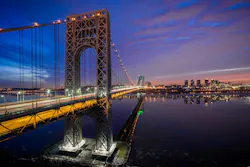
The George Washington Bridge is one of the most iconic structures in the country. Spanning the Hudson River between Manhattan and Fort Lee, N.J., the bridge was designed by legendary Swiss-American engineer Othmar Ammann, one of the most influential bridge builders of the 20th century.
Construction began in 1927 under the direction of the Port of New York Authority, now known as the Port Authority of New York and New Jersey.
When the bridge opened in 1931, it immediately set records. Its main span of 3,500 feet was the longest suspension bridge span in the world, surpassing all previous bridge designs and demonstrating the possibilities of modern engineering. Ammann's innovative use of lightweight steel trusses allowed the bridge to achieve unprecedented scale while maintaining structural efficiency.
Originally constructed with a single deck carrying six lanes of traffic, the bridge quickly became a victim of its own success. Traffic volumes surged as automobile ownership increased and suburban development expanded throughout the region. To address growing demand, engineers added a lower deck in 1962, effectively doubling capacity and creating the bi-level configuration seen today.
The bridge's exposed steel towers have become an iconic feature of the New York skyline.
The George Washington Bridge carries more vehicle traffic than any other bridge in North America. Roughly 290,000 to 305,000 vehicles cross it each day, making it one of the most important transportation links in the United States.
A Lasting Legacy
George Washington's influence on America extends far beyond the pages of history books. Roads and bridges are named after Washinton because he understood that a nation is only as strong as its connections.
Whether winding along the Potomac River, tracing a journey through New England or spanning one of the busiest waterways in the world, these transportation corridors reflect the enduring relationship between infrastructure and national identity. As America celebrates its 250th birthday, they serve as reminders that mobility, connectivity and engineering ambition have helped define the nation since its earliest days.
About the Author
 Gavin Jenkins, Head of Content
Gavin Jenkins, Head of Content
Head of Content
Gavin Jenkins is an award-winning journalist based in Pittsburgh. His work has appeared in The New York Times, The Washington Post, The Atlantic, VICE, Narrative.ly, Prevention, the Pittsburgh Tribune-Review and Beijing Review.
In 2020, two stories he wrote for Pitt Med Magazine earned three Golden Quill Awards from the Press Club of Western Pennsylvania. “Surviving Survival” won Excellence in Corporate, Marketing and Promotional Communications – Written, Medical/Health, while “Oct. 27, 2018: Pittsburgh’s Darkest Day, and the Mass Casualty Response” won Excellence in Written Journalism, Magazines – Medical/Health, as well as the Ray Sprigle Memorial Award: Magazines, a Best in Show award.
After graduating from the University of Pittsburgh at Johnstown in 2003, he covered sports for the Bedford Gazette, in Bedford, Pa., and the Martinsville Bulletin, in Martinsville, Va. In 2006, he returned to Pittsburgh to write for Trib Total Media. Based out of the Kittanning Leader Times, he worked for the Trib for two years, and then he moved to Shenzhen, China, to teach English and freelance. After two years in China, he earned an MFA in nonfiction from the University of Pittsburgh.
When he's not at work, he's usually playing with his border-collie mix, Bob.