Roads & Bridges' Mount Rushmore of Roads
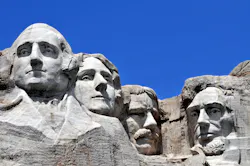
The story of America can be told through transportation. As our country celebrates its 250th birthday, it’s important to remember that we have been defined by our mobility.
Given this, Roads & Bridges’ editorial team decided to name a Mount Rushmore of American Roads.
Mount Rushmore features the faces of George Washington, Thomas Jefferson, Theodore Roosevelt and Abraham Lincoln. Washington symbolizes the birth of our nation, Jefferson represents the country’s growth and expansion thanks to the Louisiana Purchase, Roosevelt symbolizes our development as a global and economic force, and Lincoln embodies the preservation of our union for leading the country through the Civil War.
What roads symbolize the birth, growth, development and preservation of the United States? Our transportation network offers countless worthy candidates.
The Pennsylvania Turnpike pioneered modern superhighways. Route 66 became the nation's most famous roadway and a symbol of freedom. The Pacific Coast Highway showcases engineering against some of the world's most spectacular scenery. The Santa Fe Trail opened commerce with the Southwest. The Oregon Trail carried generations of settlers westward. The National Road, America's first federally funded highway, helped bind the young republic together.
Yet only four roads can earn a place on this symbolic monument. These routes tell the story of America: a collection of colonies that expanded and evolved into continental nation connected by one of the most advanced transportation networks in human history.
These are the four roads, according to Roads & Bridges, that belong on America's Mount Rushmore of Roads.
Birth: The King's Highway
Long before there was an America, there was the King's Highway. Established in the late 17th century, the King's Highway was not a single road but a network of colonial routes stretching from Charleston, S.C., to Boston.
Ordered to be built by Charles II, it connected the 13 colonies at a time when travel was difficult, communication was slow and the concept of a united America did not yet exist.
The importance of the King's Highway extended far beyond transportation. Merchants used it to move goods between colonial cities. Post riders carried news and information along its route. Political leaders traveled its length, sharing ideas that would eventually fuel independence.
In many ways, the King's Highway became the first transportation corridor to link the colonies into something resembling a single nation. The roadway helped create economic and cultural ties between distant settlements.
The road also witnessed many of the defining moments of the American Revolution. Troops marched along portions of the route, messengers carried intelligence and revolutionary ideas traveled from colony to colony.
If roads are the physical manifestation of a nation's identity, then the King's Highway represents America's birth. It helped transform isolated colonies into interconnected communities and laid the groundwork for the country that emerged in 1776.
Growth: The Lincoln Highway
If the King's Highway helped create America, the Lincoln Highway helped unite it.
Dedicated in 1913, the Lincoln Highway became the nation's first transcontinental automobile route, stretching more than 3,000 miles from Times Square in New York City to Lincoln Park in San Francisco.
Carl Fisher, an entrepreneur who founded the Indianapolis Motor Speedway, said in 1912 of the Lincoln Highway, “Let’s build it before we’re too old to enjoy it.”
At a time when cross-country travel was still considered an adventure, the Lincoln Highway represented possibility. It stitched together hundreds of towns and cities across the Midwest and West, encouraging commerce, tourism and migration. The route inspired hope and demonstrated that the automobile could reshape American life.
The highway arrived during a period of extraordinary national growth. America was becoming an industrial powerhouse. Automobiles were transforming mobility. Rural communities sought better connections to markets and population centers.
The Lincoln Highway became a catalyst for all of it. Businesses sprang up along the route. Restaurants, service stations and roadside attractions emerged to serve travelers. Communities proudly advertised their place on the nation's most famous highway. The route inspired the Good Roads Movement and helped convince policymakers that modern highways were essential to economic progress.
More importantly, the Lincoln Highway connected Americans to one another. For the first time, ordinary citizens could realistically dream of driving across the continent. The road did more than connect destinations. It connected a growing nation.
Development: The Interstate Highway System
No transportation project has transformed America more than the Interstate Highway System.
Authorized by the Federal-Aid Highway Act of 1956 and championed by President Dwight D. Eisenhower, the Interstate System fundamentally changed how Americans travel, conduct business and build communities.
“A modern, efficient highway system is essential to meet the needs of our growing population, our expanding economy, and our national security,” said President Eisenhower, during his State of the Union address on Jan. 6, 1955.
Today, the network spans nearly 50,000 miles and serves as the backbone of the nation's transportation infrastructure.
Its impact is difficult to overstate.
The Interstate System dramatically reduced travel times, improved safety, enhanced military mobility and created unprecedented efficiency for freight movement. It enabled the rise of modern logistics, national supply chains, suburban development and regional economic integration.
Entire industries evolved around the network. Distribution centers, manufacturing facilities, trucking operations and retail developments clustered near interstate corridors. The system helped create the modern American economy.
For transportation professionals, the Interstate System remains the ultimate example of infrastructure development on a national scale. It required engineering innovation, political vision and sustained investment across generations.
The system also became a model for highway construction around the world.
While individual roads may be more scenic or historic, no transportation facility better represents America's development than the Interstate Highway System. It stands as the country's largest and most influential public works achievement—a transportation network that reshaped the nation and continues to drive its economy.
Preservation: The Natchez Trace
Not every great road survives because it remains the fastest route. Some endure because a nation chooses to preserve its history.
The Natchez Trace began as an ancient travel corridor used by Native Americans for thousands of years. Later, it became a vital route for traders, settlers, soldiers and frontier travelers moving through the south.
By the early 19th century, thousands of "Kaintucks"—boatmen from Kentucky and other frontier regions—walked the Trace home after floating goods down the Mississippi River. It became one of the most important transportation corridors in early America.
Eventually, steamboats and railroads diminished the route's commercial importance. Many historic roads would have faded into obscurity. The Natchez Trace took a different path.
Rather than modernizing it beyond recognition, Americans chose preservation. Today, the Natchez Trace Parkway protects roughly 444 miles of historic landscape stretching from Mississippi through Alabama and into Tennessee.
On the National Park Service’s website, the Trace is described as "An avenue of travel, trade, change, conflict, and communication for more than 10,000 years."
The corridor preserves archaeological sites, historic landmarks, Native American history, Civil War connections and remnants of early American transportation.
It reminds us that roads are more than infrastructure assets. They are cultural resources that tell the story of who we are and how we got here.
For that reason, the Natchez Trace represents preservation—the recognition that America's transportation history deserves protection alongside its continued progress.
The Roads That Built America
Together, these four roads tell the story of the United States. The King's Highway represents birth, linking colonies before they became a nation. The Lincoln Highway symbolizes growth, connecting Americans during an era of expansion and opportunity. The Interstate Highway System embodies development, creating the modern transportation network that powers the nation's economy. The Natchez Trace stands for preservation, protecting the history and heritage that shaped the American journey.
Countless roads helped build the United States. Some moved armies. Others carried settlers, freight, ideas and dreams. But if America were to carve four roads into a mountainside alongside the ideals they represent, these routes would tell the nation's story from its earliest days to its 250th birthday.
About the Author
 Gavin Jenkins, Head of Content
Gavin Jenkins, Head of Content
Head of Content
Gavin Jenkins is an award-winning journalist based in Pittsburgh. His work has appeared in The New York Times, The Washington Post, The Atlantic, VICE, Narrative.ly, Prevention, the Pittsburgh Tribune-Review and Beijing Review.
In 2020, two stories he wrote for Pitt Med Magazine earned three Golden Quill Awards from the Press Club of Western Pennsylvania. “Surviving Survival” won Excellence in Corporate, Marketing and Promotional Communications – Written, Medical/Health, while “Oct. 27, 2018: Pittsburgh’s Darkest Day, and the Mass Casualty Response” won Excellence in Written Journalism, Magazines – Medical/Health, as well as the Ray Sprigle Memorial Award: Magazines, a Best in Show award.
After graduating from the University of Pittsburgh at Johnstown in 2003, he covered sports for the Bedford Gazette, in Bedford, Pa., and the Martinsville Bulletin, in Martinsville, Va. In 2006, he returned to Pittsburgh to write for Trib Total Media. Based out of the Kittanning Leader Times, he worked for the Trib for two years, and then he moved to Shenzhen, China, to teach English and freelance. After two years in China, he earned an MFA in nonfiction from the University of Pittsburgh.
When he's not at work, he's usually playing with his border-collie mix, Bob.