California Crash on Highway 101 Puts Screen-Obsessed Driving in the Spotlight
Key Highlights
-
A California Highway Patrol cruiser was hit by a driver who admitted he was watching YouTube while driving, a stark example of how often screens are pulling attention away from the road.
-
Even with features like lane keeping and automatic braking, about 40,000 people die each year in traffic crashes, and thousands of those deaths are tied to distracted driving.
-
Researchers say large touchscreens and semi-automated systems can give drivers too much confidence, leading them to rely on the car’s technology instead of staying fully focused.
The video is hard to watch.
A white pickup barrels down Highway 101 in Redwood City and slams into a California Highway Patrol cruiser parked at the scene of another crash, the San Franciso Chronicle reported.
An officer, waving a strobe flashlight, has to jump out of the way. Later, the driver explains that he had been watching YouTube on his phone. He says he never saw the flares. He never saw the patrol car. He never saw the officer.
The March 3 crash could have been mistaken for slapstick if it were not so dangerous. Instead, it has become another example of a growing problem on American roads. Drivers are looking at screens instead of traffic.
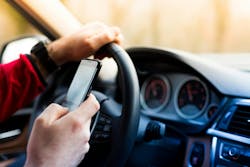
Motorists scroll through their phones while creeping along in congestion. They tap and swipe dashboard touchscreens while moving at freeway speeds. Navigation apps command more attention than the road ahead. The behavior is so common that it barely surprises anyone anymore.
“We see people reading, watching videos, watching a football game,” Officer Sophie Lu, a spokesperson for the California Highway Patrol’s Redwood City division, told the news outlet. She shared body camera footage of the crash on social media with a simple warning: stay focused behind the wheel.
Safety experts worry that reminders alone are not enough. Modern cars are packed with features designed to prevent crashes. Lane keeping systems nudge vehicles back into position. Automatic braking steps in when drivers do not. Rearview cameras and collision warnings add extra layers of protection. Crumple zones absorb impact.
In theory, all of this should make driving safer.
In practice, the technology can create a false sense of security. Scott Moura, a professor of civil and environmental engineering at the University of California, Berkeley, says many drivers begin to believe the car is doing more of the work than it actually is.
Automakers often promote a vision of driving that feels closer to being chauffeured than actively operating a vehicle. Large screens dominate dashboards. Entertainment and vehicle controls blend together. Drivers use touchscreens to adjust climate settings, switch songs, respond to messages or search for faster routes. Phone mounts keep devices within easy reach. Last year, a wireless adapter began allowing YouTube and Netflix to stream directly onto car screens, even though California law prohibits videos visible to a driver while the car is moving.
The result is a strange contradiction. Cars are more advanced than ever, yet roadway deaths remain stubbornly high. According to the National Highway Traffic Safety Administration, about 40,000 people die each year on U.S. roads. The number climbed to nearly 43,000 in 2021, the highest level in 16 years. In 2023, distracted drivers were responsible for 3,275 fatal crashes. In 369 of those cases, cellphones were specifically involved.
In the Bay Area, conversations about road safety often focus on self driving vehicles. Moura believes the greater risk may lie with cars that are only partially automated and the humans behind the wheel. When drivers feel they can hand off some of the mental effort to the vehicle, they may shift their attention elsewhere. The technology handles the lane changes and braking, so the driver checks a text.
Suraj Lama, of Richmond, appreciates the technology in his Tesla Model X. He trusts its cameras and safety systems. But even he has noticed how distracted drivers have become. When he drives his daughter to school, he sees people roll through stop signs without looking up from their phones.
Sometimes the consequences are devastating. In Redding, a woman recently drove through a red light while using FaceTime. She struck another vehicle and died in the crash. Two children in her truck were injured.
Not every automaker is doubling down on bigger screens. Volkswagen and Subaru have started bringing back more physical buttons and knobs in some models. Patents filed by Rivian suggest future vehicles could include traditional dials below touchscreens. Daniel Sperling, founding director of the Institute of Transportation Studies at the University of California, Davis, says there is growing interest in returning to simpler controls.
Many drivers find physical knobs easier and safer to use because they can adjust them by feel, without taking their eyes off the road. Research backs up that instinct. A widely cited 2020 study compared drivers impaired by alcohol or cannabis with drivers using handheld phones and drivers operating in car touchscreens. The touchscreen users had the slowest reaction times and performed the worst behind the wheel.
Most people have experienced the frustration of trying to adjust the radio or climate settings through a screen while driving. Each extra second of attention spent on a display is a second not spent watching traffic.
Moura’s research suggests that drivers tend to think about automation in extremes. They either want full control, or they want the car to handle everything. The middle ground, where a car assists but does not fully drive itself, can lead to confusion. Drivers relax too much, assuming the vehicle will save them.
Many commuters are tired. They are stressed. They want to get from one place to another and use that time to catch up on messages or watch a video. The technology makes it easy.
But the laws of physics have not changed. A two ton vehicle moving at highway speed still requires a human being who is paying attention.
For those who truly want to tune out and let someone else do the driving, Moura points out that the option already exists. It is called a bus.
Sources: The San Fransico Chronicle
About the Author

Karina Mazhukhina, Digital Content Specialist
Digital Content Specialist
Karina Mazhukhina has extensive experience in journalism, content marketing, SEO, editorial strategy, and multimedia production. She was previously a real-time national reporter for McClatchy News and a digital journalist for KOMO News, and ABC-TV affiliate in Seattle.