USDOT Moves to Restrict Federal Funding for Automated Traffic Enforcement Cameras
Key Highlights
- Federal funding distributed through the Safe Streets and Roads for All program will no longer be available for automated enforcement cameras installed outside of school and work zones.
- USDOT is considering a complete ban on automated enforcement cameras in Washington, D.C., where the city currently operates 546 cameras that generated more than $267 million in revenue in fiscal year 2025.
- Supporters argue enforcement cameras improve safety and reduce fatalities, while opponents say the technology prioritizes revenue generation and lacks proper oversight.
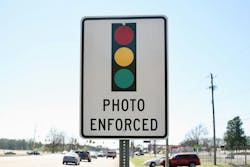
The Trump Administration announced it will restrict the use of federal funding for automated traffic enforcement cameras, The Washington Post reported.
In a letter sent to city officials in December, the administration said federal dollars would no longer be granted to install traffic cameras outside of school or work zones in order to align with “administration priorities.” The funding was being distributed through the 2021 Safe Streets and Roads for All program, which was designed to reduce traffic fatalities.
The decision is similar to a declaration from the U.S. Department of Transportation (USDOT) earlier this month that threatened to bar the use of automated enforcement cameras in Washington D.C., according to Politico.
The December letters from USDOT also stated that projects proposing sidewalk curb extensions into roadways would not receive funding, except at transit stops, roundabouts, school zones, on-street parking areas or for extensions that do not eliminate traffic lanes, The Washington Post reported.
Cities expecting to receive grants under the program had not yet signed final agreements with the White House, meaning the funds can still be rescinded.
According to the Washington Post, the administration has previously argued that projects replacing vehicular lane capacity with bike lanes or pedestrian infrastructure conflict with the USDOT’s goal of increasing roadway capacity for vehicles.
Supporters of automated cameras say the technology saves lives by reducing crashes and fatalities on high-risk roadways and intersections. Cameras are also major revenue generators for municipalities and often pay for themselves through fines, leading some advocates to argue that removing federal funding will not stop their deployment.
Opponents of automated enforcement argue that issuing citations without a law enforcement officer present is unjustified and that speed cameras often enforce speed limits that are set too low, The Washington Post reported.
In Washington D.C., USDOT’s proposal would ban all automated enforcement cameras, including speed, red-light and stop-sign cameras, according to Politico.
Washington D.C. currently operates 546 active enforcement cameras, having first implemented red-light cameras in 1999. The cameras monitor violations including such as speeding, unauthorized use of bus lanes and truck-restricted routes.
Lawmakers have repeatedly attempted to restrict the program, arguing it is used more to generate revenue than improve safety, likening it to a commuter tax. The D.C. government maintains the program is a road safety tool. Politico reported that the cameras generated $267.3 million in fiscal year 2025.
Sources: The Washington Post, Politico