How Street Sweepers Are Protecting Roads, Increasing Safety
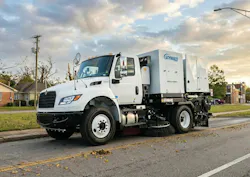
Often associated with only curbside cleanup and aesthetics, the role of a street sweeper in broader roadway maintenance is widely misunderstood. Beyond cosmetics, they serve as essential tools for protecting infrastructure, improving safety and supporting environmental goals.
Manufacturers say the functions of a street sweeper continue to expand as they are further integrated into roadway maintenance strategies—not only to remove debris, but to improve traction and visibility, protect pavement and drainage systems and provide data that helps optimize operations.
Beyond Debris Removal
Roadway cleanup provides safety benefits the average driver may not notice every day but are of critical value in roadway safety.
Street sweeping helps remove roadway debris before it can create hazards for drivers.
Removing loose gravel, debris and sediment maintain tire traction on a roadway, according to Chad Schiele, product manager at Elgin Sweeper, a staple in the street sweeper industry for the past 110 years.
Improved tire traction can lead to more effective braking, better control when turning or changing lanes, reduced skidding and a lower crash risk.
A roadway free of debris minimizes swerving and lane obstructions, and the possibility of objects going airborne when struck by a vehicle, said Nicholas Bruhn, product manager at Schwarze Industries, which offers the largest line of street sweepers on the market.
“Not only do you have people swerving out of the way if there’s say a tire tread or a broken hubcap in the way, but when vehicles run over that, it gets airborne,” Bruhn said. “Especially if you have a big piece of equipment like an 18-wheeler and it runs over a bunch of rocks or something on the highway … it can launch those.”
He added that debris removal also improves safety by keeping the road shoulder open for breakdowns and ensuring lane markings remain visible following a storm.
Street sweepers are integral to preventative maintenance in the event of a storm, Schiele said, because if debris is not removed it can block drainage systems and catch basins, which can cause “standing water and hydroplaning.”
Protecting Infrastructure Investments
Agencies are more frequently viewing street sweeping as an effective vehicle for protecting their infrastructure investments—reducing the need for costly repairs that are largely avoidable.
“Over the past ten years, municipalities and contractors have increasingly recognized sweeping as a cost-effective form of maintenance, rather than just simply a cosmetic service,” Schiele said.
Abrasive materials and sediments can have a detrimental effect on pavements, and their removal extends the lifespan of the road, eliminating the need for more frequent repaving, he added.
Debris can damage the surface by compacting into the asphalt, according to Bruhn, causing cracks and deterioration into the road.
Sweepers are of use before paving work as well as cleaning the roadway supports improved pavement adhesion.
“When we pave our roads, we are clean and good to go, the surface is really well prepped before we pave so that the new pavement has a lot better chance of adhesion and long life, so we are not having to repave a repaved road,” Bruhn said.
As agencies increasingly rely on sweepers to protect infrastructure, they are also looking to them as tools for meeting environmental and sustainability goals.
Supporting Environmental Goals
Roadway debris that is left unmanaged often ends up in stormwater systems and nearby waterways, positioning street sweepers on the front lines of environmental protection.
Sediment, brake dust and other roadway contaminants can impact water quality and removing them from the roadway stops them in their tracks.
“There’s been a lot more focus on environmental impact, so instead of just cleaning for aesthetics, making sure the roads look pretty,” Bruhn said, “sweeping makes sure that we get material off the ground and contained before it goes into things like the stormwater system, or becomes an environmental impact with water runoff.”
The environmental conversation does not stop with what sweepers remove from the roadway; it also includes the machines themselves.
According to Schiele, sustainability has played a major role in purchasing decisions as agencies are calling for vehicles with lower emissions, reduced fuel consumption and improved water efficiency.
There has been a heightened focus on “efficiency pickups,” such as switching from hydraulics to electric components so there isn’t as much strain on the chassis or the auxiliary engine, which decreases overall fuel usage, according to Bruhn.
Increased sustainability goals have led agencies to more frequently consider electric sweepers, according to both manufacturers.
Schiele said interest in electric sweepers has grown, particularly in urban areas where lower emissions and reduced noise are key considerations, as well as the heightened environmental benefits and potential cost-savings in the long term.
Though, he added that practical considerations such as cost and charging infrastructure have remained barriers to widespread implementation.
Bruhn said that Schwarze has seen agencies turning towards electric sweepers “not necessarily for the sake of electrification, but electrification for the increase in efficiencies” that coincide with it, such as the reduction in hydraulics, environmental impact and troubleshooting and maintenance benefits.
“They’re more interested in making sure maintenance is easier and there’s less chance of an environmental issue, and then always the fact that they are more efficient in a lot of ways,” he said.
Alongside the shift towards sustainable operations, manufacturers are seeing a change in how agencies deploy sweepers with the rise of data-driven operations.
Smarter Sweeping Though Data
Agencies are optimizing their fleets for more efficient use with the help of data-informed insights, according to manufacturers.
With the use of telematics, agencies can track the location, the amount of fuel used, utilization and maintenance of their sweepers, which supports route optimization, reduces idle time and improves planning initiatives, Schiele said. These tools can support broader agency operations, in addition to street sweeping.
“Connected technologies are really transforming sweepers into valuable sources of operational intelligence gathering,” he said. “Systems provide real-time visibility into equipment location, utilization, fuel consumption and maintenance operator performance.”
In addition to fleetwide visibility, connected technologies support analytics at a smaller scale, according to Bruhn.
Data-driven operations provide fleet managers with intelligence into broom usage, water consumption and engine RPM, which informs predictive maintenance, reduced downtime, performance troubleshooting and operator training insights.
“People are paying a lot more attention to not just where something is but all of the details around it,” Bruhn said. “We are seeing a focus really centered around getting into the nitty gritty, getting into how fast your brooms were spinning, how much water did you use, what was your engine RPM at, so they can really fine tune their analytics.”
As municipalities continue to grow ever-more connected, manufacturers say sweepers will continue to play an expanded role in systemwide operations.
The Future of Street Sweeping
As connected infrastructure becomes more common, manufacturers say street sweepers are evolving from maintenance equipment into mobile data platforms that support broader transportation operations.
“Sweepers will play an increasingly important role in smart city and resilient infrastructure,” Schiele said. “Especially as communities invest in connected transportation networks, climate resilience and environmental stewardship.”
Sweepers’ value will not only serve smart cities operationally, but through the data they collect, he said, especially as the technology continues to advance to “incorporate advanced sensors, predictive maintenance capabilities and real-time reporting tools.”
These features will equip agencies with the ability to manage their infrastructure more proactively, Schiele added.
While manufacturers point to a more connected and data-driven future, they also emphasize that the fundamentals of street sweeping remain critical.
Schwarze Industries noted that one of the biggest misconceptions is that sweeping is simply about appearance, when in reality it has a direct impact on roadway safety, environmental protection and infrastructure performance.
As agencies continue balancing safety, sustainability and efficiency, ensuring the right equipment is matched to the right application will also be key to maximizing the benefits of sweeping programs.
About the Author
 Jessica Parks, Staff Writer
Jessica Parks, Staff Writer
Staff Writer
Jessica Parks is a staff writer at Roads & Bridges with newsroom experience in Brooklyn, Long Island and the U.S. Virgin Islands, and several years spent living in Puerto Rico. She is currently based in Tulsa, Oklahoma.