Engineering Against the Unknown
By Suze Parker, Contributing Author
In the early hours of Dec. 26, 2024, a cavernous hole opened on the eastbound shoulder of Interstate 80 in Wharton, N.J. Measuring 40-feet wide and encroaching into the right lane, the sinkhole disrupted traffic on one of the state’s busiest highways and triggered a chain of events that would test the speed and breadth of emergency responsiveness and engineering ingenuity.
Over the next three months, two more sinkholes emerged on I-80 near the original one as portions of a long-abandoned, 19th-century iron ore mine, invisible from the surface but stretching hundreds of feet below the highway, caved in.
With public safety and mobility as top priorities, the New Jersey Department of Transportation (NJDOT) activated a months-long emergency repair effort that included closing the road and deploying innovative geotechnical solutions.
Responding rapidly to the crisis in partnership with HNTB, contractors and a coalition of state and local agencies, NJDOT assessed the issues, established alternative traffic routes and delivered a long-term solution.
An Escalating Challenge
After receiving a call about the first sinkhole, HNTB and NJDOT’s geotechnical unit arrived on-site within hours. As its first assignment under a newly executed NJDOT staff augmentation agreement, HNTB designed a reinforced soil repair that contractors completed, allowing the road to reopen in just four days.
The situation changed dramatically on Feb. 10, 2025, when a depression appeared in the center eastbound lane, 70 feet from the original sinkhole site.
That night during a soil boring investigation, the depression collapsed forming a second sinkhole. The team suspected that the issue may be systemic and began an in-depth study at the same time the sinkhole was being stabilized.
“Like natural disasters, infrastructure emergencies happen unexpectedly,” said NJDOT Assistant Commissioner of Operations Chris Feinthel. “The professionals at NJDOT who handle infrastructure emergencies also manage all weather-related emergencies, so emergency management is something we do incredibly well. The structure we have in place to respond to such emergencies is well refined. There’s comfort in adhering to those protocols and equating each new situation to something we’ve done before. However, this was more challenging because it took time to determine what caused the subsurface instability creating the sinkholes.”
Engineers discovered an abandoned mine, active from 1786 to 1896, that in some places was 700-feet deep and about 3,000-feet long. The mine had begun to give way beneath the highway.
To determine how to proceed, “the team undertook a deep historical review of documents from the 1800s and early 1900s that described the mine,” said HNTB Project Manager Brian Felber. “Importing these historical maps into Google Earth, we could determine where the mine was in relation to the highway. The second sinkhole was to the northeast of the first one, very similar to the mine’s stope.”
On March 19, a third sinkhole opened in the median of the eastbound work zone. Additional testing revealed a significant void beneath the westbound lanes, prompting closure of I-80 in both directions.
Advanced Geotechnical Analysis
When the first closure went into effect on I-80 eastbound, NJDOT knew a repair needed to happen quickly, so they implemented a phased approach, engaging the agency’s emergency contractor, IEW Construction Group, to stabilize the ground.
Simultaneously, the HNTB design team explored the area’s subsurface rock conditions. That aggressive investigation utilized multiple geophysical methods, including destructive borings and probes. Geophysicists from NJDOT and around the country provided expertise that contributed to identifying a long-term solution.
“Our first concern was the safety of the traveling public,” said Matt Riegel, HNTB geotechnical team leader. “The investigation was designed to help us peer below the ground surface, not only to assess the extent of the problem under the eastbound lanes, but also to assess how far the mine extended to the northeast and whether there were concerns for the westbound lanes.”
The team deployed compaction grouting — a technique typically used to stabilize soil — adapting it to serve a dual purpose: mitigate risk and map the underground voids. By measuring grout volumes and pressures, engineers created a 3D model of the mine.
“It was like injecting frosting into a cake,” said Mohab Hussein, NJDOT assistant engineer. “It was an innovative idea that may not have been done before. Based on how much grout we used, we could predict the size and location of the voids.”
The investigation relied on advanced technologies, including:
- Geophysical methods: Ground-penetrating radar, microgravity and seismic analysis
- Borehole imaging: Acoustic, optical and downhole sonar tools
- Monitoring systems: Shape acceleration arrays and multipoint borehole extensometers
These tools allowed engineers to visualize the mine’s size and validate their findings across multiple data sources. The result was a comprehensive understanding of the subsurface conditions, critical for designing a permanent solution.
With more than 110,000 vehicles traveling I-80 daily, the pressure to reopen the highway was immense.
“Under benign circumstances, the technical analysis required to address the sinkholes — and the larger issue of the potential for the mine’s position under the roadway to pose future collapse risks — would have taken months,” said Andrew Tunnard, HNTB vice president and director of strategic initiatives. “The NJDOT and HNTB teams didn’t have that luxury, but they were able to balance the urgency with accuracy. That was the key to success.”
The Long-Term Solution
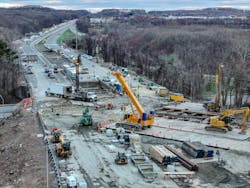
The permanent solution was a series of micropile-supported concrete slabs. Micropiles were drilled into bedrock and bonded with grout, supporting concrete caps.
The slabs covered all three sinkhole zones, including the original December repair. Additional fill and soil were placed atop the concrete and compacted before several layers of asphalt were applied to reconstruct the road.
A long-term monitoring system tracks subsurface conditions. Sensors beneath the road, installed to detect early subsurface shifts, include multipoint borehole extensometers in 12 locations to measure settlement at varying depths and a shape acceleration array that will identify any ground movements below the micropile slabs.
Managing Mobility Challenges
While engineers tackled the underground threat, NJDOT’s mobility team focused on rerouting tens of thousands of vehicles daily on nearby state highways not designed for the volume of traffic carried by I-80.
“After ensuring safety by closing I-80, our next priority was mobility,” said NJDOT Senior Director of Mobility Sal Cowan.
Working with law enforcement and local and county governments, the mobility team instituted a detour plan that accommodated interstate drivers, including large trucks that make wide turns. Portable variable message signs were deployed to advise motorists of the detour many miles in advance.
The department adjusted signal timing along the alternate routes, in some cases reprogramming intersections to give priority to high volume turns or to accommodate traffic surges. Portable cameras were installed to monitor congestion, and NJDOT provided local first responders with access to the cameras to accelerate incident responses.
Nearly 30 state troopers participated in manually controlling traffic signals during peak hours on the alternate routes when I-80 was closed, before NJDOT traffic engineers were able to adjust the traffic signal timing to optimize traffic flow.
Coordination with Google and Waze ensured that those map platforms avoided routing drivers through sensitive sites like the Picatinny Arsenal military base. Work with GPS companies that aggregate and deliver travel-time data helped balance the network by allowing drivers to choose the shortest alternate routes to their destinations. New Jersey Transit offered discounted train service from nearby stations to reduce traffic volume.
To reach long-haul truckers, NJDOT used Drivewyze, which sends alerts directly to electronic logging devices in commercial vehicles. These messages, triggered by GPS coordinates, warned drivers of the I-80 closure up to 30 miles in advance. The system generated more than 430,000 alerts to truckers during the closure.
NJDOT hosted weekly virtual briefings for local and state elected officials, hospitals and area businesses. Participants provided feedback on which roads were struggling with the additional traffic and which neighborhoods were experiencing cut-through congestion, playing a key role in refining the detour and alternate route strategy.
The Department made detour plans available to the public through press releases, a project page on NJDOT’s website, a dedicated I-80 closure page on its 511NJ traveler information service, social media and other channels.
Reopening Ahead of Schedule
On May 21, two eastbound lanes reopened. Two westbound lanes followed on May 30. By June 21, all lanes in both directions were fully restored — days ahead of schedule.
“This was New Jersey at its best,” Assistant Commissioner Feinthel said. “There’s not a bigger route in the state than I-80 and responding to the crisis was our huge moment. Everyone rolled up their sleeves, worked collaboratively and got the job done.”
Former Gov. Phil Murphy called the reopening “a major milestone.”
“I was thrilled to see all lanes of I-80 open safely so we could continue to ensure that New Jerseyans can get to where they need to go efficiently and safely,” Murphy said. “Importantly, I thank the thousands of New Jerseyans who have been impacted by these sinkholes for their patience as we worked to secure this roadway. I also want to thank NJDOT Commissioner Fran O’Connor, the NJDOT crews and the New Jersey State Police who worked around the clock to open this highway safely.”
The I-80 crisis revealed the power of collaboration and innovation to respond swiftly and accurately to an unprecedented infrastructure emergency. NJDOT is now evaluating other mine-adjacent highways and working with federal agencies to develop long-term monitoring strategies to ensure the safety and reliability of New Jersey’s highways.
Suze Parker is a public relations consultant who frequently writes about roads, bridges and other infrastructure projects.