How a Rebar Innovation Earns Its Way into DOT Specs
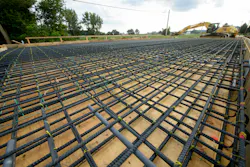
Bridge decks take the worst of what a structure faces: wheel loads, freeze-thaw cycles and season after season of deicing salts working into every crack. For decades, epoxy-coated rebar has been one of agencies' main defenses against the corrosion that follows. But conventional coated bar has a known tradeoff. Its smooth finish reduces bond with the surrounding concrete, which forces longer lap splices, adds steel tonnage and can produce wider cracks.
A newer option, textured epoxy-coated reinforcing steel standardized under ASTM A1124 in 2023, is designed to close that gap. Researchers at the University of Illinois, the University of Kansas and Clemson University have tested it, and the Wisconsin Department of Transportation (WisDOT) has piloted it on an Interstate 39 bridge deck.
Textured epoxy is entering a crowded field. Agencies today can choose from several reinforcement systems for corrosion protection on bridge decks. These include hot-dip and continuously galvanized bar, low-carbon chromium steel (ASTM A1035), solid stainless steel and glass fiber-reinforced polymer (GFRP) bars. Each comes with its own tradeoffs in cost, availability, handling and design requirements. Many departments of transportation (DOT) also rely on the concrete itself, using low-permeability mixes, added cover, sealers and overlays to keep chlorides away from the steel in the first place. Which approach makes sense depends on exposure conditions, budget and each agency's experience. No single system has become the industry standard.
Roads & Bridges spoke with Brent Toller, managing director of the Epoxy Interest Group of the Concrete Reinforcing Steel Institute (CRSI), about how agencies should weigh first cost against life-cycle performance, why crack control matters so much to deck durability, and what it takes to move a durability innovation from the lab into DOT specifications.
This interview has been edited for length and clarity.
R&B: How should transportation agencies think about the tradeoffs between upfront construction costs and long-term durability when selecting materials and corrosion-protection systems for bridge decks?
BT: Agencies have to move past simple "invoice-price" thinking and adopt a rigorous, 75-to-100-year life-cycle cost analysis (LCCA). Uncoated black steel has the lowest upfront cost, but it represents a maintenance liability, with first repairs typically required within 10 to 25 years. On the other end of the spectrum, premium materials like solid stainless steel offer outstanding corrosion resistance but carry upfront cost premiums and possible supply limitations.
Until recently, conventional epoxy-coated rebar (ECR) (ASTM A775) served as the industry's economic sweet spot, but it came with a structural "bond tax." Because the smooth, glossy epoxy finish reduces the mechanical bond with concrete by approximately 15% to 17%, structural design codes (ACI 318 and AASHTO LRFD) require a coating factor of 1.2 to 1.5 on development and lap splice lengths, depending on cover and bar spacing. This "splice penalty" increases total steel weight, inflates material budgets, and leads to severely congested steel cages that obstruct concrete placement.
Independent beam-end and lap-splice testing at the University of Kansas found TEC bond strength comparable to uncoated bar, with lap-splice strength averaging 1.05 times uncoated bar versus 0.83 for conventional smooth ECR. The current standard, ASTM A1124/A1124M-25a (Section A1.4.3), now requires every powder coating manufacturer’s product to demonstrate bond strength of at least 99.5% of uncoated bar from the same heat of steel. That is what allows the designer to treat TEC like uncoated bar for bond.
R&B: Your work on textured epoxy coatings grew out of research into the relationship between reinforcement coatings, bond strength and cracking. More broadly, how important is crack control to bridge-deck durability, and what role can reinforcement and protective coatings play in controlling deterioration?
BT: Crack control is the cornerstone of long-term deck durability. Concrete naturally shrinks as it cures and expands/contracts during thermal cycles, generating internal tensile stresses that inevitably trigger cracking. While we cannot prevent concrete from cracking, our goal is to control those cracks by keeping them exceptionally fine and tightly spaced.
The physical mechanics of crack control are governed by the bond performance of the reinforcement surface. A high mechanical bond spreads the flexural-tensile strain along the length of the bar, which forces the concrete to "take up" the strain via many narrow, tightly closed micro-cracks. Conversely, a weak or low-friction bond—such as that of conventional smooth ECR—leads to localized slip and concrete strain concentration, resulting in fewer but significantly wider cracks.
This behavior has been quantified in major university studies. In sustained flexural load testing at Clemson University, conventional smooth ECR exhibited the worst relative performance, cracking 12% worse than the average. Conversely, textured epoxy bars exhibited excellent bond and crack-control performance, cracking 5% to 15% better than the average.
Furthermore, microcracking testing at the University of Illinois Urbana-Champaign (UIUC) demonstrated that the concrete cracks around TEC bars were about half as wide as those around conventional ECR, resulting in a 33% reduction in total exposed cracked area. Using advanced Digital Image Correlation (DIC) to visually map strain fields in real-time, UIUC researchers recorded a 60% to 74% reduction in residual concrete strain near the cracks of TEC specimens, proving that the surface texture successfully resists localized boundary slip and prevents cracks from widening under load. By keeping cracks narrow, we significantly delay chloride penetration and extend the service life of the structure.
R&B: There is often a significant gap between a promising materials technology being validated in research and actually being specified and used on transportation projects. What does it take to move a durability innovation from the laboratory into DOT specifications and ultimately into the field—and what can agencies, engineers and contractors do to make that process work better?
BT: Moving a new material from a university lab to a highway jobsite requires bridging three distinct phases: rigorous academic validation, national standardization, and "living laboratory" field pilots. First, the technology must undergo multi-institutional validation, which TEC accomplished through years of testing at UIUC, Kansas, and Clemson.
Second, agencies need a predictable, standardized blueprint to specify the product with confidence. The establishment of the national standard specification ASTM A1124/A1124M in 2023 was the critical catalyst, formalizing requirements for SSPC-SP 10 near-white abrasive blasting, 10-to-20-mil total coating thickness, and mandatory surface roughness limits of 8 to 18 mils.
Third, we must get the material dirty in the field to build real-world construction confidence. WisDOT took a leading role in this by establishing a "Living Lab" pilot on Interstate 39 near Madison. WisDOT split the 8.5-inch-thick deck of a 143-foot single-span bridge (Bridge B-13-729) directly down the middle, reinforcing one half with ASTM A1124 TEC rebar and the other half with hot-dipped galvanized rebar. Subsequent inspections verified a crack-free bridge deck across both sections; both halves were crack-free through the research period.
For contractors and installers, the transition to TEC is practically seamless because it utilizes the exact same proven chemistry, bending fabrication, and field-handling equipment as traditional green bar. Even better, Sherwin-Williams gravel bombardment and parking lot drop tests demonstrated that TEC provides damage tolerance, exhibiting an 80% reduction in coating chips compared to conventional smooth ECR (averaging only 3 chips versus 15). This ruggedness drastically reduces the need for tedious jobsite touch-ups, saving labor hours and protecting the barrier.
The good news is that this isn’t a leap of faith for most agencies. Nearly every DOT already relies on the corrosion protection of the base coating, ASTM A775 epoxy-coated bar, which has been in service since 1973. The next step is simply to try it: put TEC on a trial or comparison bridge, as the Ohio DOT did with a full TEC deck on U.S. 22 and as the Minnesota DOT did on its Westbound Highway 212 bridge in Plato, and specify it by its standard, ASTM A1124. What agencies get is improved bond and crack control on top of the same epoxy protection they’ve depended on for 50 years.
About the Author
 Gavin Jenkins, Head of Content
Gavin Jenkins, Head of Content
Head of Content
Gavin Jenkins is an award-winning journalist based in Pittsburgh. His work has appeared in The New York Times, The Washington Post, The Atlantic, VICE, Narrative.ly, Prevention, the Pittsburgh Tribune-Review and Beijing Review.
In 2020, two stories he wrote for Pitt Med Magazine earned three Golden Quill Awards from the Press Club of Western Pennsylvania. “Surviving Survival” won Excellence in Corporate, Marketing and Promotional Communications – Written, Medical/Health, while “Oct. 27, 2018: Pittsburgh’s Darkest Day, and the Mass Casualty Response” won Excellence in Written Journalism, Magazines – Medical/Health, as well as the Ray Sprigle Memorial Award: Magazines, a Best in Show award.
After graduating from the University of Pittsburgh at Johnstown in 2003, he covered sports for the Bedford Gazette, in Bedford, Pa., and the Martinsville Bulletin, in Martinsville, Va. In 2006, he returned to Pittsburgh to write for Trib Total Media. Based out of the Kittanning Leader Times, he worked for the Trib for two years, and then he moved to Shenzhen, China, to teach English and freelance. After two years in China, he earned an MFA in nonfiction from the University of Pittsburgh.
When he's not at work, he's usually playing with his border-collie mix, Bob.