Rethinking Midwestern Infrastructure: Q&A with AECOM’s Ryan Lake
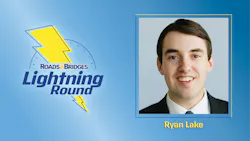
Ryan Lake’s passion for infrastructure began with a high school engineering class and a desire to solve large-scale problems. After earning his bachelor’s degree in civil engineering from the University of Illinois Urbana-Champaign in 2022 and completing his master’s there in 2026, Lake joined AECOM as a roadway transportation engineer in Chicago’s Loop.
His perspective is shaped by his Midwestern roots and his experiences at college, where he was involved with the Marching Illini, Engineers Without Borders and the Civil Engineers Young Engineers Division.
He also brings an interest in transportation systems that extend beyond simply moving vehicles. In this Q&A, Lake discusses the infrastructure challenges facing Midwest cities, the Seoul project that has influenced his thinking about urban transportation and his vision for a future in which public transportation can connect people across major metropolitan areas quickly and efficiently.
Lake, who recently earned his professional engineer license, also knows a thing or two about thinking quickly about infrastructure. Before earning his license, he won the pilot episode of Roads & Bridges’ Lightning Round, beating out two other transportation professionals in the pilot episode of our new game show.
R&B: You grew up in the Chicago area, a region known for its highways, transit and freight network. What do you think is the biggest infrastructure challenge facing Midwest cities over the next decade?
RL: Safe, reliable, clean, and efficient transportation options to get people from Point A to Point B is a major infrastructure and planning challenge within Midwest cities. Within dense city networks, this means widening sidewalks, adding bike and bus lanes, and creating green spaces that enhance the journey along the transportation network. For connections to suburbs, there is a real challenge with transit connections both in space and time. We need to decrease the waiting times for suburban and commuter transit and expand where passengers can go using only public transportation. As much of our infrastructure in the U.S. reaches the end of its design life, this gives engineers an opportunity to assess how we cannot just put back what is currently out there but improve transportation operations and enhance our community spaces.
R&B: Every transportation professional has a project they admire. Is there a road, bridge or infrastructure project—whether in Chicago or elsewhere—that has always impressed you?
RL: The Cheonggyecheon stream in Seoul, South Korea is a project that has always inspired me, both from the engineering and cultural perspective. From the 1970’s until 2005, this corridor was a massive highway that carried passenger cars through the heart of the South Korean capital, until it was torn down and turned into a park, restoring a waterway that was previously used for centuries. There was major pushback by some, arguing that removing a road of this scale would cause gridlock, but this did not happen. By the time I visited the stream in 2024, it has been a successful park and community space for 20 years that also decreases flooding and cools the city. This project is a fantastic example of challenging the status quo and transforming corridors into safe and resilient community spaces.
R&B: If you could solve one transportation problem overnight, what would it be and why?
RL: Get from anywhere within a major city in the US to anywhere within a 30-mile radius of the city center within 1 hour using only public transportation. This would drastically help with many other problems within transportation engineering, the first being safety and the goal of Vision Zero. With a reliable transit system, many would opt for public transportation over personal vehicles, where safety risks are significantly higher. This increased access to transit would also greatly decrease greenhouse gas emissions, decrease the need for parking and urban sprawl, help the economy, increase worker productivity and health, and decrease overall stress.
Click here to compete in Roads & Bridges’ Lightning Round.
About the Author
 Gavin Jenkins, Head of Content
Gavin Jenkins, Head of Content
Head of Content
Gavin Jenkins is an award-winning journalist based in Pittsburgh. His work has appeared in The New York Times, The Washington Post, The Atlantic, VICE, Narrative.ly, Prevention, the Pittsburgh Tribune-Review and Beijing Review.
In 2020, two stories he wrote for Pitt Med Magazine earned three Golden Quill Awards from the Press Club of Western Pennsylvania. “Surviving Survival” won Excellence in Corporate, Marketing and Promotional Communications – Written, Medical/Health, while “Oct. 27, 2018: Pittsburgh’s Darkest Day, and the Mass Casualty Response” won Excellence in Written Journalism, Magazines – Medical/Health, as well as the Ray Sprigle Memorial Award: Magazines, a Best in Show award.
After graduating from the University of Pittsburgh at Johnstown in 2003, he covered sports for the Bedford Gazette, in Bedford, Pa., and the Martinsville Bulletin, in Martinsville, Va. In 2006, he returned to Pittsburgh to write for Trib Total Media. Based out of the Kittanning Leader Times, he worked for the Trib for two years, and then he moved to Shenzhen, China, to teach English and freelance. After two years in China, he earned an MFA in nonfiction from the University of Pittsburgh.
When he's not at work, he's usually playing with his border-collie mix, Bob.