Strengthening Interstate 10
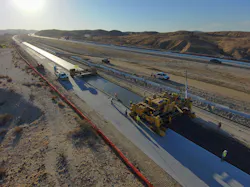
The California Department of Transportation’s (Caltrans) District 8 is nearing the end of a multi-year effort to rehabilitate Interstate 10 in eastern Riverside County, Calif., a major east-west freight corridor connecting Los Angeles and Phoenix. The work includes restoring existing pavement, upgrading ramps, improving safety systems and constructing a new truck climbing lane.
Because I-10 is one of Southern California’s most important freight routes, Caltrans placed a high priority on selecting a pavement strategy that could withstand heavy loading, extreme desert conditions and long-term maintenance demands. The result: a major rehabilitation program centered on jointed plain concrete pavement (JPCP), designed to provide a service life of more than 40 years with reduced maintenance needs.
The I-10 rehabilitation program was proposed in 2015 and funded by California’s Senate Bill 1, the Road Repair and Accountability Act of 2017, which supports transportation infrastructure improvements statewide through fuel tax and vehicle registration fee revenues.
In total, the project includes rehabilitation of 262 lane miles at an estimated cost of $692 million, including $160 million for concrete pavement and $86 million for hot mix asphalt (HMA).
Using a combination of contracting methodologies, the concrete pavement rehabilitation is being completed through full-depth reconstruction and concrete overlays ranging from 12 inches to 14.5 inches thick.
The overall program was divided into three major segments:
- The I-10 Blythe Pavement Rehabilitation project was completed in December 2024 and covered more than 30 miles of interstate, extending east from Desert Center to the Wiley’s Well Rest Area, about 15 miles west of Blythe. Concrete pavement work covered 120 lane miles. The segment also included new guardrail systems, beautification elements and other safety enhancements. The segment cost was $267 million, including $67 million for concrete paving and $37 million for HMA.
- The I-10 Desert Rehab project, completed in December 2025, covers nearly 14 miles east of Coachella in Riverside County, south of Joshua Tree National Park. Concrete pavement rehabilitation covers 54.4 lane miles. The total segment cost was $193 million, including $43 million for concrete paving. A new truck climbing lane is a major component of the Desert Rehab project. Along the section that includes the climbing lane, a new traffic lane was added to the inside of the roadway, allowing the outside lane to function as the climbing lane. Both the new inside lane and the new 10-foot inside shoulder were constructed with JPCP.
- The easternmost segment began in early 2024 and is currently under construction. It extends from just west of Wiley’s Well Rest Area to the Arizona state line. This segment includes 88 lane miles of rehabilitation at a total cost of $232 million, including $50 million for concrete paving and $49 million for HMA.
Originally constructed between 1966 and 1968, this four-lane freeway operates in a desert environment marked by summer high temperatures that can reach 125 degrees Fahrenheit and winter lows that can fall to 35 degrees Fahrenheit. The corridor carries an average daily traffic volume of about 35,000 vehicles, with trucks making up approximately 35% of the traffic stream.
Selecting the Pavement Strategy
Caltrans District 8 Materials Engineering conducted site-specific field exploration and laboratory testing, which supported the recommendation to reconstruct key sections with JPCP.
During early project development, Caltrans also completed a value analysis study that evaluated drainage, staging, constructability and pavement alternatives.
“While the value analysis study showed that some hot mix asphalt alternatives had lower initial costs, these alternatives resulted in reduced long-term performance. The study ultimately supported maintaining a concrete pavement strategy while optimizing construction staging,” said Parwaz Khasraw, who served as a materials/pavement engineer for Caltrans District-8 at the time and currently serves as a senior transportation engineer, District 8 Design Division, Caltrans.
Additionally, Caltrans’ Pavement Management System indicated that some asphalt sections had required rehabilitation approximately every five years over the past three decades, further influencing the decision.
“This situation was weighing heavily on the maintenance budget and on the field staff who needed to maintain the road,” said Michael Ristic, District 8 maintenance engineer.
Caltrans evaluates pavement condition using its Pavement Management System for federal MAP-21 reporting, along with its traditional condition categories: major structural distress, minor structural distress, minor surface distress, no distress and poor ride quality (International Roughness Index values greater than 171).
A life-cycle cost analysis (LCCA) was conducted during the pavement design phase to compare alternatives across a long-term analysis period.
“Given limited transportation funding, Caltrans prioritizes cost-effective and efficient solutions across the full lifecycle of infrastructure,” Ristic said. “This responsibility begins at the initial capital cost and extends to the later maintenance and operations costs, throughout the entire life of the pavement.”
For the I-10 project, the LCCA used an analysis period of 55 years and compared flexible, rigid and composite pavement types, rehabilitation strategies, 20-year versus 40-year design lives and implementation strategies, including whether widening and rehabilitation projects should be combined or constructed separately.
Although JPCP carried a higher initial construction cost in some comparisons, the analysis showed it to be the most cost-effective option over time. The benefits included reduced maintenance frequency, improved durability under heavy truck traffic and stronger performance in the desert environment. By contrast, HMA alternatives would have required multiple rehabilitation cycles during the same period, increasing total life-cycle costs.
“Based on the LCCA results, along with the proven performance of concrete pavement on Interstate 40 in a similar desert environment over the past 25 years, concrete was selected,” Ristic said.
Charles Stuart, executive director of the Southwest Concrete Pavement Association, noted that on the I-10 Desert Rehab project, Caltrans project data showed the asphalt option was 47% more expensive than the JPCP option over the 55-year analysis period.
Concrete Construction Approach
One strategy Caltrans evaluated was overlaying the existing HMA pavement with concrete, commonly known as white topping. Field investigations showed, however, that the existing HMA pavement varied in thickness and did not consistently meet structural requirements for long-term HMA overlay.
Instead, the HMA was determined to be suitable for reuse as a base beneath the new concrete pavement. A deflection study was used to evaluate in-place structural capacity and support this approach.
At bridge locations and other constrained areas, full reconstruction was used instead of overlay to maintain vertical clearances. Because a concrete overlay raises the pavement elevation, transitions were incorporated to maintain a smooth profile and meet clearance requirements.
“This approach allowed us to preserve the existing pavement where feasible, reducing excavation, haul quantities and construction time, while still achieving the long-term performance objectives,” Khasraw said.
Fisher Sand & Gravel also developed a value engineering cost proposal that shortened the construction schedule and eliminated the need to widen 44 bridges. The original plan called for widening the existing roadway along the inside lane, which would have required a 30-mile split-lane detour through the work zone and bridge widening at dry washes.
After reviewing the plans, Fisher proposed constructing temporary culvert crossings over the dry washes instead of widening the bridges. The project team also revised the sequence of operations, allowing JPCP paving to begin earlier than originally planned. Larger, more continuous work areas improved production and reduced staging conflicts.
“The changes represented a savings of roughly $20 million dollars, and reduced the schedule by 125 days,” said Josh Alves a project manager for Fisher Sand & Gravel. “But the most significant improvement was to project safety. By building a temporary two-lane road over the ditches, access was maintained for emergency vehicles in the event of an accident, improving safety for the traveling public. It also moved detour traffic away from construction work zones, protecting workers.”
Concrete also proved competitive from a construction standpoint. Because I-10 is a heavy truck corridor, an asphalt alternative would have required a thick section. Staging also allowed traffic to be removed from the roadway, enabling wider concrete paving operations.
“All three projects were scoped with concrete pavement, and competitive bids were received below the established budgets,” said Armando Garcia, construction manager, Alternative Delivery, Coffman Specialties. “One reason for this is, being a truck corridor, asphalt pavement would have needed to be thick. So, volume-to-volume, concrete was competitive. Also, staging was used to remove traffic from the roadway, allowing concrete to be placed at greater widths. By placing the concrete in a 39-foot width, labor and time savings were achieved, resulting in cost savings.”
Recognition for the Corridor
The project has already earned several industry honors. The California Transportation Foundation recognized the I-10 Blythe Pavement Rehabilitation project with an Emergency Response and Repair Award at its 34th Annual Transportation Awards. The same segment was later named Freeway/Expressway Project of the Year in the 36th Annual California Transportation Foundation Awards program.
The overall I-10 Pavement Rehabilitation Project received national recognition from the American Concrete Pavement Association, winning in the Divided Highways, Rural category of the 36th Annual Excellence in Concrete Pavement Awards. The Southwest Concrete Pavement Association also honored the project with an Outstanding Achievement in Concrete Paving Award.
For Caltrans District 8, the I-10 rehabilitation program represents more than a pavement replacement effort. It is a long-term investment in one of California’s most important freight corridors, combining life-cycle cost analysis, field investigation, constructability improvements and concrete pavement design to improve reliability across a demanding desert route.
Kristin Dispenza is a senior account manager at Advancing Organizational Excellence.