Closing the Loop on Raleigh’s Outer Beltway
By Michael Alford, Contributing Author
Raleigh’s ascent as one of Amercia’s fastest growing cities has brought excitement and challenges to North Carolina’s capital. With thousands of new residents arriving each year, the Triangle, which is the metropolitan area anchored by Raleigh, Durham and Chapel Hill, along with the surrounding suburbs and Wake County communities, faces unprecedented growth in housing, commercial development and daily traffic volumes.
To keep pace, planners have had to balance expansion with the need to strengthen the region’s transportation network. The construction of the Interstate 540 Outer Loop — the North Carolina Department of Transportation’s (NCDOT) decades-long effort designed to connect the Triangle and streamline commutes across the metropolitan area — has been one of the most significant developments.
Now, with the final segments of the I-540 Outer Loop under construction and scheduled for completion in 2028, NCDOT’s effort to fully encircle Raleigh is entering its most critical phase. The project represents one of the largest transportation investments in the region’s history, designed to relieve congestion, improve regional connectivity and support continued population and economic growth. The following work — from complex joint-venture construction to environmental coordination and utility relocation — reflects the scale of the challenge and the importance of completing the Triangle’s outermost transportation link.
The first highway loop around Raleigh, known as 440 or the “Beltline,” was finished more than 40 years ago. As the area grew, the need for a second, larger loop was identified as a necessity to help connect Raleigh’s suburbs.
That second loop, now called Interstate 540 or the Raleigh Outer Loop, opened its first section in 2007. Between approximately 1999 and 2001, S.T. Wooten constructed a non-toll section of I-540 near North Carolina Highway 50, contributing early to the development of the outer loop.
About 15 years ago, S.T. Wooten also built a 3.4-mile stretch of the Triangle Expressway — then called the Triangle Parkway. This toll road connects the Durham Freeway (North Carolina Highway 147) to the Raleigh Outer Loop.
When the Raleigh Outer Loop is complete, it will span roughly 70 miles. The last 6-mile stretch is under construction, marking a major milestone in closing one of the region’s vital transportation gaps.
Joint Venture
NCDOT awarded the contract for the final phase of the Outer Loop construction — Phase 2 of the Southeast Extension R-2829A — to a joint venture between Branch Civil and S.T. Wooten. A neighboring segment, which was awarded only a couple months earlier, running from Rock Quarry Road to I-540/Interstate 87/U.S. Route 64/U.S. Route 264 (R-2829B), is being delivered by a separate joint venture between Flatiron Construction and Fred Smith Company.
Branch Civil and S.T. Wooten are leading the $287 million design-build project (R-2829A), which runs from Interstate 40/U.S. Route 70 (future Interstate 42) to south of Rock Quarry Road. Supported by engineering partners RK&K and STV, the team is constructing 12 bridges, 10 concrete box culverts, tolling structures and performing extensive grading, storm drainage and utility work along the corridor.
Dealing with Delays
The Branch Civil/S.T. Wooten joint venture project was awarded in 2023 and design work kicked off in 2024. Delays tied to another segment of I-540 temporarily slowed construction progress, but the pause allowed the team to align processes and establish strong collaborative workflows.
“We’ve put a consistent meeting cadence in place, including weekly design and operations meetings and bi-weekly DOT meetings,” said S.T. Wooten’s Project Manager Brian Narron. “That structure allows us to stay aligned and quickly shift resources as needed to keep work moving.”
Construction officially ramped up following a May 2024 groundbreaking. By late 2025, most clearing activities were complete, with two bridges and three culverts finished and several additional structures under construction. Major utility relocations — including power, gas and communications — are ongoing at key intersections such as White Oak Road, U.S. 70 and East Garner Road.
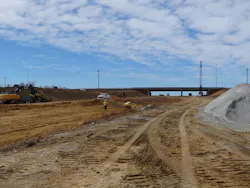
In total, the project includes 4.6 miles of new roadway and more than 3 million cubic yards of earthwork. On any given day, roughly 50 pieces of heavy equipment — from dozers and excavators to cranes and motor graders — are actively moving soil, installing drainage systems and preparing bridge foundations.
Building Safely and Efficiently
Maintaining safety for drivers and crews is always a top priority. Detailed traffic-control plans include staged detours, clear signage and concrete barriers in higher-risk areas. Work that involves lane closures or operations over traffic at the I-40/I-42 interchange is being performed at night to minimize commuter disruption, with similar nighttime operations planned for bridge construction over U.S. 70.
On the ground each day, roughly 200 workers from Branch Civil, S.T. Wooten and their network of subcontractors are pushing the project forward. Close communication will be important between the crews as workforce peaks in coming years for bridge work and paving operations.
“The collaboration among all the different teams — contractors, engineers, NCTA and oversight agencies — is what keeps this project moving smoothly,” Narron said. “Everyone recognizes how important this link is for the Triangle’s future mobility.”
Keeping Up the Pace
While communication is key for onsite crews, maintaining progress has also required close coordination with utility providers, environmental agencies and private landowners, as the corridor passes through multiple municipalities.
“Utility relocations are always one of the biggest challenges on a project of this scale,” Narron said. “We’re coordinating with Duke Energy, Spectrum, AT&T and several gas providers across dozens of locations. So far, everyone’s progressing well.”
Environmental stewardship is another major focus. The joint venture manages more than 30 permit-regulated sites, each reviewed by the North Carolina Department of Environmental Quality (NCDEQ) and the U.S. Army Corps of Engineers. These include several jurisdictional streams, creeks and wetlands that require strict erosion control and monitoring throughout construction. Field conditions are inspected regularly by both agencies as well as on-site staff from the N.C. Turnpike Authority (NCTA).
Severe weather events, including Tropical Storm Chantal, have also informed design decisions.
“We factor historic flood levels and rainfall intensity into bridge and culvert designs,” Narron said. “That ensures structures are resilient to both current and future conditions.”
Connecting Communities
As part of the project, five new interchanges will be added in conjunction with the R-2829B Southeast Extension — at White Oak Road, U.S. 70, Rock Quarry Road, Auburn-Knightdale Road and Poole Road. Each is designed to improve connectivity between neighborhoods, schools and businesses across southeast Wake County.
The project also includes major improvements to local roads that tie into the new expressway:
- White Oak Road will be widened and rerouted over I-540.
- Raynor Road will be realigned to meet White Oak Road via a new roundabout.
- U.S. 70 will be widened, easing congestion for east-west travelers.
- East Garner Road will be realigned and pass under I-540, with the new expressway bridging over both the road and the adjacent railroad tracks.
While some individual properties and businesses were acquired early in planning, no established neighborhoods fell within the final construction footprint.
“About 15 homes scheduled for demolition were purchased long ago by NCTA as part of the project’s right-of-way strategy,” said Narron.
Looking Ahead
Like other sections of the I-540 Outer Loop, the new segment will operate as a toll facility managed by the NCTA. Tolling revenue helps fund ongoing maintenance and debt repayment, making the highway financially self-sustaining without relying solely on tax-based funding. It also enables future expansions and improvements without draining the state’s general transportation budget.
For drivers, the payoff will be faster travel times and fewer bottlenecks on existing routes such as I-40, U.S. 70 and I-440. The loop also provides a direct, efficient bypass for freight carriers to avoid the region’s urban core — a critical advantage as Raleigh and the broader Triangle region continue to attract industrial and logistics investment.
“We’re proud to be a contributing partner in the final phase of a roadway that has been strategically planned over decades,” said Narron. “This loop is a true asset in connecting Wake County and the greater Raleigh-Cary metro area – for commuters, families, businesses and visitors alike.”
When the final stretch opens, the I-540 Outer Loop will stand as a generational achievement for the Triangle, demonstrating how proactive infrastructure planning can support long-term regional growth. By improving connectivity and easing pressure on existing routes, the extension is expected to deliver immediate benefits for travelers while supporting the balanced, sustainable advancement that continues to define the region’s appeal.
Michael Alford is a vice president of S.T. Wooten Corporation, overseeing its heavy highway and utilities groups.
Supported by Quickrete