Inside Western North Carolina’s Historic Highway Recovery After Hurricane Helene
Key Highlights
- Hurricane Helene dumped 31 inches of rain in three days, washing away roads, bridges and utilities across western North Carolina.
- More than 2,000 NCDOT employees, contractors and utility crews worked around the clock to build temporary roads and bridges, reconnecting communities like Bat Cave and Chimney Rock.
- While more than 99% of storm-damaged roads have reopened, permanent reconstruction along U.S. 64 is expected to continue through 2029.
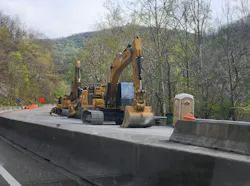
When Hurricane Helene unleashed historic flooding across western North Carolina in September 2024, it didn't just damage roads. It erased them.
More than 31 inches of rain fell in just three days, sending rivers far beyond their banks and destroying roads, bridges and homes across the region. The Swannanoa River, which typically reaches flood stage at about 10 feet, surged to more than 26 feet.
It was the most destructive storm to hit western North Carolina's infrastructure in recorded history.
Entire sections of Interstate 40, Interstate 26 and several U.S. highways were damaged, but one corridor quickly became a symbol of the region's recovery: U.S. 64 between Bat Cave and Chimney Rock.
For residents, it wasn't simply another road. It was the connection to work, school, emergency services and the outside world.
"It was completely destroyed," Bat Cave resident Eric Eastridge told WCNC. "Life is getting back to normal, but it's going to take a long time."
In the days after the storm, getting anywhere became nearly impossible.
"We weren't able to get anywhere for quite a while," Eastridge said, according to WCNC.
A Race to Reconnect
The devastation stretched far beyond the highway. More than 6,900 damaged road and bridge sites resulted in over 1,400 closures, according to Roads & Bridges. More than 1,700 cell towers across North Carolina, South Carolina and Georgia went dark, over one million people lost electricity, and many communities around Asheville were left without functioning water or sewer systems.
Restoring access became the North Carolina Department of Transportation's top priority.
More than 2,000 NCDOT employees, alongside consultants, contractors and utility crews from multiple states, joined the recovery effort. Existing transportation projects were paused so crews could focus on reopening roads and restoring power and communications.
Teams often worked from before dawn until well past midnight, holding daily safety meetings while navigating washed-out roads, landslides, downed power lines and limited cell service, according to Roads & Bridges.
Rather than waiting years for permanent construction, crews first built temporary roads and bridges to reconnect isolated communities.
Building While Traffic Keeps Moving
One of those temporary connections now carries traffic once again between Bat Cave and Chimney Rock.
"The connection here from Bat Cave to Chimney Rock is really important for the community, for tourists, for those that have businesses here, but also those that live here and are traveling in and out daily," NCDOT engineer Nathan Moneyham told WLOS.
The work, however, is far from finished.
Engineers are still finalizing permanent designs, securing environmental permits and negotiating construction costs before major rebuilding can begin along the corridor, according to WLOS. Construction also has to be carefully coordinated because residents and businesses continue using the roadway every day.
"We still have to maintain traffic in this area," Moneyham told WLOS. "These businesses are open. Folks live here."
Signs of Life Returning
Despite those challenges, progress has been significant.
More than 99% of the roads closed by Hurricane Helene have reopened, and roughly 8,500 of the more than 9,000 damaged sites have already been repaired, according to WCNC.
"Helene recovery has been the department's No. 1 priority and will remain our top priority until the work is complete," NCDOT Secretary Daniel Johnson said, according to WCNC.
The reopened route has also helped local businesses begin to recover.
"We are very happy to see that there's a lot of customers from the past coming back," Maggie Almanzar, owner of Chimney Factory Outlet, told WLOS. "The new ones, they just want to see the progress in Chimney Rock."
The Long Road Ahead
Johnson acknowledged that while thousands of recovery projects have been completed, the remaining ones are among the most difficult.
"It's remarkable how much we've got done," Johnson told WLOS. "We've just got some bigger, more complex projects to complete over the next couple of years."
Permanent reconstruction of the U.S. 64 corridor is expected to be finished by the end of 2029, according to WCNC.
For Eastridge, the rebuilt roadway represents more than a transportation project.
"To see people in Chimney Rock having their businesses up is just a great thing," he told WCNC. "Part of me wondered if it was ever going to come back."
The river may never look the way it once did, he said, but the return of the road is proof that even after one of North Carolina's worst natural disasters, communities can begin moving forward, one mile at a time.
Sources: WCNC, WLOS, Roads & Bridges
About the Author
 Karina Mazhukhina, Digital Content Specialist
Karina Mazhukhina, Digital Content Specialist
Digital Content Specialist
Karina Mazhukhina has extensive experience in journalism, content marketing, SEO, editorial strategy, and multimedia production. She was previously a real-time national reporter for McClatchy News and a digital journalist for KOMO News, and ABC-TV affiliate in Seattle.