Spanning History: Four Bridges That Changed America
Bridges are central to the story of America.
They serve as a backdrop to some of the country’s most recognizable events, as a marker for technical development, and as a symbol of our achievements.
Though it would be impossible to list every bridge that is significant to our country’s history, Roads & Bridges is taking you for a deep dive into four bridges that are inseparable from the American experience.
Brooklyn Bridge – Brooklyn, N.Y.
On May 24, 1883, a star was born.
Standing tall as a symbol of the country’s largest metropolis, the Brooklyn Bridge connects the city’s two most popular boroughs—Manhattan and Brooklyn—over the East River.
To celebrate its opening, schools and businesses closed its door to remark at what remains today as the unofficial Eighth Wonder of the World.
At the time of its construction, the Brooklyn Bridge was the longest suspension bridge in the world, a true engineering marvel of the 19th century. The crossing shattered all of the world records at its time for span length and its towers stood higher than New York’s tallest office building, according to the American Society of Civil Engineers (ASCE).
The Brooklyn Bridge is the most famous project designed by the German-born American civil engineer John A. Roebling. He utilized a hybrid cable-stayed/suspension bridge design that was considered ambitious for the time. The original structure was constructed of iron but later switched to steel to reduce the dead load weight, ASCE reported.
Today, the bridge continues to carry more than 103,000 vehicles, nearly 29,000 pedestrians and over 5,500 cyclists each day.
Golden Gate Bridge – San Francisco, Calif.
The Golden Gate Bridge is the most recognizable bridge in the United States. Fulfilling a long-awaited mission to connect San Francisco to its northern neighbors, the Golden Gate Bridge is a two-mile trek across the junction of San Francisco Bay and the Pacific Ocean.
The construction of the Golden Gate Bridge is tied to the Great Depression, as it provided workers an opportunity for steady employment at a time when jobs were few and far between. Though, this job had quite some risk involved as crews constructed the roadway and towers during strong tides, deep water, heavy fog and high winds.
The bridge’s suspension design was not the original concept for the structure but became the plan later through the design process. When it was constructed in 1937, it’s 4,200-foot span broke world records for longest bridge span, and its towers stood as the tallest in the world.
The Golden Gate Bridge opened to a weeklong celebration, complete with a motorcade of 200,000 revelers that broke through three ceremonial barriers, with the first being a redwood log, the second a series of three chains—one copper, one gold and one silver—and the third was formed by a “living chain of fiesta queens,” according to the Federal Highway Administration.
The party continued into the skies, when President Franklin Delano Roosevelt ordered the release of 100 skyrockets over San Francisco, joined by the sounds of 500 aircraft. Every bell, siren and horn in the city rang out.
Edmund Pettus Bridge – Selma, Ala.
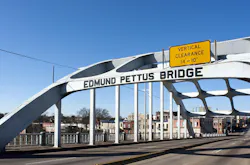
While many bridges’ significance marks a celebratory time in our history, the Edmund Pettus Bridge’s legacy is of a different vein.
Named after Confederate general and grand dragon of Alabama’s Ku Klux Klan, the Edmund Pettus Bridge stands as the backdrop to a dark moment in our country’s history — home to the deadly Bloody Sunday march.
Though the Civil Rights Act of 1964 had been passed months earlier, the law was in name only, and was not in practice in many southern states, prompting civil rights protesters to lead a peaceful march from Selma, Ala., to the state capital of Montgomery to demand voting rights from the governor himself.
When the marchers reached the Edmund Pettus Bridge on March 7, 1965, they were met with violent force by state troopers.
The showdown sent shockwaves through the country, putting Selma on the map as the stage of the ongoing civil rights crisis. Martin Luther King, Jr. attempted another march days later that came to a halt when troopers again blocked the highway at the Edmund Pettus Bridge.
Marchers were finally able to pass on March 21, protected under court order and escorted by federalized National Guard troops, and reached Montgomery four days later with a crowd of 25,000 people.
Their bravery is credited with helping secure the passage of the Voting Rights Act of 1965, enshrining voting rights protections into federal law.
Eads Bridge – St. Louis, Mo.
The first major bridge to cross the Mighty Mississippi still stands in St. Louis, Mo., today. Constructed at a time when railroad traffic was becoming increasingly predominant, the Eads Bridge was built to maintain St Louis’ position as a regional commercial hub, according to the American Society of Civil Engineers (ASCE).
Following the Civil War, James Buchanan Eads was tasked with building his namesake bridge. Though he had never constructed a bridge before, the self-educated engineer had been selected by Washington to construct several Ironclad gunships in a mere 65 days, according to the city of St. Louis.
The ASCE reports numerous challenges throughout its construction, including political and financial divides, shipwrecks, ice storms and tornadoes. Some 14 men died due to caisson disease, a decompression sickness that occurs from the rapid change of pressure when working in underwater foundation chambers.
Opened in 1874, the structure is the world’s first steel-truss bridge. Betting on its stability, fifteen 50-ton train engines packed with coal, water and passengers crossed the Eads Bridge to mark its opening to the public.
Bridges to the Past
Though countless bridges have helped shape the story of the United States, these four stand apart for the ways they reflect American progress, conflict and ambition. Together, they show how bridges can do more than connect places; they can mark turning points in the nation’s engineering, cultural and political history.
About the Author
 Jessica Parks, Staff Writer
Jessica Parks, Staff Writer
Staff Writer
Jessica Parks is a staff writer at Roads & Bridges with newsroom experience in Brooklyn, Long Island and the U.S. Virgin Islands, and several years spent living in Puerto Rico. She is currently based in Tulsa, Oklahoma.