Aging Washington Bridges Near Tipping Point as Repair Costs Top $9.2 Billion
Key Takeaways
-
342 Washington bridges are now at least 80 years old, with an estimated $9.2 billion needed to replace them.
-
WSDOT manages 3,427 bridges, and 9.9% were rated in poor condition as of June 2025, up from 8.5% the previous year.
-
Officials say delayed preservation work, including skipped repainting and deck sealing, has sped up deterioration on bridges like the Fairfax Bridge and Hansen Road overpass.
-
Gov. Bob Ferguson proposed a $2.1 billion, 10-year bridge preservation plan, but lawmakers disagree on how to use the funds.
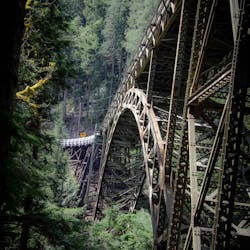
Washington’s bridges are getting older, and state officials say the cost of waiting is climbing fast.
On Feb. 19, transportation leaders told the Washington State Transportation Commission that 342 of Washington’s bridges are now at least 80 years old, according to the Center Square.
Replacing those aging structures would cost an estimated $9.2 billion.
The Washington State Department of Transportation (WSDOT) manages 3,427 bridges statewide. The oldest was built in 1915. The average bridge age is now 51.7 years, edging closer to the typical 75-year lifespan for similar structures.
As of June 2025, 9.9% of state-owned bridges were rated in poor condition — up from 8.5% in June 2024, according to the Center Square. By comparison, only 4.8% of the 4,346 bridges owned by cities, counties and other entities are rated poor.
According to the news outlet, WSDOT Bridge Engineer Evan Grimm told commissioners that a “poor” rating does not necessarily mean a bridge is unsafe, but it does make repairs more expensive the longer they’re delayed.
“The preservation need isn’t changing,” Grimm said. “The problems we’re seeing aren’t going anywhere.”
A System Stretched Thin
James Morin, WSDOT’s maintenance operations manager, told the Center Square that crews are increasingly responding to potholes and urgent overnight issues, pulling them away from long-term preservation work.
He compared the situation to a homeowner trying to stretch a 35-year roof to last 50 years.
“You’re going to end up with a blue tarp on the roof in the middle of a storm, right? Your neighbors are all going to be upset, and the homeowner association is going to get after you,” Morin said. “And, unfortunately, we really are in the situation where we have … a blue tarp situation around the state.”
Morin said bridge decks should be resealed every three to five years to prevent contaminants from entering the substructure. Instead, limited staffing has forced WSDOT to prioritize preventive maintenance on newer bridges while crews repair damage on older ones.
Grimm described the cumulative impact as a “downward spiral.”
“We’re playing wack-o-mole,” he said, referring to the cycle of responding to emergencies as they arise.
The Fairfax Bridge Example
Grimm pointed to the Fairfax Bridge as a clear example of deferred maintenance consequences.
The bridge, a key gateway to Mount Rainier, was closed in April 2025 after decades of deferred maintenance, according to the Center Square.
Grimm said routine repainting every few years would have prolonged the structure’s life. But preservation funding was allocated to other priorities, even though officials knew the bridge was deteriorating.
“This shows how rapid the deterioration was happening,” he told commissioners. “We don’t know exactly when it’s going to happen. We can’t predict, but we saw it right in front of our eyes. It’s just very quickly deteriorating.”
Repainting the bridge in 2013 would have cost about $5 million or more, Grimm said. Now, taxpayers are potentially facing a $160 million replacement project.
Morin cited another example: the Hansen Road overpass, which WSDOT closed last month after it went three decades without being sealed, according to the Center Square.
National Context
Washington’s situation reflects a broader infrastructure challenge nationwide.
More than 41,000 bridges across the United States — roughly 6.7% of the total inventory — were rated in poor condition as of 2024, according to Federal Highway Administration data compiled by Equipment World.
Nearly 221,800 bridges nationwide require major repair or replacement — representing more than a third of U.S. bridges, according to a report by the American Road & Transportation Builders Association.
Engineers note that a “poor” rating does not automatically signal imminent danger, but it does indicate that significant rehabilitation or replacement will be needed.
Funding and Political Debate
At the end of last year, Gov. Bob Ferguson announced what he called a historic $2.1 billion preservation budget for the next decade, just days after visiting local officials regarding the Fairfax Bridge.
About $1.1 billion would go toward bridge preservation, though none is currently earmarked specifically for Fairfax, according to statements from the governor’s office and reporting by the Center Square
Republican lawmakers argue the funding has long been available. They’ve criticized the Democratic majority for directing revenue from the state’s Climate Commitment Act toward fish passage projects and electrifying Washington’s ferry fleet, while limiting its use for most highway and bridge projects.
Commissioners said WSDOT’s presentation shows the state is “at a tipping point.” They said it’s time for “hard conversations” about how Washington manages — and pays for — its aging bridge system.
Without sustained investment in preservation, officials warned, more bridges could follow the path of Fairfax, where a relatively modest maintenance project left undone ultimately turned into a nine-figure replacement.
About the Author

Karina Mazhukhina, Digital Content Specialist
Digital Content Specialist
Karina Mazhukhina has extensive experience in journalism, content marketing, SEO, editorial strategy, and multimedia production. She was previously a real-time national reporter for McClatchy News and a digital journalist for KOMO News, and ABC-TV affiliate in Seattle.