Whether a bridge lasts 100 years or needs major rehabilitation long before then often comes down to decisions made before any steel is erected. How water drains off the structure, which corrosion-protection system engineers specify and how carefully crews prepare the surface in the field all shape how long that protection holds up.
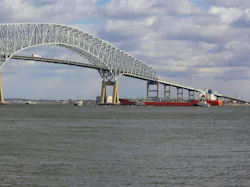
Those decisions are being made now on bridge projects that were funded by the Infrastructure Investment and Jobs Act (IIJA), which Congress extended to Dec. 11 while it (hopefully) works on a successor law. They're also being made in Baltimore, where the Maryland Transportation Authority is rebuilding the Francis Scott Key Bridge.
Ernst Toussaint is a P.E. and vice president of civil infrastructure at the Association for Materials Protection and Performance (AMPP), where he works with state departments of transportation to align AMPP's standards with agency specifications. Formed through the merger of NACE International and SSPC, AMPP develops corrosion and coatings standards and certifies inspectors and accredits contractors whose credentials appear in many DOT bridge specifications.
In this email Q&A, Toussaint explains why corrosion protection belongs at the start of design, which avoidable mistakes shorten coating life, and why a shortage of qualified inspectors could undercut today's bridge investment.
R&B: Corrosion protection is often something that gets discussed after the structural design is already established. How early in a bridge project should DOTs and engineers be thinking about corrosion, and what decisions made during design and material selection have the greatest impact on a bridge's long-term durability?
Ernst Toussaint: Corrosion protection should be considered at the very beginning of a bridge project. The ideal time is during the conceptual and preliminary design stages, not after the structural design is complete. Once materials, details, connections, drainage, and access have been established, many of the most important durability decisions have already been made.
The greatest impact comes from taking a full life cycle management approach to corrosion mitigation. During design and material selection, DOTs and engineers should consider the bridge’s environment, expected service life, thermal cycles, exposure to moisture, chlorides and deicing salts, and the accessibility of components for future inspection and maintenance.
Material selection is particularly important, but it is only part of the equation. Details that minimize water and debris accumulation, provide adequate drainage, avoid crevices and moisture traps, and allow for effective inspection and coating maintenance can significantly extend service life. The selection of the appropriate corrosion protection system, whether coatings, weathering steel, metalizing, galvanized steel, or a duplex system, should be based on the exposure conditions and the desired service life rather than initial cost alone.
Perhaps most importantly, corrosion protection should be incorporated into the project’s life cycle cost and asset management strategy. A system that costs slightly more during construction may substantially reduce maintenance, traffic disruption, and rehabilitation costs over the long term.
In short, the best time to address corrosion is before the bridge is built. Designing for durability from the outset gives DOTs the greatest number of options and the greatest opportunity to reduce long-term costs while improving the reliability and service life of our infrastructure.
R&B: DOTs are under pressure to stretch infrastructure dollars and get the most life possible out of existing bridges. Where do you see agencies making avoidable mistakes when it comes to coatings, corrosion protection and inspection—and what can they do differently?
ET: One of the biggest avoidable mistakes is waiting until corrosion becomes a significant problem before taking action. When budgets are tight, it can be tempting to defer coating maintenance or rehabilitation, but deterioration rarely becomes less expensive to address with time; hence the importance of utilizing a corrosion curve.
A corrosion curve is a predictive graph used by engineers to track and forecast how fast a bridge's steel and concrete components will corrode and weaken over time. It visually maps out the bridge's lifespan, showing how protective coatings slowly break down until reaching their Practical Service Life (PSL) – the critical threshold where 5% to 10% localized failure occurs. Past this point, rust accelerates, cracking concrete and thinning critical steel sections and structural supports. This curve matters immensely for maintenance because it allows asset owners and engineers to identify the PSL and shift from reactive fixes to proactive planning. Going too far beyond this PSL can greatly exacerbate corrosion issues; missing this window means small coating failures and localized corrosion rapidly escalate into much more extensive and costly repairs.
Another common mistake is treating inspection, coatings and corrosion protection as separate activities. Inspection findings should guide maintenance decisions and identify problems early, while coating systems should be selected and maintained based on actual exposure conditions and expected service life.
Agencies should also emphasize surface preparation, coating application and quality control during construction or rehabilitation. The majority of coating failures are associated with improper or inadequate surface preparation. Even a high-quality coating system can underperform if surface preparation is inadequate, environmental conditions are not properly controlled or the coating is not applied to specified requirements. Well-written specifications, qualified contractors and inspectors, and appropriate quality assurance and quality control practices can significantly reduce premature failures.
Finally, DOTs should look beyond the lowest initial cost and consider life-cycle costs, including durability, inspection requirements, maintenance intervals, traffic impacts and future rehabilitation. The goal should be to move from reactive maintenance to proactive corrosion management by addressing deterioration early and using inspection data to plan maintenance before problems become major rehabilitation projects.
R&B: The Francis Scott Key Bridge rebuild has put a tremendous amount of attention on Baltimore's transportation infrastructure. Without getting into the specifics of an ongoing project, what corrosion-protection and materials decisions should engineers and DOTs be thinking about when rebuilding a major bridge that is expected to serve for the next century?
ET: When a major bridge is expected to serve the community for the next century, engineers and DOTs need to think beyond initial construction and design to the structure's entire service life. Corrosion protection should be treated as an integral part of the bridge design and asset-management strategy, not as a coating decision to be made at the very end of the project.
The first consideration is the environment and exposure conditions. Engineers should evaluate chloride exposure, marine environments, humidity, temperature, thermal cycles, pollution, drainage and other factors that can accelerate corrosion. Material selection and corrosion-protection systems should then be matched to those conditions and to the desired service life.
Material selection should also consider durability and redundancy. Depending on the application, that may include appropriately selected structural steels, high-performance coatings, galvanized components or duplex systems. No single material or protection system is appropriate for every component or exposure condition.
Just as important is the design of the details. Connections, cables, joints, drainage, back-to-back angles, crevices, edges and areas where water or debris can collect should be designed to minimize corrosion and provide access for inspection, maintenance and recoating when necessary. A bridge designed for a 100-year service life should also be designed so that its corrosion-protection systems can be effectively maintained throughout that period.
Finally, agencies should incorporate inspection, maintenance and life-cycle costs into the original design decisions. The question should not simply be, "What will this cost to build?" but "What will it cost to own, inspect, maintain, and rehabilitate over the next 100 years?"
A century-long service life requires a century-long mindset. The most durable bridge is not necessarily the one with the most expensive materials; it is the one where materials, corrosion protection, structural detailing, inspection, maintenance and life-cycle planning are integrated from the beginning.
R&B: IIJA has put a huge amount of bridge work into the pipeline, but the industry also faces a shortage of experienced coating inspectors and other preservation professionals. How significant is that workforce challenge, and what happens to bridge durability when agencies and contractors don't have enough qualified people to inspect and maintain these systems properly?
ET: The workforce challenge is significant and a critical issue that could limit the long-term value of today's infrastructure investment. Having the funding to repair or replace bridges is only part of the overall equation. We also need enough qualified professionals who understand coatings, corrosion, pre-surface preparation, surface preparation, inspection and quality control to ensure that the work is performed correctly.
The durability of a bridge preservation project depends on much more than specifying the right coating system. It depends on proper pre-surface preparation, surface preparation, application, environmental controls, quality assurance and quality control throughout the work. Qualified contractors, qualified inspectors and preservation professionals are the people who make sure those requirements translate from the specification into what is actually installed in the field.
With the level of infrastructure investment generated by IIJA, we have an enormous opportunity to extend the service life of the nation's bridges. But increasing the volume of work also increases demand for a skilled workforce that was already strained. If agencies and contractors cannot put enough properly trained and qualified people on these projects, the result may be project delays, escalating costs and performance risks. Deficiencies can be missed during construction and may not become apparent until years later, when premature coating failure and renewed corrosion require intervention.
That creates a compounding effect. A coating system that should provide decades of protection may require maintenance or rehabilitation much earlier than anticipated. Agencies then have to spend limited transportation dollars to address problems much sooner, while also dealing with traffic disruptions, environmental impacts and potentially more extensive deterioration of the underlying steel.
That is why workforce development needs to be viewed as part of infrastructure investment itself. We need to attract people to the corrosion-control and coatings professions, provide accessible pathways for training and certification, and continue developing the skills of the professionals already in the field. At AMPP, we see qualified contractors, qualified inspectors and corrosion expertise as an essential component of achieving the service life that bridge owners expect from these investments.
Ultimately, IIJA gave us an opportunity not simply to rehabilitate more bridges, but to preserve them better. The measure of success should not only be how many projects we complete with this funding, but how long those investments perform for the public.
About the Author
 Gavin Jenkins, Head of Content
Gavin Jenkins, Head of Content
Head of Content
Gavin Jenkins is an award-winning journalist based in Pittsburgh. His work has appeared in The New York Times, The Washington Post, The Atlantic, VICE, Narrative.ly, Prevention, the Pittsburgh Tribune-Review and Beijing Review.
In 2020, two stories he wrote for Pitt Med Magazine earned three Golden Quill Awards from the Press Club of Western Pennsylvania. “Surviving Survival” won Excellence in Corporate, Marketing and Promotional Communications – Written, Medical/Health, while “Oct. 27, 2018: Pittsburgh’s Darkest Day, and the Mass Casualty Response” won Excellence in Written Journalism, Magazines – Medical/Health, as well as the Ray Sprigle Memorial Award: Magazines, a Best in Show award.
After graduating from the University of Pittsburgh at Johnstown in 2003, he covered sports for the Bedford Gazette, in Bedford, Pa., and the Martinsville Bulletin, in Martinsville, Va. In 2006, he returned to Pittsburgh to write for Trib Total Media. Based out of the Kittanning Leader Times, he worked for the Trib for two years, and then he moved to Shenzhen, China, to teach English and freelance. After two years in China, he earned an MFA in nonfiction from the University of Pittsburgh.
When he's not at work, he's usually playing with his border-collie mix, Bob.