The Benjamin Franklin Bridge and Modjeski’s Legacy
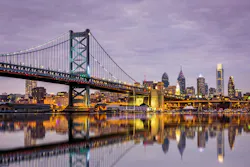
The Ben Franklin Bridge opened to traffic on July 2, 1926. Spanning the Delaware River between Philadelphia and Camden, N.J., the suspension bridge became a vital transportation link for the growing region.
Few American bridges epitomize engineering innovation and public service like this iconic structure. As the bridge celebrates its 100th anniversary, it remains a testament to the vision and ingenuity of its designer, legendary bridge engineer Ralph Modjeski.
Modjeski's influence on American infrastructure extends far beyond the Benjamin Franklin Bridge. Widely regarded as one of the nation's most accomplished bridge engineers, he helped shape the development of long-span bridge design during a transformative period in U.S. transportation history.
Today, his legacy lives on through Modjeski and Masters, the engineering firm he founded in 1893, which continues to play a prominent role in the inspection, preservation and design of major transportation structures across North America.
To mark the centennial of the Benjamin Franklin Bridge and America’s 250th anniversary, Roads & Bridges spoke with Michael Britt, president and CEO of Modjeski and Masters.
Roads & Bridges: The Benjamin Franklin Bridge was one of the longest suspension bridges in the world when it opened in 1926. A century later, what aspects of Ralph Modjeski’s design continue to impress engineers today, and what does the bridge teach us about designing infrastructure for the long term?
Michael Britt: Ralph Modjeski’s design continues to stand out for its balanced approach to strength, redundancy, adaptability and aesthetics. The Benjamin Franklin Bridge was engineered with conservative load assumptions and robust materials, allowing it to accommodate highway and rail traffic volumes far beyond what was originally envisioned. Its structural design and detailing have contributed to long-term resiliency, while its adaptability has enabled upgrades without compromising its integrity and iconic place in the Philadelphia skyline.
Modjeski’s design teaches us that long-term infrastructure planning requires anticipating growth, building in redundancy and making room for future maintenance and modernization. Those same principles remain just as relevant today.
RB: Modjeski and Masters has had a relationship with the Benjamin Franklin Bridge that spans generations. What does it mean for your firm to still be involved in the inspection and maintenance of a structure designed by your founder, and how has bridge stewardship evolved over those 100 years?
MB: For Modjeski and Masters, continued involvement is a direct connection between the firm’s founding principles and today’s engineering practice. It reinforces our continuing professional relationship with the Delaware River Port Authority and their confidence in our firm’s technical expertise.
Over the past century, stewardship has evolved from periodic inspection to data-driven asset management. Today’s stewardship is far more proactive than reactive, with a focus on maximizing performance and extending service life.
RB: The bridge was built during a period when America was investing heavily in transformative infrastructure. As the nation prepares to celebrate its 250th birthday, do you see the same level of ambition today, and where do you think the next generation of landmark infrastructure projects will emerge?
MB: While the early 20th century was marked by bold, highly visible infrastructure investments, today's ambition is shaped by a more complex set of challenges. Modern projects must balance funding constraints, environmental considerations and stakeholder alignment.
That said, ambition still exists, particularly in:
- Resilient and climate-adaptive infrastructure.
- Major transit and mobility upgrades.
- Energy and grid modernization.
- Transformational urban redevelopment.
The next generation of landmark projects will likely emerge where sustainability, technology and public needs intersect.
RB: Many of America’s most important bridges are now 50, 75 or even 100 years old. From your perspective, what are the biggest challenges facing owners and engineers as they work to extend the service life of these aging assets while keeping them safe and reliable?
MB: The most pressing challenges include:
- Deterioration of materials (fatigue, corrosion, aging components).
- Increasing demand loads beyond original design assumptions.
- Funding limitations and prioritization.
- Maintaining operations during rehabilitation.
Engineers and owners must balance safety, cost, aesthetics and service continuity, often extending asset life while minimizing disruption.
Success requires thoughtful rehabilitation planning, the use of advanced materials and repair techniques and strong public engagement.
RB: If the Benjamin Franklin Bridge serves as a symbol of America’s engineering achievements during its first 250 years, what should the infrastructure community focus on over the next 25 to 50 years to ensure future generations inherit an equally strong legacy of innovation, resilience and public investment?
MB: Looking ahead, the infrastructure community should focus on:
- Resilience: Designing for climate change and extreme events.
- Sustainability: Reducing carbon footprint across lifecycle.
- Investment discipline: Securing consistent, long-term funding.
- Equity and access: Ensuring infrastructure serves all communities.
The goal is to build systems that are not only durable, but also adaptable, efficient, and accessible.
RB: Ralph Modjeski helped define an era of American bridge building and mentored generations of engineers. Looking back at his influence and the firm's history, what qualities do you think today's infrastructure leaders need to navigate the challenges of the 21st century?
MB: Modern infrastructure leaders must combine technical excellence with strategic vision. They need to think long term, adapt to evolving technologies and risks, collaborate across disciplines and stakeholders, and embrace innovation while respecting proven engineering fundamentals. Just as importantly, they need a strong stewardship mindset and a willingness to take ownership of infrastructure throughout its lifecycle.
Like Modjeski, today’s leaders must be both engineers and visionaries, capable of guiding complex systems that shape society for generations.
About the Author
 Gavin Jenkins, Head of Content
Gavin Jenkins, Head of Content
Head of Content
Gavin Jenkins is an award-winning journalist based in Pittsburgh. His work has appeared in The New York Times, The Washington Post, The Atlantic, VICE, Narrative.ly, Prevention, the Pittsburgh Tribune-Review and Beijing Review.
In 2020, two stories he wrote for Pitt Med Magazine earned three Golden Quill Awards from the Press Club of Western Pennsylvania. “Surviving Survival” won Excellence in Corporate, Marketing and Promotional Communications – Written, Medical/Health, while “Oct. 27, 2018: Pittsburgh’s Darkest Day, and the Mass Casualty Response” won Excellence in Written Journalism, Magazines – Medical/Health, as well as the Ray Sprigle Memorial Award: Magazines, a Best in Show award.
After graduating from the University of Pittsburgh at Johnstown in 2003, he covered sports for the Bedford Gazette, in Bedford, Pa., and the Martinsville Bulletin, in Martinsville, Va. In 2006, he returned to Pittsburgh to write for Trib Total Media. Based out of the Kittanning Leader Times, he worked for the Trib for two years, and then he moved to Shenzhen, China, to teach English and freelance. After two years in China, he earned an MFA in nonfiction from the University of Pittsburgh.
When he's not at work, he's usually playing with his border-collie mix, Bob.