Inspecting Hard to Reach Places
By Dillon Winters, Contributing Author
On many structures, the hardest part of an inspection is simply accessing the work. The underside of a bridge, the face of a dam or a steep rock slope often can’t be reached efficiently with trucks, lifts or scaffolding. In those situations, access can drive the schedule more than the inspection itself.
Rope access has become a practical way to deal with that. It’s no longer limited to unusual conditions. More inspection teams are using it as part of their regular approach, especially where traditional methods add time, cost or disruption.
I started performing structural assessments in 2017 and became rope access certified in 2019. Since then, I’ve been involved in more than 2,000 inspections for state agencies, federal clients and private owners. The work has ranged from simple span bridges to cable-stayed structures, tunnel exhaust shafts and high-mast light poles.
The structures are different, but the job is consistent. You need to reach the right locations, see the details clearly and do it without slowing everything else down around you. What’s changed is how often rope access is part of that solution.
There’s a moment at the start of every descent where the work shifts from planning to execution. You step over the edge, commit your weight to the system and the structure that looked distant from above is suddenly right in front of you.
It’s not something you rush.
You’re aware of the height, the exposure and the environment, but the focus narrows quickly to the task.
The rope system is controlled, deliberate and redundant, so once you’re on it, the movement becomes steady and methodical rather than dramatic.
From there, the inspection becomes hands-on. You’re moving along the structure, positioning yourself to examine connections, welds, bearings or cables up close. Depending on the structure, that can involve measuring section loss, checking alignment, sounding concrete, documenting conditions with photos or verifying details against plans.
Because you’re directly on the element, you can take the time to look at how components behave together, not just as isolated pieces. That level of access is what makes the method effective — it’s not just about getting there, it’s about being able to do the work thoroughly once you are.
A few years ago, rope access was something you brought in when nothing else worked. That’s not really the case anymore.
At GFT, the program has grown to nearly 60 certified technicians working across the country, with more in training. In 2025, the team logged more than 2,200 rope-access hours on bridges, dams and rock slopes.
That workload changes how the work is planned. Instead of treating rope access as a specialty, it’s built into inspection programs from the start. It’s used where it makes sense, not just where nothing else will work.
Bridge work still makes up most of the effort, but the same approach is also used on slopes, and other structures where access is the main challenge.
“The growth of our rope access program reflects both market demand and strong leadership,” said Jennifer Laning, GFT bridge inspection practice leader.
Why Rope Access Matters
There’s no shortage of work. More than 600,000 bridges in the United States are inspected on a regular cycle, and many of them have components that are difficult to reach.
Inspectors using rope access can get hands-on in those areas without large equipment or extended traffic disruptions. Crews can mobilize quickly and move from one location to the next with minimal setup.
During an inspection, you’re looking for cracking, corrosion, deformation and other signs of distress. The difference is how directly you can access those areas.
For owners, that usually means fewer disruptions and less time spent coordinating traffic control or equipment. It also helps keep inspection work moving, especially on larger programs where delays can add up.
Operations and Oversight
As the work has grown, so has the need to keep it consistent. Earlier this year, I took on the role of rope access program administrator, focusing on how the work is planned, executed and reviewed across projects.
That includes procedures, training, certification, equipment monitoring and making sure crews are working to the same standards regardless of location.
Consistency across teams is what keeps the work aligned, regardless of where it’s performed.
Projects in the Spotlight
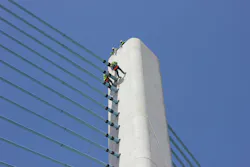
Charles W. Cullen Bridge (Indian River Inlet Bridge): This Bethany Beach, Del., bridge is a key link in the coastal infrastructure for the Delaware and Maryland beaches. The inspection team climbed long sets of ladders inside the pylons to reach the top before descending along cables and faces of the pylons. Access to the underside of the structure required an under-bridge inspection unit and manlifts.
Arthur Ravenel Jr. Bridge: This Charleston, S.C. bridge required a different approach. Crews used elevators inside the towers to reach the top, then descended along cables and structural elements. Access to the underside of the deck still required an under-bridge inspection unit, so multiple methods were used on the same structure.
Commodore Barry Bridge: This bridge spans Chester, Pa. and Bridgeport, N.J. On this project, the main challenges were working in a high-traffic corridor and on a bridge where a significant percentage of the main span is above the reach of any equipment’s capability. Crews were able to reach key areas without extensive lane closures or large equipment setups, which helped keep the inspection moving.
Tainter Gate Inspection Program: Since 2021, GFT teams have inspected more than 100 Tainter gates across the United States. Tainter gates are curved radial gates used at dams and spillways to control water flow and reservoir levels, and across this work GFT has evaluated gates ranging from 6 feet to 60 feet tall and from roughly 10 to more than 100 years old.
Like bridges, Tainter gates reflect a rich history of engineering, with each facility representing different design eras, fabrication methods and operating demands. That breadth of age and configuration is one reason detailed inspections are so important, helping owners better understand asset condition while taking an approach that minimizes outage burdens on facility operators.
Rockfall Inspections: In mountainous areas, inspectors descend directly onto rock slopes to assess surface conditions, identify loose material and evaluate potential hazards. Many of these sites are adjacent to active roadways, making traffic maintenance a critical part of the work. Rope access allows crews to perform close-up inspections efficiently while minimizing lane closures and reducing disruption to the traveling public.
Looking Ahead
Inspection work continues to get more demanding. Structures are aging, and access is still one of the biggest constraints.
Rope access doesn’t solve every problem, but it has become a regular part of how many inspections are carried out. In most cases, the question isn’t whether it can be used. It’s whether it’s the most practical option for the work at hand.
Access has always been the part of an inspection that slows things down. When you can get to the work without adding time, complex setups or disruption, everything else becomes more straightforward. That’s where rope access fits. It has become a practical, dependable way to reach critical areas and keep inspection work moving.
Dillon Winters, P.E., SPRAT Level III, is GFT's rope access program administrator.