I-5 Bridge Replacement Between Washington and Oregon Climbs to $14.4 Billion
Key Highlights
- Replacement and corridor upgrades for the I-5 bridge are now pegged at $14.4 billion, over four times the 2014 plan.
- The current bridge, with spans from 1917 and 1958, is the only I-5 stretch from Canada to Mexico with a stoplight, causing frequent congestion.
- A scaled-back first phase replacing the bridge and extending light rail is estimated at $7.7 billion, with $5.5 billion in funding identified.
- Construction could start in 2028 pending federal approval, with the new bridge opening in the mid-2030s.
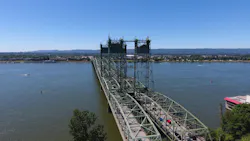
For drivers heading north from Portland into Vancouver, Washington, the I-5 bridge over the Columbia River is both a vital link and a daily frustration. The twin spans, one more than a century old, lift regularly to allow ships to pass. Each lift can bring traffic to a standstill, creating backups on a highway that otherwise runs uninterrupted from Mexico to Canada.
A Critical Link with Daily Delays
Now, after decades of debate, false starts and political gridlock, leaders in Oregon and Washington say they are ready to move ahead with a long-delayed replacement. The price tag has ballooned to $14.4 billion, according to reports cites by Axios.
The current bridge consists of two structures, one completed in 1917 and the other in 1958, according to reports cited by Axios. Together they carry tens of thousands of vehicles each day across a river that serves as a major shipping channel. The lift mechanism that allows marine traffic through also creates what officials often point out is the only stoplight on I-5 along the entire West Coast corridor.
Concerns extend beyond congestion. Engineers have long warned that the aging spans are vulnerable in the event of a major earthquake. In a region where seismic risk is a constant consideration, the possibility of collapse has added urgency to replacement efforts, according to reports cited by Axios.
How the Original Plan Fell Apart
Talk of a new crossing dates back to the late 1990s, when congestion began worsening. By 2002, a bistate task force recommended building a larger bridge that would include additional lanes and light rail service into Vancouver. That vision evolved into the Columbia River Crossing project, launched in 2005.
Federal officials approved that earlier proposal in 2011, and Oregon lawmakers committed $450 million toward construction. But the effort unraveled in 2013 when the Washington State Senate declined to approve its share of funding, with opposition centered largely on the inclusion of light rail. The project was formally shut down in 2014, drawing national attention as a high-profile infrastructure failure, according to reports cited by Axios.
Rising Costs and a Scaled-Back Approach
Planning resumed in 2019 under a new framework. Since then, inflation, rising material costs and updated risk projections have dramatically increased the expected price, according to Axios. The latest estimate reflects not only the bridge itself but also improvements to surrounding freeway interchanges and transit connections.
To make the project more manageable, officials are now prioritizing a core phase. That plan would remove the existing spans, construct a new bridge, connect it to I-5 and extend light rail to the Vancouver waterfront. The cost of that phase is estimated at $7.7 billion, with roughly $5.5 billion in state and federal funding already secured, according to reports cited by Axios.
A New Fixed-Span Design
One significant design decision has already been settled. The new structure will be a fixed-span bridge that does not lift for passing ships. The U.S. Coast Guard signed off on the concept earlier this year. Project officials say opting for a fixed height will save about $1.7 billion compared with building another movable span, while also eliminating bridge lifts that interrupt traffic, according to Axios.
What Comes Next
Political leaders in both states have signaled a renewed determination to see the project through. Washington Gov. Bob Ferguson has publicly vowed to move forward, and Oregon Gov. Tina Kotek has said the region needs a new bridge and must begin building.
Before construction can start, the project must complete its federal environmental review. Approval is expected later this year. If that timeline holds, major construction could begin in 2028, according to reports cited by Axios.
Even under that schedule, drivers will be waiting years. The new bridge is not expected to open until the mid-2030s. For a crossing that has been under discussion for more than two decades, the long horizon reflects both the scale of the challenge and the complexity of replacing one of the Pacific Northwest’s most important transportation links, according to reports cited by Axios.
Source: Axios
About the Author

Karina Mazhukhina, Digital Content Specialist
Digital Content Specialist
Karina Mazhukhina has extensive experience in journalism, content marketing, SEO, editorial strategy, and multimedia production. She was previously a real-time national reporter for McClatchy News and a digital journalist for KOMO News, and ABC-TV affiliate in Seattle.