From Barrier to Gateway
As state and local agencies repair the impacts of mid-century highway construction, pedestrian bridges are emerging as a key tool to restore connectivity and improve safety.
While building highways was essential to driving commerce and increasing mobility in the decades following World War II, many communities suffered during their inception as neighborhoods were bulldozed, and long-connected populations were severed from one another.
With the rise of pedestrian crossings, fractured communities are reconnected through foot and bicycle traffic, rejuvenating areas that were isolated by the construction of highways by encouraging more active modes of travel.
Beyond restoring connections between neighborhoods, pedestrian bridges also deliver tangible safety, accessibility and environmental benefits.
Bicyclists and pedestrians are protected from vehicular traffic when crossing on a pedestrian bridge, significantly reducing crashes along busy corridors and improving traffic flows as less pedestrians are crossing risky at-grade intersections.
Pedestrian bridges also deliver accessible crossings for people with mobility challenges.
By making alternative travel easier, pedestrian bridges can help reduce vehicle emissions and support more sustainable transportation networks.
The following pedestrian bridge projects in the United States epitomize this wide range of benefits.
Sycamore Trail Overpass Pedestrian Bridge — West Sacramento, Calif.
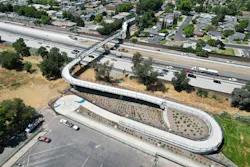
This 1,950-foot-long bridge crossing U.S. Route 50 in West Sacramento, Calif. took home sixth place in Roads & Bridges 2025 Top 10 Bridge Awards for its dedication to ADA accessibility, multimodal connectivity and community-focused design.
The bridge provides connection between two disadvantaged neighborhoods that were divided by the construction of US-50 70 years ago. Path users no longer need to cross auto-centric streets when traveling to two local schools and Joey Lopes Park.
The Sycamore Trail Overpass Pedestrian Bridge is also an essential segment of the city’s Bicycle, Pedestrian & Trails Master Plan to construct an alternative transportation network connecting the city.
The project team’s commitment to sustainability was built into the fabric of the project. The crew planted native drought-tolerant vegetation along the trail. They were selected for their resiliency to air conditions, reduced irrigation demand and improved water retention in the soil.
Energy-efficient measures also include the use of LED pedestrian-scale lighting fixtures selected for their low energy draw, reduced maintenance needs and increased life span.
Beautification is central to the project, as a compass plaza greets visitors entering and exiting from the southern side of the bridge, which is outfitted with decorative fencing made with custom metal silhouettes.
The team overcame major engineering constraints to complete the project, as property lines and utilities’ right of ways dictated the bridge’s size. To navigate the challenges, the team employed an S-shaped alignment on the crossing’s southern side and utilized a Mechanically Stabilized Earth wall — a retaining wall mixing soil with layers of backfill to support slopes and soil retention.
The construction of the crossing’s S-shape required the creation of three independent frames and two hinges.
The bridge’s northern side needed to fit within the property constraints of the neighboring community gardens. Therefore, its narrow span hugs the project limits on one side and a bioretention and driveway on its other side.
The Sycamore Trail Overpass Pedestrian Bridge was completed through the collaboration of the city of West Sacramento, Dewberry Engineers, Bridgeway Civil Contractors and Consor.
The project team said their biggest challenge was the “significant level of coordination between Caltrans and the city” that was required due to the construction crossing US-50.
“In addition to spanning a major freeway, the Sycamore Trail Bridge project coincided with concurrent Caltrans work within the same project limits,” said Mark Reuter, a construction inspector for Consor. “As a result, any activities affecting the freeway demanded weeks of advance planning and communication to properly manage overlapping work zones and traffic control measures.”
The Sycamore Trail Overpass exemplifies the many benefits that pedestrian bridges bring to the surrounding community. This project delivers a lasting connection that will serve future generations of West Sacramento.
New Bedford Pedestrian Bridge — New Bedford, Mass.
As the Massachusetts Bay Transportation Authority (MBTA) embarked on its first commuter rail expansion in more than 30 years, long disconnected cities saw the return of rail service to and from Boston.
The city of New Bedford not only gained a crucial transit link to Boston, but also a new pedestrian bridge designed to imprve access between downtown and the terminal station as part of the broader project.
Massachusetts Route 18 created a longstanding divide between New Bedford’s downtown and the waterfront, which became more consequential with the addition of the new transit station. As the commuter rail expanded service into the city, there needed to be a safe, accessible crossing along with it to reduce the reliance on cars.
The former bridge crossing was exclusionary in location and design. Constructed a quarter mile to the north of the new pedestrian bridge, users needed to complete a 1.5-mile detour to reach the rail station from downtown. The previous crossing’s steep grades exceeded ADA-standards, making it nearly impossible for commuters with mobility challenges to reach the station.
Those shortcomings shaped the new project’s priorities: a crossing that is direct, accessible and built for daily use.
The New Bedford Pedestrian Bridge provides multi-modal connectivity in a historically underserved neighborhood, reducing reliance on single-occupancy vehicles as traffic congestion continues to grow across the state.
It serves as a critical connector and incubator for the local economy by providing an improved gateway for visitors and effectively connecting the downtown to regional transit options that provide access to Boston and surrounding neighborhoods.
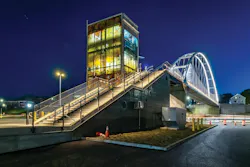
The network tied-arch structure reinforces the bridge’s role as a welcoming portal into the city, instead of a simple method of transportation. The design is not commonly seen among pedestrian bridges, but its use of inclined arches, rhythmic cable system and integrated lighting signify its civic presence.
The community’s identity is woven into the structure itself as local artists helped shape the bridge’s aesthetic. The group of artists advised on the bridge’s final design, influencing materials, lighting and architectural details. Glass elevators, included for expanded accessibility, served as canvases for public art. They created a physical tie between the city’s rich cultural identity and its residents. It also reinforced local ownership of the project.
Sustainability was integral in each step of construction, and the project team rose to the challenge by improving transportation options within a minimal footprint. In addition to reducing the area’s car dependency, the pedestrian bridge’s sustainability measures include the selection of materials proven to last in coastal environments and energy-efficient lighting, reducing maintenance needs and long-term environmental impact.
VHB/HNTB Joint Venture, Barletta Heavy Division and the city of New Bedford banded together to compete this project in March 2025.
The New Bedford Bridge shows how a piece of essential infrastructure can do more than expand transportation options — it can strengthen a community’s sense of place and express a local identity rooted in its surroundings.
“One of the most meaningful opportunities on this project was delivering the bridge on an ambitious schedule ahead of the station opening while also creating something that reflected the area’s history and community,” said Joshua Clogston, a project manager at HNTB. “Regular coordination with local agencies and intentional design choices that welcomed local artistic expression helped make the bridge a lasting connection.”
Global Gateway Connector Bridge and Trail — College Park, Ga.
Right outside one of the world’s busiest airport, pedestrians and cyclists were forced to cross a dangerous four-lane arterial roadway carrying more than 26,000 daily vehicles to reach public transit.
The Camp Creek Parkway in College Park, Ga., largely served as a barrier between the MARTA College Park Station, within the city’s historic downtown area, and the Georgia International Convention Center, Gateway Center and the ATL Skytrain, which connects directly to the Hartsfield-Jackson Atlanta International Airport.
The lack of safe and ADA-compliant crossing left visitors, students and residents exposed to oncoming traffic, and it cut off people with mobility challenges from several local amenities.
To provide safe passage, the City of College Park partnered with Stratus, STV and C.W. Matthews Contracting Company, with support from ECS, Pentagon 540, Wommack and Associates, and VHB, to deliver the Global Gateway Connector Bridge and Trail in July 2025.
“Bringing the bridge to life across one of Atlanta’s busiest corridors was a tall order, but watching it come together as a safe, accessible connection for the community made every moment worth it,” said Josh Stamm, senior associate of STV. “What started as a major infrastructure project became something much bigger: a landmark that connects people and supports mobility.”
The 200-foot-long pedestrian bridge encourages alternative methods of transportation, as bicyclists and pedestrians can reach the airport without the need of a vehicle. It also links to the Phoenix Trail, connecting a once-fragmented area to a cohesive multimodal corridor.
Aside from reducing vehicle emissions, the project team used energy-efficient lighting and durable materials to reduce the structure’s long-term environmental impact.
For visitors to College Park’s historic downtown from the neighboring airport, the connector bridge is the first impression and stands as a gateway into the city — an idea that is largely reflected in the bridge’s design.
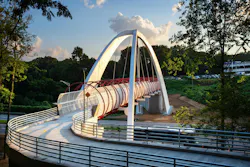
Two 80-foot-tall steel arches intersect at midspan, in a design that appears graceful but proved to be highly complex — requiring specialized analysis, fabrication and placement. Completed with wax-sealed vertical hangars, flared railings and red, illuminated hoops, it aims to please as a memorable passageway between downtown and the airport.
Not only is its unique design recognizable during daytime hours, but the project team also carefully integrated lighting to transform the structure into a glowing landmark, seen from nearby highways and airport approaches, without impacting pilot’s visibility.
The structure introduces College Park to the global stage with an inviting entryway from the airport, further reinforcing its identity in a high-traffic area. Serving as more than just a crossing, the pedestrian bridge stands as a point of pride in the surrounding community.
“This bridge is more than infrastructure, it’s a catalyst for connection, mobility and long-term growth in College Park,” said Kalyn Keeney, principal civil engineer of Stratus. “It’s the kind of project that reshapes how a community moves and comes together, and I’m proud to have played a role in bringing that vision to life.”
Pedestrian bridges do more than carry people over traffic — they stitch neighborhoods back together, turn barriers into gateways and prove that a community can reclaim what roads once took. As more cities invest in them, these bridges are becoming a visible measure of what — and who — transportation is finally being built for.
About the Author
 Jessica Parks, Staff Writer
Jessica Parks, Staff Writer
Staff Writer
Jessica Parks is a staff writer at Roads & Bridges with newsroom experience in Brooklyn, Long Island and the U.S. Virgin Islands, and several years spent living in Puerto Rico. She is currently based in Tulsa, Oklahoma.