An S-Curve Statement in Indianapolis
By Alex Perry, Contributing Author
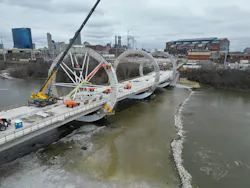
Scheduled to open in the spring of 2027, the new Henry Street Bridge in downtown Indianapolis is curvilinear — a long-span, prestressed concrete beam structure with an S-shaped alignment.
This stunning new bridge is a reflection of the broad shift in how infrastructure can reconnect neighborhoods, support redevelopment and serve communities.
Designed as a multimodal bridge with a core focus on pedestrian and cyclist traffic, this project delivers necessary transportation capacity, while creating a new and impressive Indianapolis landmark. It’s also central to the White River Innovation District (WRID), a major redevelopment initiative that’s tied to the transformation of a former General Motors stamping plant and the relocation of Elanco Animal Health’s global headquarters.
The project stands out with a 60%/40% distribution of pedestrian-to-vehicular deck usage, a curvilinear “S-shaped” alignment and prominent architectural rings. It was planned to serve as transportation infrastructure and a civic gateway. For this endeavor, leaders also sought to repair long-standing disconnects between the city’s downtown and west-side neighborhoods.
“There are a limited number of crossings for the White River in downtown Indianapolis,” said Mary Appel, assistant vice president and bridge manager for WSP in the U.S. “This project brings a unique opportunity of connectivity to neighborhoods that have been historically isolated.”
Multimodal Intent
This project was delivered in three phases, with WSP serving as bridge segment designer. The city emphasized early on that the bridge should serve pedestrians as much as drivers.
“We took the city’s desire to heart and deployed a strong commitment to multimodal connectivity, and delivering a statement bridge,” Appel said regarding the bridge’s 60/40 pedestrian-to-vehicular traffic design.
Sixty percent of the bridge deck is dedicated to non-motorized vehicle users, such as walkers and cyclists. The 60% dedication to these users is an unusual commitment for a bridge of this scale, as the wide pathways, integrated and linear planters were treated as essential elements rather than optional.
A major milestone for the project was the inaugural extension of the Indianapolis Cultural Trail, a major, shared-use pedestrian and bicycle path network in downtown. This extension west of the White River creates a direct link between downtown destinations and White River State Park.
“That milestone demonstrates the bridge’s pedestrian-focused amenity space,” said Joe Mayes, landscape architect with Context Design.
Design Collaboration
As the bridge’s prime designer, WSP closely collaborated with the city of Indianapolis, contractors and design partners. Originally conceived as a design-bid-build project, the contract eventually transformed into a contractor-engaged delivery model, which allowed the design team to consider feedback and refine the project as they approached construction.
“Shifting the project’s delivery model allowed us to deliver refinements that helped with cost and schedule,” Appel said.
WSP played a key role in balancing budget constraints with the city’s architectural and multimodal targets. Additionally, careful coordination with the contractor and various city agencies allowed WSP to support material selection, sequencing and quality control early in the process, reducing overall risks during construction.
“We championed the project’s pedestrian amenities and architectural features, which helped keep those elements consistent throughout the refinement projects, while still keeping the project buildable,” Appel said.
Vision and Structure
The Henry Street Bridge is defined architecturally by the “Circle City Gateway” concept, which refers to Indianapolis’s nickname. Large concrete rings are positioned above segments of the bridge, with travelers threading through them on their way to destinations on either side of White River.
“The idea was to create a gateway to the city’s new, expanding area,” Appel said.
City officials were focused on the rings being aesthetic attributes rather than structural components.
“The rings were added as architectural features, rather than load-bearing features, which also simplifies long-term maintenance and inspections for the city,” said Keith Echternach, bridge design program manager for Indianapolis Department of Public Works.
The bridge’s structure is curvilinear, and this geometry was based on site conditions, approach road alignments and other surrounding constraints, such as utilities and right-of-way restrictions.
“The S-shaped alignment was ultimately recommended by WSP’s bridge team following a collaborative discussion with the WRID’s road designer,” Echternach said. “This has proven to be a prominent feature of the structure which lays the groundwork for the bridge’s character.”
Engineering the curve required careful detailing. Straight, prestressed beams had to fit a curved profile without excessive variation, which required close attention.
“There was a lot of effort that went into making straight beams that work within the curved alignment,” Appel said.
Building Within Constraint
The project site came with a complex array of constraints that shaped the project’s overall design and construction. In addition to crossing the White River, access to the site’s east side was restricted for most of the project. This was due to sensitive historic burial grounds.
“The contractor couldn’t access the site from the east side, so all construction had to be staged from one side for much of the time,” Appel said.
A temporary causeway was built from the west side of the river, which allowed crews to reach key areas while minimizing environmental impacts. Nearby transmission lines, a data center and various utility corridors further added constraint for the bridge’s alignment and foundation placement.
“WSP did most of the utility coordination for this project,” Echternach said. “We were successful in keeping most utilities off the bridge, another priority for the city.”
Long-Term Resilience
Central to the bridge’s design were resilience and lifecycle performance. Drilled shaft foundations were chosen for their cost effectiveness and added resilience against potential impacts from scour, while the superstructure was designed as a jointless, continuous bridge to reduce long-term maintenance.
The design also considers Indiana’s difficult climate, in which bridges must withstand significant temperature swings and repetitive freeze-thaw cycles. These fluctuations informed concrete quality control and material selection.
These measures will help extend the bridge’s service life while minimizing potential maintenance demands for the city.
“This bridge is going to take a beating from the weather, but that was simply part of the design challenge for this project,” Echternach said.
Civic Pride
Another priority for this project was civic engagement, encouraging residents, businesses and neighborhood groups to participate in public meetings, hearings and open houses.
Renderings, mockups and virtual reality walkthroughs helped stakeholders understand the project’s design. These stakeholders provided feedback in turn, and that engagement helped build trust and confidence as the project moved into construction.
As Indianapolis continues to evolve and develop, the Henry Street Bridge stands as a model for how urban bridges can do more than facilitate traffic. By combining multimodal connectivity, architectural expression and durable engineering, the bridge demonstrates how infrastructure can work for all, serving as a transportation asset and civic landmark.
For cities facing similar challenges, Henry Street Bridge stands as an example of what’s possible when design, engineering and community goals work in tandem.
Alex Perry is a content writer for WSP in the U.S.