Redefining Bridge Engineering
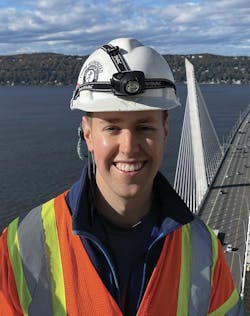
Erik Zuker is reshaping modern bridge engineering through a career grounded in hands-on experience and forward-looking technology. With 15 years in the field, he has worked as a bridge inspector, designer and construction-phase contributor, giving him a full-picture understanding of how bridges are planned, built and maintained.
His wide-ranging expertise in bridges made him a perfect fit for the Top 25 Under 40.
Early in his career, Zuker worked on some of the country’s most recognizable structures, including the Brooklyn Bridge. That first assignment left a lasting impression.
“To have the Brooklyn Bridge be the first bridge I ever worked on was such a privilege,” Zuker told Roads & Bridges. “It included not just desk work but actually inspection and climbing around the bridge. I’m not sure there is a better introduction to the field of bridge engineering, and it set the tone for my career that followed.”
From those early field experiences, Zuker moved into bridge design and construction support on major projects like the RFK Bronx Toll Plaza, the Bruckner Viaduct and Maryland’s Purple Line. Today, he serves as HNTB’s bridge technology lead, where he helps integrate emerging tools into everyday engineering practice.
“The ultimate goal is to design and maintain safe bridges,” he said. “That is the singular thread that runs through my work. “On the demand side, it is better quantifying extreme weather and freight. On the response side, it is measuring structural behavior with sensors and improving analytics with software. On the human side, it is using automation and AI-based quality control to verify strong work products.”
A defining moment in Zuker’s career came in 2021, when he was deployed as an emergency bridge inspector during Hurricane Ida. Seeing a catastrophic bridge washout firsthand changed how he viewed climate and flood risk.
“Before Ida, my perspective was that a relatively small increase in design criteria or engineering standards would address the shifting landscape of extreme weather,” he said. “After seeing the damage firsthand, I knew that new strategies would be necessary.”
That experience pushed Zuker to focus on flood risk at a broader scale. His work led to rainfall analytics that help agencies compare observed extremes against current design criteria across statewide bridge inventories.
Zuker also leads structural health monitoring on the Governor Mario M. Cuomo Bridge, overseeing more than 400 sensors that track strain, temperature and movement. The system generates roughly 27 million data points per hour. He helped turn that volume of data into practical information owners can use to make decisions during extreme events.
When the bridge transitioned from construction into long-term operations, Zuker played a key role in ensuring the monitoring system supported real-world decision-making. By translating complex sensor data into clear indicators, he helped give the owner confidence in the bridge’s long-term performance during wind, seismic and other unexpected events.
Beyond individual projects, Zuker is advancing innovation across HNTB and the wider industry. He has led work involving advanced sensing technologies, predictive maintenance and data-driven analysis, including machine-learning early warning systems, computer vision for measuring structural deflections and cloud-based platforms that integrate live traffic, rainfall and river data.
He is also helping guide the responsible use of generative AI in engineering workflows by developing internal protocols and training programs so engineers can use these tools safely and effectively.
Zuker remains deeply involved in the profession. He serves on the NOAA Industry Proving Ground Advisory Panel, the Transportation Research Board’s Standing Committee on Intermodal Freight and Truck Transportation and ASCE’s Modular, Rapidly Erectable and Deployable Structures Committee. He also chairs HNTB’s National Bridge Practice Virtual Design and Construction Committee.
Mentoring the next generation is important to him, as well. Zuker advises students at Cooper Union and Notre Dame, supports capstone teams at West Virginia University and regularly lectures at universities on resilience, data analytics and bridge technology.
“Simply put, Erik stands out for his ability to leverage new technology and large datasets to help HNTB become better bridge engineers,” said Ted Zoli, HNTB’s national bridge chief engineer. “What makes this truly noteworthy is that Erik accomplished so much without a formal project, budget or research stipend, driven purely by his own curiosity.”
Zoli added that Zuker’s work on extreme rainfall risk, network-critical bridges and large structural health monitoring systems shows both the depth and range of his impact.
For Zuker, the recognition reflects the people around him as much as the work itself.
“I’m always humbled by honors such as this,” he said. “I’m able to do the work I do because of the engineers I collaborate with and the mentors who guided me for more than a decade.”