Driving Strategy and Innovation
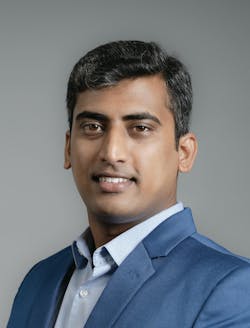
No project is too big or too small for Selvaraj Ramaswamy. From achieving millions in financial returns for his employers to conceptualizing lane closure plans, his footprint transcends to all levels of a project.
“His leadership has strengthened collaboration across commercial, engineering and executive teams, particularly during periods of significant pressure,” said James Purkis, project director at Colas Canada. “He consistently demonstrates a rare combination of commercial rigor, strategic judgment, and calm leadership under pressure on one of Canada’s most complex transit infrastructure projects.”
Ramaswamy’s experience spans continents, with degrees in the United Kingdom and Canada, and 17-year career working across the United Arab Emirates, Oman and India, in addition to Canada. For his leadership and global influence, he was perfect choice for the Top 25 Under 40.
As senior contracts manager at Parsons Inc., Ramaswamy is leading commercial governance on one of Canada’s most complex transportation infrastructure projects.
In his role on Edmonton’s Valley Line West LRT project, he has settled claims and disputes exceeding $100 million, secured an 18-month extension and mitigated more than $50 million in risk exposure. His attention to detail and rigor has achieved millions in gains for his employers throughout his career.
He excels at simplifying intricate processes into digestible reports, namely with the introduction of real-time dashboards on the Edmonton project. This interface tracks claims, cash flow and risk exposure enabling executives to make informed, data-driven decisions quickly.
“What sets Selvaraj apart is his ability to translate complex commercial and contractual issues into clear, actionable decisions,” Purkis said. “He combines strong technical understanding with credibility at the executive level and consistently focuses on long-term project and public outcomes.”
His revolutionary approach to managing lane closures is now being explored by Edmonton for application in future transportation projects.
“I developed an alternative approach to managing lane closures during construction, supported by a tailored commercial mechanism,” Ramaswamy said. “The solution minimized traffic disruption while maintaining contractor accountability and has been adopted on the project, with the City of Edmonton considering its application on future infrastructure works.”
His workplace innovations have resulted in myriad benefits, including a reduction in contract disputes, boosting transparency and strengthening financial oversight, resulting in projects delivered on time and within budget.
“Selvaraj has elevated the commercial function from a reactive role to a proactive partner in decision-making by introducing clearer governance, real-time commercial visibility, and disciplined risk management practices,” Purkis said.
Ramaswamy sees the industry’s biggest challenge as the growing labor shortage, an issue he believes will be intensified with the rise of infrastructure projects in dense, urban areas.
“As projects become larger and more complex, the availability of professionals who can manage risk, contracts, and stakeholder expectations is not keeping pace with demand,” he said. “At the same time, infrastructure is increasingly being delivered in dense urban environments, where cost pressures, schedule constraints, and public tolerance for disruption are high. This combination amplifies the consequences of skills gaps and fragmented decision-making.”
His response to this issue is bolstering multidisciplinary talent and implementing data-driven methodologies to better fortify the infrastructure of tomorrow.
“Organizations that invest in capability-building, early risk identification, and collaborative delivery approaches will be better positioned to deliver resilient, publicly accountable road and bridge infrastructure in the years ahead,” he said.
He advices young professional to focus on their foundational knowledge in the field before seeking leadership titles, and to challenge oneself with complex, high-pressure assignments as they are the most effective learning experiences.
“Focus on building strong fundamentals before chasing titles. A solid understanding of how projects are planned, built, and governed — including contracts, risk, and cost — is essential to earning trust on complex road and bridge projects,” Ramaswamy said. “Seek exposure to challenging assignments and projects under pressure. These environments accelerate learning and develop judgment that cannot be gained in low-risk roles. Take ownership, communicate clearly, and aim to contribute solutions rather than simply identifying problems.”