Solving Tough Problems
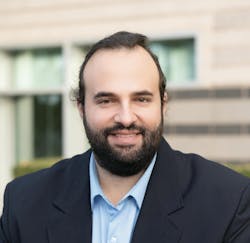
Since earning his professional engineer license, Frank Artmont has become known for his ability to effectively solve complex structural challenges, as well as his expertise in finite element analyses (FEA). For these capabilities, he was an easy choice for Roads & Bridges’ inaugural Top 25 Under 40.
“It’s hard to think about Frank’s work in regard to achievements. It’s really the qualities that he brings to the team that make him so deserving of this award,” said Andy Adams, project manager of Modjeski & Masters’ National Bridge Group. “Frank attracts the most difficult problems, because the team has the confidence in his understanding of structural behavior, analysis, and design to know he’ll find a solution that meets the needs of the project.”
In a decade with Modjeski & Masters, Artmont has climbed the ranks to reach the level of senior engineer. He began his career while completing a doctorate degree in structural engineering and has obtained a professional engineer license in New Jersey and Pennsylvania.
Earlier in his career, Artmont designed critical components for a major arch bridge project, which included the pin bearings, skewback foundations and wind tongues.
“I cannot understate how much I learned about bridge analysis, design and construction through this project, and it will stay with me for the rest of my life as a wonderful entry into bridge engineering practice,” Artmont said. “I’m also proud to have assisted in the design of a bridge so close to home.”
As his FEA expertise and analysis skills continued to grow, he was tasked with increasingly challenging projects. When investigating the collapse of a bridge during construction, he created and ran FEA models to evaluate the failed structure and established a chain of events through the review of thousands of documents. His investigations included findings on the philosophical considerations of engineers’ roles in society.
“From rehabilitation of suspension bridges to optimizing designs for arch and cable stayed bridges and performing forensic investigations of structural failures, Frank has the knowledge, experience, and ability to always implement new strategies or methods to solve the issues at hand,” Adams said.
As an experienced leader at the firm, Artmont heads Modjeski & Masters’ internal FEA training program. This initiative is emblematic of a factor of Artmont’s career: his dedication to supporting young professionals in the field.
“Frank’s humility, desire to learn and to become a better engineer, and to help and mentor all of the engineers around him set him apart from others, and make him a natural leader that will surely become more and more an important part of our industry in the future,” Adams said.
Artmont’s advice to young professionals is to get involved in the industry, whether it be through volunteer groups or networking opportunities. He cites his involvement with the American Association of State Highway and Transportation Officials (AASHTO) and the National Steel Bridge Alliance (NSBA) as a breakthrough opportunity to learn the ins and outs of the industry.
“Get in the habit of saying yes! When it comes to work assignments, industry volunteer groups, networking opportunities, and lifelong learning, don’t be afraid to get involved and voice your thoughts,” he said. “Being involved in the AASHTO/NSBA Steel Bridge Collaboration has given me a great opportunity to learn from the best in the industry.”
He also warns young professionals to not let the fear of making a mistake hold them back from making an impact but instead to take the opportunity to learn from them.
“It is still incredible to me how much simpler a problem can seem when coming back to it after taking a break,” he said. “Finally, don’t be afraid to make mistakes. You WILL make mistakes in your work; this is why we have quality control processes. Learn from your mistakes and just do better the next time.”
Artmont sees funding as the biggest challenge in the industry, arguing that the money issued for transportation projects is not enough to revitalize the country’s road and bridge infrastructure.
“Not only can we not devote enough funds to start projects which are sorely needed, but we also are forced to reduce the amount of time and money spent on projects we are able to get started, making them less effective in the long run,” he said. “Hopefully, advanced technology such as Building Information Modeling and Artificial Intelligence will serve as excellent tools for bridging this gap and allowing us to do more with less.”