Performance and Durability
Key Highlights
- The Pennsylvania Turnpike Commission relies on rigorous inspection, lab testing and long-term performance analysis to ensure pavement quality.
- Advanced testing methods help predict issues such as rutting, cracking and moisture damage before they appear in the field.
- Research findings from the Somerset materials lab directly influence specifications, materials selection and future pavement design.
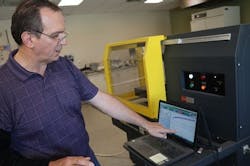
Quality pavement doesn’t happen by accident. On the Pennsylvania Turnpike, it is the result of a tightly connected system of inspection, laboratory testing and long-term performance evaluation—one that spans asphalt plants, aggregate sources, construction sites and a specialized materials laboratory in Somerset, Pa.
Recently, Roads & Bridges sat down with two of the people at the center of that system: Chris Forry, materials management supervisor for the Pennsylvania Turnpike Commission (PTC), and Brian Paroda, engineer project manager and supervisor of the commission’s materials laboratory.
Forry and Paroda oversee how the materials used on one of the nation’s busiest toll road systems are selected, tested, verified and continuously improved.
Forry manages a statewide team of materials managers and inspectors who are embedded throughout bituminous, concrete, precast and prestress production facilities, as well as the PTC Materials Lab. With 35 years of experience in the materials field, he has seen inspection practices evolve from basic acceptance testing to a far more comprehensive focus on performance, sustainability and long-term durability.
Today, his team works closely with industry partners while enforcing detailed Commission specifications that are critical in a low-bid environment.
Paroda leads operations at the Somerset Materials Laboratory, where asphalt, aggregate and binder samples are tracked through strict chain-of-custody procedures before being subjected to a wide range of tests.
Some are routine and completed within a day, while others are part of multi-year forensic research efforts designed to answer a more complex question: How will this pavement perform decades from now?
Paroda and Forry explain how the PA Turnpike Commission is adapting its materials program to meet increasing traffic demands, heavier loads and evolving environmental challenges—while keeping performance and public safety at the forefront.
Roads & Bridges: Walk us through what happens to an asphalt sample from the moment it arrives at the Somerset lab to when results are finalized.
Brian Paroda: Once a sample is received by the materials lab, it is recorded and we confirm its delivery with what our chain of custody — we make sure all the information is correct and samples are then documented and receive a reference number to ensure the integrity of that sample is maintained, which is important. The samples are then placed in a testing queue while waiting to be tested and typically within 24 hours a test can be completed but that depends on the testing itself. If performing something more extensive, like research analysis, some of those tests on a single sample could take several days, even up to a week depending on what exactly we're looking at. That’s generally the short version of the life of the sample.
RB: Chris, with more than three decades in the materials field, how has the approach to inspecting the PA Turnpike changed over time?

Chris Forry: Well, our focus on quality has certainly elevated. We are focused not only on the final product, but also what is used to produce the product and also how the products will perform on our roadway network. We work with the Pennsylvania Asphalt Producer Association, known as PAPA. We also work with the Pennsylvania Aggregates and Concrete Association to improve the quality of the materials used and then to get optimum performance and sustainability out of the materials that we're placing on the roadway.
RB: Brian, the lab creates extreme conditions like heat, rutting and long-term wear. What are some of the most important tests you rely on to predict how asphalt will perform years down the road?
BP: Before I answer that, it's important to note that asphalt forensics is a science and, of course, science is not 100% accurate. These samples are subjected to various predictive testing methods that are based upon certain laboratory hypotheses. Confidence in these test methods must be gained, and I think that’s an important aspect of all this. It must be gained through the correlation between the laboratory specimens and actual pavement performance.
With that, there are currently two tests in which Pennsylvania has recently adopted.
One is called the Double Wheel Tracker, or the Hamburg Test, which is a predictor for rutting, and then the other is Indirect Tensile Asphalt Cracking Test, which is a predictor for fatigue cracking. Now these predictive tests are relatively new in our state and the acceptable thresholds have not been determined yet. There is hope among agency and industry that there will be some thresholds established soon that will provide us with some predictable data. To continue upon that we have developed our own predictive test to assist in identifying moisture damage in asphalt materials.
This serious issue plagues not only us but other states and even worldwide. Our test is based upon the American standard testing method D3625, which is a boil test. We call our tests the PTC-extended boil test. Many of the current laboratory tests lack environmental influences that we generally see in the Northeast such as water pH and chlorides. Our simple test utilizes a sodium bicarbonate soak along with the boil test and has shown asphalt materials can be negatively influenced by an increase in water pH and chlorides.
RB: Tell me about the innovations, Brian, and adjustments that your team is currently experimenting with.
BP: Sure. First off, the general purpose of an asphalt mix design is to optimize the asphalt material itself with sufficient liquid asphalt binder. Being the lifeblood or glue of the mix, a lot of these modern design changes have focused on the complexities of the binders themselves.
The development of our extended boil test has shown that the alkaline water and chlorides can negatively impact the adhesive properties of the asphalt binders and when adhesion is lost between the asphalt binder and the aggregate surface, we see pavement distresses such as the rutting and cracking. We’re of the opinion that if we can remedy the serious moisture damage that we see within our pavements, then the rutting and cracking, distresses should diminish.
Our study has also shown that chemical silane-based anti-strips used in asphalt materials tend to perform well when they are subjected to our extended boil test. When they're soaked in that sodium bicarbonate solution, they tend to hold up better than amines so there is some optimism there. It's showed such great promise in our extended boil test that in 2024, we've specified that all asphalt materials will have a silane-based anti-strip in it.
Previously. Amine-based anti-strips were used — I think going back to about 2010-2012, when their use was mandated by Pennsylvania and they've failed.
RB: OK, Chris, back over to you. How do you ensure consistency and accountability across the wide range of materials and locations that you guys work on?
CF: We provide annual training sessions for our inspection staff to give them the tools they need to ensure the Commission's material specifications are followed by our materials producers. I have four materials managers, and they are continually reviewing daily inspection reports, so that when issues arise, we can address them in a fair and consistent manner across the PA Turnpike network.
The backbone is the enforcement of our Commission specifications to ensure compliance and quality system wide. We function in a low bid environment, so our specifications are critical to achieving the desired levels of performance and quality that we desire.
RB: OK, so tell me about the materials laboratory and what role does that the laboratory play in supporting field inspectors and validating what they see during production and placement?
CF: Sure. Our materials inspectors are in the producer asphalt lab locations, witnessing acceptance testing and reviewing production practices. So, when there are issues that arise: for example a lot of asphalt that is placed on a project fails or there's a penalty, the sample is retained and it is then shipped out to our materials lab for additional testing. At that point, the lab can verify the reason for the failure and confirm what the inspector has witnessed. We also take aggregate and liquid asphalt samples from our asphalt producers for verification, again, ensuring that the specifications are met. So, when there's a question in the field that our inspectors may see or think something may be just a bit out of tolerance, we can pull those samples, bring them back to the lab and verify there is or isn’t a problem.
RB: Let's talk a little bit more about those samples. Brian, what kind of insights specifically can you determine when you test those samples? What specifically are the problems that come up when you test something and you say this this isn't working out?
BP: Well, it all goes back to that that correlation between the laboratory testing and real world performance and that's the key to all asphalt science. Without having a correlation between the laboratory test and real world perfromance, all the laboratory testing that we do is essentially useless.
Our research on the moisture damage and development of that extended boil test all derived from real-world pavement performance because the phenomenon of asphalt moisture damage has been around for decades. To combat that issue, there were laboratory models that were universally facilitated and used as well as Amine-based anti-strips. Back in 2012 that were mandated, by the state, to be put in all asphalt materials.
I think there was some common universal understanding that perhaps these changes were going to remedy it. Maybe these tests were going to predict it, maybe the anti-strips were going to prevent it, but, we began analyzing pavement cores. We started taking pavement cores across our system — across the Turnpike system — and we discovered that 70% of the specimens that we were analyzing had showed severe moisture damage and they all had passed previous predictive models and tests. They all had amine-based anti-strips in them and they were still showing signs of moisture damage, so this was becoming a huge problem for us. These results were taken from real world samples. Standard Laboratory testing wasn't predicting the observed moisture damage and what was sold as “anti” strips weren't preventing moisture damage.
This led us to perform our own forensic study, which concluded with our general hypothesis that alkaline water and perhaps some of these chlorides that we use for de-icing are actually eliminating or negating the use of those amine-based anti-strips. This is why we started looking at tnew technology of the organosilane based anti-strips. Real world data is definitely important and now with silane based anti-strips in the field we will need to gather in field performance from it as well.
RB: How do those results directly influence construction decisions, maintenance strategies and future specifications on the PA Turnpike?
BP: As a laboratory, we play the supportive role for the Turnpike and assist with many of these innovations. Innovations go beyond just anti-strips and I'm sure Chris can talk about some of those.
The innovations are generally implemented prior to laboratory testing or approval because oftentimes these need to be implemented and need to do pilot projects with them. We need to see how they're going to perform in the real-world environment. It may take a year, it may take several years to start seeing some distresses because we're looking at asphalt products that are designed for a 25-plus year life cycle.
We serve to correlate those numbers from the lab actual performance data and if those innovations perform well based upon our forensic studies. We will update our specifications. An example of this was with the implementation of silane-based anti-strips, that was all based upon our forensic study which took nearly three years. At the completion we felt confident that was the right way to go and in 2024 we implemented those silane-based anti-strips into all PTC asphalt materials.
So the laboratory does play a key role. Again, I think we serve as that supportive role to be able to analyze these innovations and the differences between the lab and the real-world. Hopefully we can gain confidence with some predictable tests from the lab that will predict what we're actually seeing in real time and be able to have our pavements last longer.
RB: All right. Last question for you, Chris. Looking ahead, how do you see materials testing and inspection evolving as traffic volumes, vehicle weights and climate-related stresses continue to increase?
CF: The whole issue of materials inspection has evolved from what it was 30 years ago and continues to evolve in asphalt. We began with the Marshall method of design and testing for asphalt mixture quality and performance. then in the early 90s transitioned to what's known as Super Pave and we are currently going through a transition to what is known as balanced mixed design.
Therefore, materials inspection and the methods we use to determine performance, quality and sustainability of products will continue to evolve. The materials we are now using are constantly changing. The latest innovation in asphalt that we're working with is what's known as highly modified asphalt binders that we are now incorporating into our asphalt mixes. The asphalt itself is modified with SBS polymers, which allow the asphalt to be more resilient to rutting and cracking, thus increasing the life cycle of our asphalt mixtures.
Blended cement is posing new challenges as the concrete industry seeks to attain a zero carbon footprint and aggregate producers are continuing to develop new sources to meet future construction demands.
What I'm saying is as the materials evolve, so will our test methods and the inspection practices used by the Commission to ensure that our customers have a safe and high-quality roadway to use in their travels.
About the Author
 Gavin Jenkins, Head of Content
Gavin Jenkins, Head of Content
Head of Content
Gavin Jenkins is an award-winning journalist based in Pittsburgh. His work has appeared in The New York Times, The Washington Post, The Atlantic, VICE, Narrative.ly, Prevention, the Pittsburgh Tribune-Review and Beijing Review.
In 2020, two stories he wrote for Pitt Med Magazine earned three Golden Quill Awards from the Press Club of Western Pennsylvania. “Surviving Survival” won Excellence in Corporate, Marketing and Promotional Communications – Written, Medical/Health, while “Oct. 27, 2018: Pittsburgh’s Darkest Day, and the Mass Casualty Response” won Excellence in Written Journalism, Magazines – Medical/Health, as well as the Ray Sprigle Memorial Award: Magazines, a Best in Show award.
After graduating from the University of Pittsburgh at Johnstown in 2003, he covered sports for the Bedford Gazette, in Bedford, Pa., and the Martinsville Bulletin, in Martinsville, Va. In 2006, he returned to Pittsburgh to write for Trib Total Media. Based out of the Kittanning Leader Times, he worked for the Trib for two years, and then he moved to Shenzhen, China, to teach English and freelance. After two years in China, he earned an MFA in nonfiction from the University of Pittsburgh.
When he's not at work, he's usually playing with his border-collie mix, Bob.