Innovative and Beneficial
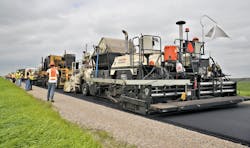
County State Aid Highway 9 (CSAH 9) is a minor arterial route between the Red River of the North and U.S. Route 75 in Crookston, Minn.
With its last overlay dating back to 2004, CSAH 9 had roughly half an inch of rutting. A typical bituminous overlay would require days of hauling tons of aggregate as the nearest gravel pits are at least 20 miles away from the project’s eastern end.
As Polk County’s annual Sugar Beet Harvest was already underway and commercial truck traffic had increased on CSAH 9, the team considered alternative options to save time.
After previously utilizing hot mix overlays as its main rehabilitation method for bituminous roadways, Polk County elected to employ a hot in-place recycling process to address the top 2 inches of the pavement.
The county chose Dustrol Inc., to serve as the project’s contractor for the rehabilitation of 29 miles of roadway — including 14 miles on CSAH 9.
Dustrol, which is headquartered in Towanda, Kan., completed the $4.8 million hot in-place project totaling 445,800 square yards. The work included 232,000 square yards on CSAH 9 from U.S. 75 to the North Dakota state line, recycled to a 2-inch depth. A 3% polymer-modified asphalt emulsion was added to rejuvenate the aged pavement.
The use of hot in-place recycling offered widespread benefits to the surrounding community, providing cost-savings, reducing environmental impacts and resulting in safer driving conditions in the winter.
This project’s innovative approach and wealth of community benefits earned it the Hot In-Place Recycling Award from the Asphalt Recycling and Reclaiming Association (ARRA), recognizing excellence in sustainable road construction.
Polk County Engineer Rich Sanders remarked on how the county had learned about the hot in-place recycling method only six years prior to putting it into action.
“It’s always an honor to receive awards for work that Polk County accomplishes,” Sanders told Roads & Bridges. “Being able to say that we first learned about hot in place at the National Association of County Engineers Conference in Wichita, Kan., in 2019 and 6 years later try [it] with the Dustrol, Inc. process and win a national award is humbling and a great honor.”
Hot in-place recycling is a continuous process using a self-contained train of equipment that heats distressed asphalt surfaces to 250 to 300 degrees Fahrenheit, mills ¾ to 2 inches, blends the material with a rejuvenating asphalt emulsion or binder, repaves it and compacts the mat for potential new surfacing based on traffic and road conditions.
The process is best suited for structurally sound pavements with good drainage but surface distress. It has been used successfully on city streets, rural roads and interstates. Distress causes should be evaluated in advance so they can be addressed during recycling, typically through an engineering investigation and core-based mix design.
Hot in-place corrects surface cracking, levels deformations, restores crowns, maintains curb heights and reuses existing materials. Construction is rapid, allowing near-immediate traffic return, but the pavement base must be strong enough to support the equipment. Deeper structural problems may reappear if they extend beyond the recycled depth.
On CSAH 9, Dustrol used its Mobile Asphalt Recycling System (MARS), a multi-unit recycling train designed to gradually heat and mill the pavement in stages before adding a rejuvenating agent and repaving the material in place. The staged heating process helps prevent premature oxidation while allowing crews to recycle up to 2 inches of existing asphalt in a single pass.
“Basic benefits include taking out all the cracks, humps and bumps, and eliminating the need for a leveling course,” said Aaron Hansen, Dustrol’s director of marketing. “And because it's in-place with 100% existing materials utilized, with much less truck traffic, there is some 30% less of a carbon footprint, with quite a bit of a cost savings compared to a conventional overlay.”
The hot-in place recycling process eliminated the need to haul materials on and off the job site, reducing project costs and environmental impacts by lowering fuel consumption, trucking needs and labor. Reducing the dependence on trucking also simplifies construction logistics.
Recycling the existing pavement conserved Polk County’s limited gravel supply and eliminated the project’s reliance on a finite natural resource or costly, less-accessible aggregate sources.
"Polk County has a gravel supply, but it's not limitless. At some point the gravel's going to run out and we're going to need to do something else in order to keep our pavements in decent shape,” Sanders said.
Additionally, the county wanted to avoid using a chip seal on the roadway due to the additional cost and impacts on safe winter travel. The hot in-place recycling method allowed the county to skip the chip-seal step altogether — a process the county had previously heavily utilized to extend the service life of their roadways despite the hazards it posed to winter travel.
Chip seals conflict with the county’s need to combat blow ice —a thin, often invisible layer of ice that forms on pavement when blowing snow, or drifting snow, melts on warmer road surfaces and then refreezes as temperatures drop.
The project’s success has not only been recognized by the ARRA, but possibly more importantly by the daily users of the roadway.
“Upon completion of the project the comments from the public on how great a job it was and from the standpoint of the owner being able to say it’s as good as a hot mix asphalt overlay is exciting,” Sanders said.
For Polk County, the project demonstrated how pavement preservation strategies like hot in-place recycling can extend roadway life, conserve resources and improve safety — all while keeping critical rural corridors open to traffic.
Roads & Bridges editorial compiled this report with contributions from Dustrol.
Tom Kuennen, a freelance editor and writer in the construction and building materials industries, contributed to this report.