CIR Efficiency Transforms Mesa Arterial
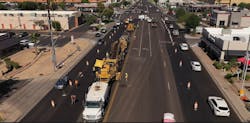
Completing a full rehabilitation of a major roadway without causing significant disruptions to traffic is a major feat to accomplish. Conducting such an endeavor using environmentally friendly methods makes a project award-winning.
The Southern Avenue Arterial Reconstruction in Mesa, Ariz., incorporates both achievements, earning the Cold In-Place Recycling Award from the Asphalt Recycling and Reclaiming Association (ARRA).
Southern Avenue serves as a major arterial roadway in the city of Mesa, carrying up to 25,000 vehicles daily. The challenge: how to keep traffic moving while conducting a full roadway rehabilitation along the 1.75-mile stretch from Gilbert Road to just west of Val Vista Road, where road segments vary from five to eight lanes.
The answer to their problem: The use of a Cold In-Place Recycling (CIR) process that met several of the project’s limitations, as it allows for a more efficient process that gets traffic back on the roadway sooner.
“We have done other sections of Southern Avenue with Cold Recycle and we have had really good luck with it,” said Aaron Lucchesi, vice president of Arizona Pavement Profiling, Inc. “[The city of Mesa] said they wanted to entertain doing it. We went through, we did mixed designs, we did dynamic modulus, we did all the testing to find out if it was feasible for a road that way, and we made sure to have the thickness available to do the Cold Recycle. Once all of that was done and we were able to prove that it was the right application for that road, then we moved forward with actually doing it.”
The original roadway utilized 5 inches of asphalt over 6-10 inches of Aggregate Base Course (ABC). The new roadway reused 100% of the existing asphalt, utilizing the 6-10 inches ABC, a 4-inch Cold In-Place Recycled asphalt layer and a 2-inch PMTR asphalt surface (PG 76-22). The recycled materials equated to a major reduction in both waste and emissions.
Capping the CIR layer with the 2-inch PMTR asphalt surface strengthened the road surface and improved ride quality and crack resistance.
Officials worked to ensure the asphalt’s continued longevity, implementing a Void Reducing Asphalt Membrane (VRAM) at the longitudinal joints and curb and gutter interfaces to improve joint performance and moisture resistance. Being the city’s first foray into the use of VRAM technology, the team needed to apply multiple test strips to establish proper application procedures before bringing the process live.
“On the VRAM, we have never done that before, that is something that the city had been approached by Main Street Materials on and that was a trial project, just something we wanted to go through and try out,” Lucchesi said.
The new asphalt mix brings enhanced durability, flexibility, improved moisture resistance and extended service life to the heavily traveled corridor.
Causing minimal traffic disruptions while delivering a smoother, more structurally-sound road surface to the community was central to the reconstruction project.
The repaving work required precise coordination as it passed through two collector intersections at 24th and 32nd Streets, and one major arterial crossing at Lindsay Road. Work was scheduled to avoid peak commute hours. Accelerated production and diligent monitoring of curing conditions allowed for the successful return of traffic to the newly repaved surface each morning.
Crucial to the project’s rapid execution, the team successfully operated a multi-unit Cold-Recycle train. The convoy of machines were used to mill, crush and screen, pugmill and pave all in one pass, streamlining the repaving process to get traffic on the roadway sooner.
Lucchesi said the use of the full recycling train required extensive public outreach to the surrounding residential and school communities.
“The first part of it was the public outreach, we did a lot of message boards, we did a whole bunch of flyers because it’s also right next to a residential area, so we had to notify the residents of the community what we were doing,” he said. “We also went right in front of a couple of schools, so the main thing we did was coordinate our start times and our stop times around when we were going to be impacting the schools and also the intersections.”
Use of the multi-unit recycling train was also coordinated to not conflict with heavy traffic times.
“We made sure we started in the middle of the job and far enough away from the intersections so that we weren’t going through the middle of the intersection when there was rush hour traffic,” Lucchesi said. “We staggered it, so we were going through them at 10 or 11 o’clock in the morning and also off the road before rush hour traffic got back on.”
Utilizing a CIR process also shaved weeks from the project timeline, with production averaging approximately 1.5 lane miles per day to meet scheduling benchmarks, all while continuing to achieve the required density, ride and performance criteria.
Their dedication to minimizing impacts to public mobility necessitated high production rates, resulting in an average of 1,900 tons of CIR asphalt mix being produced on site per day, while remaining committed to maintaining the highest quality.
“The quality overall with as fast as we were going. As much as we were able to get done, the quality is still honestly top notch, that road is one of the smoothest roads that we drive on in the city,” Lucchesi said. “The team being able to put everything together and keep things moving forward and just still keep the quality up is huge.”
Sustainability was at the heart of the project and attributed to major cost savings and material conservation. Materials reused included 17,960 tons of recycled asphalt, which corresponds to saving 16,882 tons of virgin aggregate and 1,077 gallons of paving-grade oil.
Not only were materials preserved, but the project’s use of recycled asphalt also resulted in a large reduction in emissions, as materials were not hauled to and from the site. This resulted in the elimination of 1,348 trucking hours, equating to the preservation of approximately 5,392 gallons of diesel.
The Southern Avenue Arterial Reconstruction project proves that sustainability and high‑quality pavement performance can go hand in hand with efficiency. From planning through production, the team delivered a resilient roadway with minimal disruption, reflecting their commitment to the community they serve.
About the Author
 Jessica Parks, Staff Writer
Jessica Parks, Staff Writer
Staff Writer
Jessica Parks is a staff writer at Roads & Bridges with newsroom experience in Brooklyn, Long Island and the U.S. Virgin Islands, and several years spent living in Puerto Rico. She is currently based in Tulsa, Oklahoma.