Rebuilding Indiana’s SR 13 in Indiana
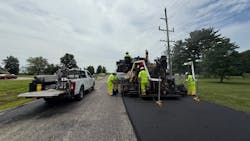
With roads getting older, budgets tighter and pressure to reduce emissions increasing, cities and small towns are having to find new ways to repair and rebuild their streets and highways.
Rather than completely removing old pavement, many are using recycling methods that save money, speed up construction and are better for the environment.
A clear example of this change is in Madison County, Ind., where a long stretch of State Road 13 was rebuilt using a carefully planned combination of cold planing, full-depth reclamation (FDR), and cold central plant recycling (CCPR).
The Indiana Department of Transportation (INDOT), along a team that consisted of E&B Paving, Evergreen Roadworks and Specialties Company, and Lochmueller Group, earned the FDR award and cold planing award from the Asphalt Recycling and Reclaiming Association (ARRA).
The work didn’t get noticed for using a flashy new material or experimental design. Instead, it stood out because established recycling methods were carefully combined into a single, well-planned approach that provided long-lasting results while keeping disruption to the community to a minimum.
State Road 13 is considered a rural major collector by INDOT. It handles between 4,800 and just over 6,000 vehicles each day, with trucks making up as much as 16% of the traffic.
The road is the main route between Lapel, a town of about 2,500 people, and Interstate 69, about 30 miles northeast of Indianapolis. Homes, businesses and farms line much of the road, so keeping traffic moving was a concern.
At first, INDOT planned a standard mill-and-overlay project. But testing with a falling weight deflectometer showed the pavement was too weak. The road had 10 to 13 inches of asphalt over 6 inches of crushed stone, and its structure had deteriorated too much for a simple surface repair. In other words, the road needed to be rebuilt from the ground up.
That led INDOT and its partners to take a bigger approach: they decided to reuse the existing materials, strengthen the road’s foundation and recycle as much as possible.
A System, not a Shortcut
Instead of using FDR and CCPR separately, the team coordinated them to work as one system. INDOT is the owner, Lochmueller Group was the consulting engineer, E&B Paving was the main contractor, Specialties Company handled FDR, Evergreen Roadworks produced the CCPR mix, and Heritage Group was in charge of quality control and testing.
“The size and scope of this project made it an ideal candidate for the Roads & Bridges Recycling award,” said Vice President Brad Schneider of Specialties Company. “It’s nearly five miles long and includes three unique recycling disciplines: asphalt milling, full depth reclamation and cold central plant recycling. From the pre-construction meeting through the Just In Time Training, the team set a goal of building a safe, high-quality project worthy of recognition.”
Construction started by removing 5 inches of the old asphalt. That asphalt was crushed, sorted and stored to create a 100% recycled asphalt mix for the cold central plant recycling (CCPR). Evergreen Roadworks ran a nearby processing site next to SR 13, so the recycled material could be made as needed without sending extra trucks onto local roads.
Beneath that layer, the leftover asphalt and stone base was strengthened with 10 inches of cement-treated full-depth reclamation. In spots where homes and businesses were as close as 30 feet from the road, the crew used a wet cement mixture instead of dry powder to reduce dust and protect nearby properties.
The finished road had 10 inches of cement-treated FDR, topped with 3 inches of recycled asphalt (CCPR) and a 2-inch layer of hot-mix asphalt on top.
Managing Traffic
With nearly 5,000 vehicles using parts of the road each day, managing traffic was a top priority. The work was done in three full-width phases, planned so that no home or business lost access for long. Construction near Lapel was scheduled during the summer to avoid interfering with school bus routes.
“Proper communication, signage and flagging were key to keeping both the public and workers safe,” Schneider said. “Securing a private CCPR processing yard along the project further reduced construction traffic on surrounding roadways.”
Recycling methods work faster than completely removing and replacing a road, so INDOT estimates this project took about 50% fewer days than a traditional rebuild. All work was finished during the 2025 construction season, from March through November.
Quality Control
Building a road with recycled materials requires careful attention to detail. Factors like moisture, material mix and compaction timing directly affect how well the pavement performs. INDOT requires “Just In Time Training” for FDR and CCPR, bringing contractors, subcontractors and agency staff together before construction to go over equipment, procedures and expectations.
One of the biggest challenges was that the existing pavement was inconsistent. Different layer thicknesses and material types meant the FDR mix had to be adjusted, adding 20% sand to meet specifications. Milling was also needed to help the recycled layers bond properly with the new asphalt surface.
Crews tested the materials continuously and adjusted right away, keeping work on schedule while maintaining high quality.
Measurable Benefits
The cost savings were significant. The 15-inch pavement section using CCPR and FDR cost about $41 per square yard, while a traditional full removal and replacement would have been around $64 per square yard — about 35% more.
The environmental benefits were just as significant. Almost all of the existing material was reused, greatly reducing the need for new aggregates and asphalt. Truck traffic was only a fraction of what a traditional rebuild would require, which lowered fuel use, emissions and wear on nearby roads.
Nick Cosenza, pavement design engineer with INDOT, said the agency has seen consistent advantages from recycling-focused strategies.
“INDOT has found pavement recycling to be a suitable treatment for various types of roadways across Indiana’s network,” Cosenza said. “With projects like SR 13, we can transform a deficient pavement into a uniform cross-section with increased structural capacity while conserving non-renewable resources and providing a cost-effective alternative.”
A preliminary review by the National Center for Asphalt Technology found that recycling methods cut up to 10% of environmental impacts from start to finish compared with traditional construction. Inside INDOT, records show that using recycling on projects has also reduced construction costs by 20 to 30%.
Lessons for the Industry
The project’s success didn’t come from a single innovation. It was the result of careful planning, early teamwork and skilled crews. By investigating materials, coordinating work steps and relying on experience, FDR and CCPR were used together as one integrated system instead of separate methods.
Schneider believes that approach should guide future projects. “There’s no need to pick a single recycling solution and stick with it,” he said. “For large projects with varied pavement conditions, owners can use multiple recycling methods to meet the needs of the roadway and the traveling public.”
For INDOT, the project reinforces plans to expand recycling use across the state. For the broader industry, State Road 13 serves as proof that sustainable pavement practices can deliver durability, efficiency and nationally recognized results without reinventing the wheel.
About the Author
 Karina Mazhukhina, Digital Content Specialist
Karina Mazhukhina, Digital Content Specialist
Digital Content Specialist
Karina Mazhukhina has extensive experience in journalism, content marketing, SEO, editorial strategy, and multimedia production. She was previously a real-time national reporter for McClatchy News and a digital journalist for KOMO News, and ABC-TV affiliate in Seattle.