Defining a geosynthetic: Type and functions
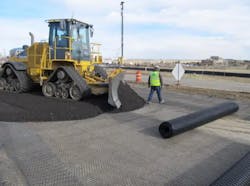
The first use of fabrics in reinforcing roads was attempted by the South Carolina Highway Department in 1926. A heavy cotton fabric was placed on a primed earth base, hot asphalt was applied to the fabric, and a thin layer of sand was put on the asphalt. The department published the results of this work in 1935, describing eight separate field experiments. Until the fabric deteriorated, the results showed that the roads were in good condition and that the fabric reduced cracking, raveling and localized road failures. This project was certainly the forerunner of the separation and reinforcement functions of geosynthetic materials as we know them today.
What are GeoSynthetics?
In all, geosynthetics, perform five major functions: separation, reinforcement, filtration, drainage and moisture barrier. There are six families of geosynthetics: geotextiles, geogrids, geonets, geomembranes, geocomposites and "geo-others."
- Geotextiles form the largest group of geosynthetics. They are indeed textiles in the traditional sense, but consist of synthetic fibers rather than natural ones, such as cotton, wool or silk. Geotextiles are porous to water flow across their manufactured plane and also within their plane, but to a widely varying degree.
- Geogrids represent a small but rapidly growing segment of the geosynthetics area. Rather than being a woven, nonwoven, or knit textile (or textile-like) fabric, geogrids are plastics formed into a very open, gridlike configuration, i.e., they have large apertures. Often they are stretched in one or two directions for improved physical properties. By themselves, there are at least 25 application areas, and they function in two ways: reinforcement and separation.
- Geonets constitute another specialized segment of the geosynthetics area. They are usually formed by a continuous extrusion of polymeric ribs at acute angles to one another. When the ribs are opened, relatively large apertures are formed in a netlike configuration. Their design function is completely within the drainage area where they have been used to convey fluids of all types.
- Geomembranes represent the second largest group of geosynthetics, and in dollar volume their sales are essentially equal to that of geotextiles. They are impervious thin sheets of rubber or plastic material used primarily for linings and covers of liquid- or solid-storage facilities. Thus, their primary function always is as a liquid or vapor barrier. The range of applications, however, is very wide.
- Geocomposites consist of geotextile and geogrid; or geogrid and geomembrane; or geotextile, geogrid, and geomembrane; or any one of these three materials with another material (e.g., deformed plastic sheets, steel cables, or steel anchors). Major functions of this creative effort encompass the entire range of five functions listed for geosynthetics discussed.
- Geo-Others is a general area of geosynthetics that has exhibited such innovation that many systems defy categorization. For want of a better phrase, geo-others describes items, such as threaded soil masses, polymeric anchors, and encapsulated soil cells. As with geocomposites, their primary function is produce-dependent and can be any of the five major functions of geosynthetics.
The above information was excerpted from the book Designing With Geosynthetics, Second Edition, by Robert M. Koerner, Ph.D., P.E. Copyright 1990 by Prentice Hall, Englewood Cliffs, N.J.