U.S. 2 Jct. S.R. 211 to Newport, Pend Oreille County, Northeast Washington State
Most of the people of Newport, Wash., could deal with car access being down 12 minutes or so. A long time without the Internet, however, made some a little nervous.
The region’s sometimes-volcanic weather pattern would send anyone into a state of paranoia if conditions had to remain perfect for a span of about a month. For prime contractor Inland Asphalt Co., subcontractor Valentine Resurfacing and the Washington State Department of Transportation (WSDOT), the best way to track cloud movement and temperature jumps during a 13-mile cold in-place (CIR) recycling project on U.S. 2 Junction S.R. 211, where every day had to be at least 60ºF, was via the web.
Daily conditions were not as ideal for boaters, campers and local commuters. The road pattern was what left them tense. Since it was a just a two-lane thoroughfare, most had to endure at least 12-minute traffic stops during the length of construction.
Wait times and the unpredictability of the weather aside, the end result offered the same degree of success for everybody. The use of CIR saved the WSDOT more than $1.25 million, relieved motorists of a stretch of highway that was well past its service life and awarded workers with the 2009 Roads & Bridges/Asphalt Recycling and Reclaiming Association Recycling Award for CIR.
“We start every job with the expectation that they are going to turn out like this,” Chad Simonson, project engineer for WSDOT, told Roads & Bridges. “When you have a job that is good enough to be an award winner, and doing something that is out of the norm with cold recycle, and still keep a fantastic relationship with the contractor . . . these are the jobs you want and that you pray for every day.”
Working with a friend
CIR is quietly firming up a friendship with contractors and project managers in the Washington region. The process has been there for the WSDOT when money was tight in the past. U.S. 2 Junction S.R. 211 is the fourth CIR endeavor taken on by the agency over the past few years, and the results continue to be convincing.
“When we get into a road that has gone past due like this one and the repairs start pushing deeper, then you can do more road miles utilizing [CIR],” said Simonson.
U.S. 2 Junction S.R. 211 leading into Newport had been under constant care for years. The 15-year-old, 13-mile stretch had received dozens of pothole patches, the result of hot, humid summers followed by equally intense conditions on the other side of the thermometer during the winter. The weather, combined with the passing presence of heavyweight trucks, knocks down the lifespan of the typical pavement in the region to just 11 years. The WSDOT pulled four more years out of U.S. 2 Junction S.R. 211, but the extra beating left cracks as deep as 4 in.
“The section of road has a lot of truck traffic and a lot of studded tire traffic, so over the years they have had some problems with rutting, and our maintenance division did a lot of patching with hot-mix asphalt,” John Morris, assistant project engineer with WSDOT, told Roads & Bridges. “So there were different types of material out there.”
Due to the inconsistency in the pavement, Inland Asphalt had to pull 12-in. cores every half mile in each direction prior to the start of the CIR process so the WSDOT could come up with two different mix designs. Additional samples also were taken in trouble areas marked by the agency that contained the pothole patching. With CIR, the size of the gradation determines the percentage of the emulsion (CIR-EE). The medium gradation mix called for 2.25% CIR-EE, while the coarse mix recommended 1.75%. Both contained 1.5% lime solids. The medium gradation version also carried 12.9% air voids, with the coarse coming in at 15.3%.
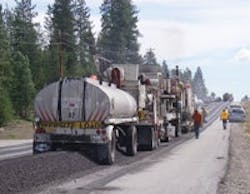
The recycling train consisted of a Caterpillar PR-1000 rotomill, an El Jay screen deck, a Cedarapids hammermill crusher, an Eagle Iron Works pugmill and AESCO (Asphalt Equipment Service Co.) electronics which kept a running tab of all of the materials—lime, oil and water—flowing through during the process. Milling depth was 4 in., and a Blaw Knox PF-5510 paver was used to spread the material. When the color of the CIR material lightened, crews came in with four rollers. A Caterpillar CB534D DDV steel double-drum vibratory roller, which had a drum diameter of 55.1 in., a drum width of 78.7 in. and operated at 3,400 vpm, served as the breakdown roller; an Ingersoll-Rand DD-118 DDV steel double-drum vibratory roller, which was the same size as the Ingersoll-Rand model, was the intermediate roller; an Ingersoll-Rand PT240R pneumatic roller came next, and a Caterpillar CB334W DDV steel double-drum vibratory roller, with a drum diameter of 31 in. and a drum width of 51 in., served as the finishing roller and cranked out 4,140 vpm.
Establishing the ideal roller pattern, however, did not fall into place as easily as the choice of equipment.
“We worked with the contractor, and depending on the date, day and time we changed the patterns,” Keith Kusler, project inspector for WSDOT, told Roads & Bridges. “The rolling pattern was something that we had to keep track of at all times.”
“The high variability of the mix [made it difficult with rolling],” added Morris. “Every time you came across a maintenance patch it changed the dynamics. It is minor adjustments as you go. It might involve changing a roller or you might pull a roller out, maybe you add a roller. It becomes a constant chasing of the cat’s tail.”
“The breakdown roller stayed consistent, and where we tried to make it up was with the pneumatic and intermediate rollers,” said Kusler.
According to Kusler, four passes is usually all that it took for the breakdown roller, and crews were consistently achieving a CIR density of 125 lb per cu ft. The target was 125-128 lb per cu ft.
A fog seal and sand also were applied.
After the CIR material was successfully placed, it was almost like watching paint dry. It takes time for the moisture levels to reach a point where it is safe to lay down the hot-mix asphalt (HMA) surface mat. Pave too early and the moisture creates tiny bubble pinholes. According to the WSDOT, crews had to wait about two weeks for the CIR layer to cure prior to applying the 2-in. HMA layer.
“We did a moisture test over the recycling mix before we paved over it, because one of the challenges that we have had in the past with cold in-place is that the layer carries a large amount of moisture that basically comes out,” said Simonson.
Inland Asphalt took advantage of an asphalt plant that was located right in the middle of the 13-mile project. The HMA mix was a 3?8th nominal mix that contained a PG 64-28 binder and a Polarbond anti-strip agent. Aggregate size ranged from ½-in. square to U.S. No. 200. With the heavy truck traffic, the mix was designed for 2.5 million ESALs.
The temperature of the HMA when it left the plant was about 310ºF, and at lay down it was approximately 290ºF. The same Blaw Knox PF-5510 asphalt paver that was used for the CIR was used for the HMA. Following a 12½-ft paving path, which overlapped into the shoulders, three rollers—breakdown, intermediate and finishing—were used during compaction. Crews were achieving 93-94% density in four passes. Anything above 91% was the target. Air voids had to fall in the 2-5% range, and Inland was getting around 31?2%. Digital thermometers and thermal imaging were used to check the consistency in the mat temperatures. If temperatures were suspect in a particular area, additional density checks were made.
The shoulders received the ½ ft of HMA plus a chip seal.
Crews rode an IRI van to check for smoothness. Before the project, the IRI index was 139. When the job was complete it was 68, resulting in a 51% improvement. The WSDOT also checked for pavement grip and received a rating of 3 on a 1 to 5 scale.
“With the CIR, they were looking for a tighter mix over the top to seal that surface,” said Simonson.
“The material was a good source,” added Morris. “The crushing people they had in there were really good and consistent, so you had a consistent pile. Then the asphalt plant and loader operators were really consistent and experienced, so the material you were getting out in the field and through our asphalt plant was very consistent.”
Hidden savings
Traffic was sealed off multiple times during the project. Variable message signs informing motorists the wait time—which was supposed to be held under 20 minutes—were placed in spots leading up to the project. The contractor also used CBs and radios to clear the lanes for emergency vehicles, and the local schools were contacted daily so the bus drivers were aware of what alternate routes to take.
The WSDOT noted the cost savings at $1.25 million, but that figure does not take into account the fact that the contractor did not have to crush 30,000 tons of material for the HMA and use an additional 2,200 tons of liquid asphalt.