Since the onset of the Cold War, the U.S. government has spent billions of dollars in the development of high technology for military applications. Now that the international competition has subsided, some of that technology is being transferred to civil uses. This may provide taxpayers with an opportunity to collect a dividend on their collective investment.
Fiber-reinforced polymer (FRP) composites, like that used in the construction of the Stealth bomber, is one such product that shows promise in the repair and replacement of our nation’s infrastructure.
Seeing that these high-tech materials are gaining a foothold in California, Japan and other countries, the New York State Department of Transportation (NYSDOT) decided to conduct a series of demonstration projects to evaluate the potential of fiber-reinforced polymer composites. The studies are being conducted in cooperation with the six dominant firms in the industry to look at various repair and strengthening techniques. The projects undertaken in 1998 involve:
• Replacing a concrete slab superstructure with a 24-in. deep, 23-ft span E-glass slab;
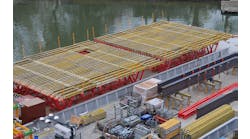
• Replacing a truss’ concrete deck with lightweight FRP panels;
• Wrapping pier columns to contain deteriorated concrete; and
• Strengthening a pier’s cracked concrete cap beam.
Though the final findings of these projects have yet to be collected, early indications are that this technology can provide new options for cost-effective bridge strategies.
First project opens
The first of these projects resulted in New York State’s first fiber-reinforced polymer composite bridge being opened to the traveling public in October. A prefabricated E-glass FRP superstructure was used to rehabilitate a reinforced concrete slab bridge on rural State Route 248 in Steuben County. The 1926 vintage structure was extremely deteriorated and its 10-ton weight restriction was a source of aggravation for the county and town because local roads were being used by heavy detoured trucks.
A win-win agreement was reached involving abutting property owners, the town, county and state. State maintenance workers rehabilitated the 23-ft span structure instead of replacing it under the DOT’s capital program, as was the plan. This provided a solution to the traveling public 15 months sooner that the replacement project would have. The new superstructure, which is designed for HS-25 loading, has allowed the route to be reopened to any legal load.
Low-volume bridges often end up low on the priority list when programming bridge work. With a traffic volume of less than 300 vehicles per day, the Route 248 bridge deteriorated over the years while attention was given to more critical bridges. The rehabilitation strategy used here may present a feasible alternative for other deficient, short-span structures on low-volume local roads.
The load capacity problem was addressed as a maintenance fix instead of a capital improvement to reduce both design effort and construction cost. After removing the old concrete slab, the existing concrete abutments were removed down to the ground line where good concrete was encountered. The abutments were then reconstructed to their original dimensions, making a simple bridge seat to receive prefabricated FRP panels.
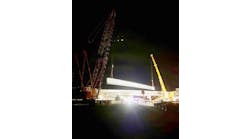
The superstructure with integral wearing surface was trucked as two 25-ft x 16 1/2-ft skewed panels from the manufacturing plant in New Castle, Del. They were placed and secured in one day. A 75-ton hydraulic crane was used to lift the 16-ton superstructure into place.
Follow-up work involved joining the two panels along the centerline of the highway where a shear key was provided. Neoprene pads (3/4-in.) were provided for bearing and anchor bolts were drilled and grouted in place to resist uplift.
A pourable bridge joint material was used between the bridge and the 15-ft long concrete approach slabs. Bridge railing consists of a composite-encased concrete parapet with steel box beam rails. Ancillary highway work was minimized by maintaining the pre-existing roadway elevations and geometry. Limiting the overall length of the project substantially reduced the cost of approach work.
Cost factors
The Route 248 project was conducted as a demonstration project in cooperation with Hardcore Composites LLC. However, the life-cycle cost of the rehabilitation would have been less than the replacement alternative even if full price had been paid for the materials.
Though the initial cost of an FRP composite superstructure can be higher than conventional steel and concrete, the total cost of a project can usually be reduced by considering the lower labor costs necessary for installation. The speed and ease of getting the bridge in also can minimize delays to the traveling public during construction.
Future maintenance expense is expected to be negligible. Because composites are not affected by de-icing salts, it doesn’t rust. It is shipped with a chemically bonded top coat to protect it from ultraviolet radiation, but no future painting is expected.
The strength-to-weight ratio of composite materials is its greatest asset. A computerized finite element analysis indicates that the working stresses are well below the material’s ultimate strength. Even so, New York State is conducting field load testing of the new bridge. This will instill an even higher level of confidence in the structure’s carrying capacity.
Though composite technology has been used successfully for years in the defense and aerospace industry, it is relatively new in the civil engineering field. This structure will provide New York State with a means to evaluate the performance of these materials under actual field conditions.