2011 Top 10 Bridges - No. 1
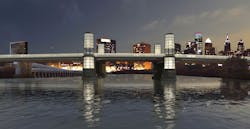
PROJECT: South Street Bridge Reconstruction
LOCATION: Philadelphia
OWNER: City of Philadelphia
DESIGNER: Gannett Fleming Inc.
CONTRACTOR: Driscoll Construction Co. Inc.
COST: $67.5 million
START DATE: December 2008
COMPLETION DATE: November 2010
Crossing over several active railroad tracks, the South Street Bridge Replacement project needed the help of a conductor, as long as they were the kind to waive their talents at the nearby Kimmel Center.
It certainly took the efforts of the orchestrated kind to successfully complete one of the most complex jobs in Philadelphia Public Works history, which in turn earned a No. 1 ranking on the 2011 ROADS & BRIDGES Top 10 Bridges list.
“It was a great project to be involved with,” Rick Kemper, project manager with lead designer Gannett Fleming, told ROADS & BRIDGES. “There were a lot of different players and a lot of different agencies to gain consensus from, and there were a lot of aspects of the bridge and the project that made it extremely interesting.
“Part of our job as an engineer is coming up with realistic, cost-effective solutions, and this had quite a number of them and we were able to develop and investigate schemes that met all of the criteria.”
The number of physical obstacles alone was high. At the west end, the South Street Bridge spans over and ties into the Souteastern Pennsylvania Transportation Authority’s (SEPTA) University Station platform and its electri? ed tracks. The overhead Norfolk Southern (NS) Railway High Line railroad bridge is located within 120 ft of the west abutment. Approximately 250 ft east of the NS High Line, the bridge crosses over Amtrak’s electri?ed four-track Northeast Corridor Main Line, and another 100 ft east the span ties into the University of Pennsylvania’s Hollenback Hall, which is eligible for the National Register of Historic Places. The reconstruction of the existing bridge was mitigated and documented through a Historic American Engineering Record, and contributing elements of the Hall were retained or matched. From there the South Street Bridge crosses over I-76 eastbound, ties into the highway’s off- and on-ramps and then spans I-76 westbound. The Schuylkill River serves as the ?nal obstacle.
“Each railroad had its own set of requirements during construction, their own set of working windows, and SEPTA and Amtrak were electri?ed and so that added to the complication because we weren’t allowed to impact their operations.”
One of the ? rst orders of duty for prime Driscoll Construction Co. Inc. was to demolish the existing bridge, which was last repaired in 1982 and had a 6-ton weight limit. Most of the equipment for that task was situated on the old bridge deck, as crews cut large sections and lowered them down to a barge for disposal. After a series of cores veri?ed the strength of the existing bascule pier foundations, it was decided to salvage four of them that were located in the river for the new self-supporting roadway bridge piers and the towers and outlooks. The move eliminated the need for cofferdams and expensive and time-consuming excavation and pier construction in the river. The lower portion of the existing stone masonry west abutment also was retained to support a portion of the new abutment.
The project involved 11 total piers supporting 12 spans assembled as multispan units. According to Kemper, the longest individual span was 154 ft, and there also was a two-span system around 220 ft long, two three-span systems of 410 ft and 210 ft long and a four-span system that was 450 ft long. The piers and deck were all cast in place. The existing 55-ft-wide cross section was replaced with one that was 83 ft wide.
Due to the tight clearances over the railroads “relatively shallow” beams (50-ksi steel) were used and were spaced closer together in certain areas. The gap between girders was as little as 5 ft 2 in. on the west approach.
A tight schedule also had to be adhered to, and the contractor responded by working in three different areas simultaneously.
Since drainage from the project could not seep onto track property scuppers, small-graded drains, were used for discharge.
“We could not discharge [the scuppers] right through vertically because the railroad was right there, so what we did was use a longitudinal pipe in one of the bays as a drainage pipe that the scuppers tied into, and that was carried to a pier and then dropped down outside the railroad right-of-way and discharged into an existing drain system.”
The new bridge towers are approximately 50 ft high, and both the upper and lower sections are clad with LEDlighted glass panels. The middle section (sidewalk level) was left open to enable pedestrians and motorists to enjoy the view of the Philadelphia skyline.
“Before the of?cial opening of the bridge we allowed people to walk on it and take a look at it. So it was a big walkway at that point and it was wonderful,” said Kemper