There is a slight parallelism between the state of our country today and in 1956, when President Dwight D. Eisenhower signed landmark legislation intended to shore up the nation’s defense and strengthen business and trade. The Federal-Aid Highway Act of 1956, also referred to as the National Interstate and Defense Highways Act, provided $25 billion (almost $200 billion in today’s dollars) to construct the Interstate Highway System.
Faced with a looming recession and a 5% unemployment rate, Eisenhower hoped the act would help kick-start the economy. It did, and succeeded in driving forward a key aspect in the nation’s construction industry—asphalt.
By the mid-1960s, highway construction and the asphalt industry gained tremendous momentum. Blaw-Knox, a leading road-building equipment manufacturer, saw a need to train contractors and road crews working on road construction projects. Company-sponsored factory training provided not only instruction on the maintenance and operation of Blaw-Knox equipment, but also best practices and knowledge for the betterment of the asphalt industry. In the 1970s, Blaw-Knox established a formal training center in Mattoon, Ill., where courses in operations and maintenance and mechanical training were available for industry-wide participation. In 1997, the training facility officially became Road Institute. At that time sales training was added to include hands-on operation and application training for the salesmen. This was known as “Boot Camp” training.
“For 40 years, Road Institute has been recognized throughout North America as the premier educator for asphalt industry professionals,” said Steve Blackwelder, director of global training for Road Institute, which is now operated by Volvo Construction Equipment.
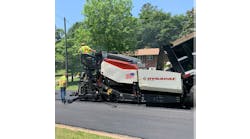
The training philosophy remains comprehensive: not only to teach participants how to operate the equipment, but also to educate them on best paving practices and to recognize common problems that occur on a paving job and how to correct those problems. Courses at Road Institute are structured to include both classroom instruction and hands-on learning applications for asphalt pavers and compactors. Instructors are asphalt industry veterans bringing nearly 100 years of experience to each class. Classes are held in Chambersburg, Pa., and in Phoenix, Ariz.
“Many of the attendees have been around pavers for a long time,” said Peter Fleming, paving instructor at Road Institute. “They learn on the job and sometimes only learn the very basics. It’s our job to give them the complete picture.”
According to Fleming and compaction instructor Wayne Tomlinson, the majority of attendees at Road Institute are paving crew personnel and supervisors. However, because of the commitment and reputation Road Institute has acquired over the years, it has attracted other professionals, such as state highway administrators and asphalt production professionals. One such attendee, John Morgan, a technical sales representative for MeadWestvaco, enrolled in Road Institute to expand on his current knowledge about asphalt paving.
“Over the years, I have acquired a background in asphalt and road construction through my professional interaction with contractors and state DOT administrators,” said Morgan. “But to be honest, there is no substitute for hands-on training.
“At Road Institute, I had the opportunity to crawl around and get inside the equipment. I listened to the instructors talk about the operation of the equipment, proper maintenance and what happens when it isn’t properly maintained.”
Morgan attended a three-day course on asphalt paver and compactor operations and maintenance. The Road Institute team packs information and training into the comprehensive course.
With 16 courses offered over a 10-month period each year, Road Institute sees many repeat attendees. Contractors will send new employees, as well as paving veterans for refresher training.
“In almost every class there will be an ‘aha’ moment for someone,” said Tomlinson.
—contributed by Dawn Buzynski, Two Rivers Marketing